

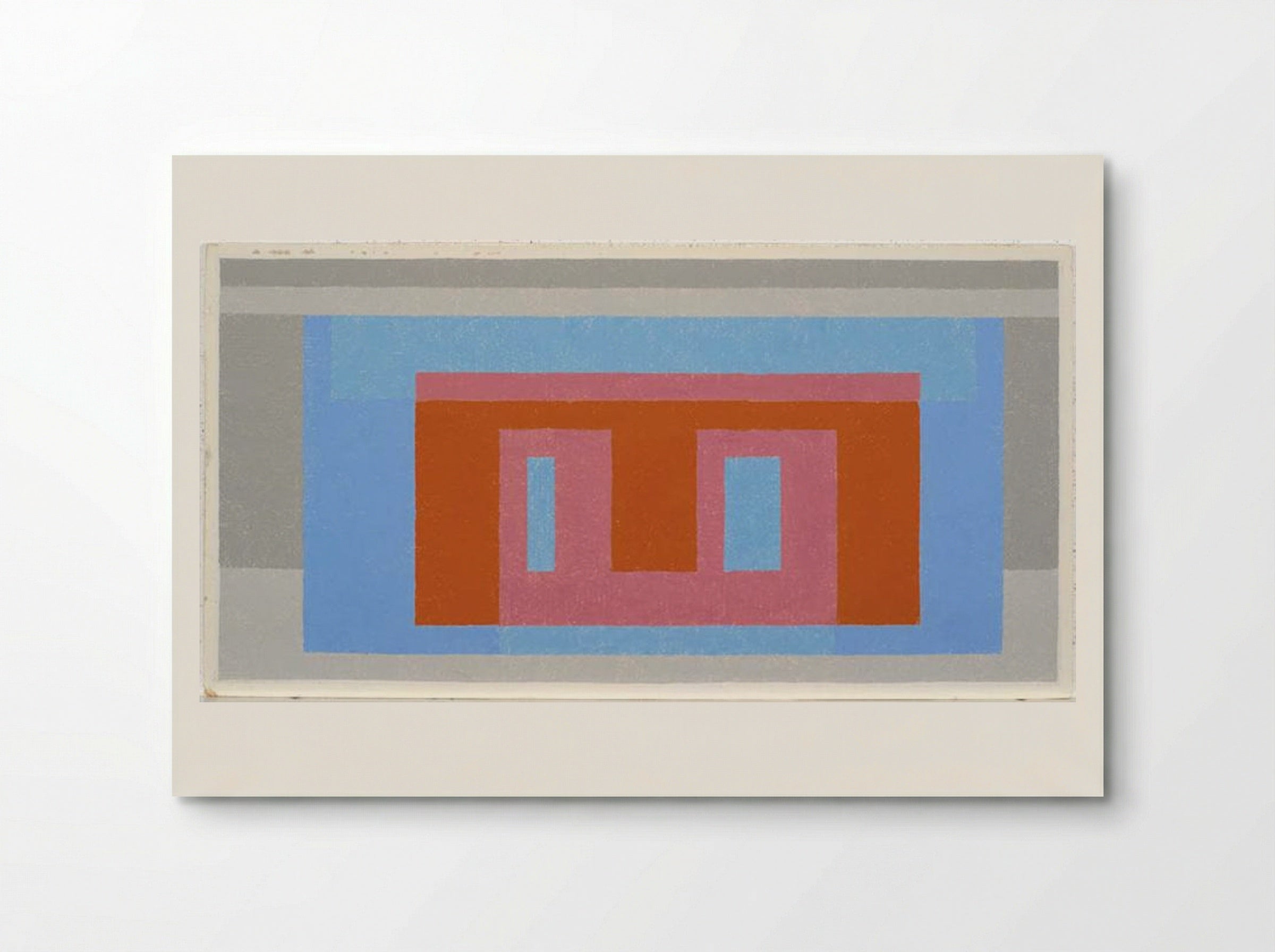
Adobe (Variant): Luminous Day - Josef Albers
Archival giclée
Frames arrive ready to hang
Secure checkout
Made to order
Description
A geometric study by Josef Albers, inspired by Mexican architecture and the interaction of colour.
Josef Albers created the Adobe series following his extensive travels in Mexico. These works reflect his fascination with the architectural forms of pre-Columbian structures. In this specific composition, Albers employs his characteristic method of layering flat, geometric shapes to explore the interaction of colour. The central U-shaped motif, rendered in a warm terracotta tone, sits against a field of cool blue. This arrangement creates a sense of depth despite the two-dimensional nature of the paint application. Albers was a teacher at the Bauhaus before moving to the United States. His work focuses on the perception of colour rather than the depiction of objects. He believed that colours change their appearance based on their neighbours. In Luminous Day, the grey border acts as a neutral frame, allowing the contrast between the orange, pink, and blue sections to dominate the viewer's experience. The paint is applied with a visible texture, which adds a tactile quality to the otherwise precise geometric forms. The Adobe series is distinct from his later Homage to the Square series. While the latter uses nested squares to study colour relationships, the Adobe works incorporate more complex, architectural silhouettes. These shapes evoke the portals and facades of Mexican buildings. Albers uses these forms as a vehicle for his colour theory, ensuring that the viewer focuses on the weight, temperature, and luminosity of each hue. The result is a balanced composition that invites quiet observation of how light and colour behave in a structured space.
Return policy
Because every print is made to order, we don't offer change-of-mind returns, refunds or exchanges. If your order arrives faulty, damaged or incorrect, we'll replace it free of charge — just contact us within 48 hours of delivery. See our refunds page for full details.
Shipping
We ship worldwide, printing at the production hub nearest to your delivery address. Delivery times and costs vary by destination — you'll see the options available to you at checkout.
Manufacturing
Each print is produced to order using 12-colour giclée printing on FSC-certified archival paper. Designed in Britain and printed at your nearest production hub to reduce waste and speed up delivery.
Care and materials
Specific Features
Every Solis piece is made to order with archival, gallery-quality materials built to last.
- Museum-grade giclée printing for rich, fade-resistant colour
- Archival matte fine-art paper, FSC-certified
- Multiple sizes and framing options available
- Frames in black, natural wood, dark wood or white
- Framed prints arrive ready to hang
Care & Cleaning
To keep your artwork looking its best:
- Dust gently with a soft, dry cloth
- Avoid prolonged direct sunlight
- Never use liquid cleaners on the print or canvas surface
- Keep in a dry, room-temperature space
- Handle prints with clean, dry hands
Materials & Sizing
Museum-grade giclée on FSC-certified archival matte paper, with framed and canvas options.
- Paper sizes: A4, A3, A2, A1, A0 and B2 (50×70 cm)
- Canvas: XS (20×30 cm) to Large (60×90 cm)
- Frames: black, natural wood, dark wood or white
Adobe (Variant): Luminous Day - Josef Albers

Artist Biography
Josef Albers
He was born in 1888 in Bottrop, Westphalia, into a Roman Catholic craftsman's family. He worked as a schoolteacher for five years before deciding to study art, joining the Bauhaus as a student in 1920 and becoming a faculty member by 1922. He married Anni Fleischmann, a Bauhaus textile student, in 1925.
At Black Mountain, his students included Robert Rauschenberg, Cy Twombly, Ruth Asawa, and Ray Johnson. He left in 1950 to head the Department of Design at Yale, where he taught until retirement in 1958. The teaching produced Interaction of Color (1963), a text arguing that colour can only be understood in context, never in isolation. It remains a standard reference.
The Homage to the Square series occupied the rest of his life: nested squares of colour, painted obsessively, with every pigment and proportion meticulously recorded. The paintings look simple. The colour relationships within them are not. He died in 1976.
Why Choose Us ?
Damage-free delivery guarantee
Fast Shipping
Museum-Quality Materials
You May Also Like