

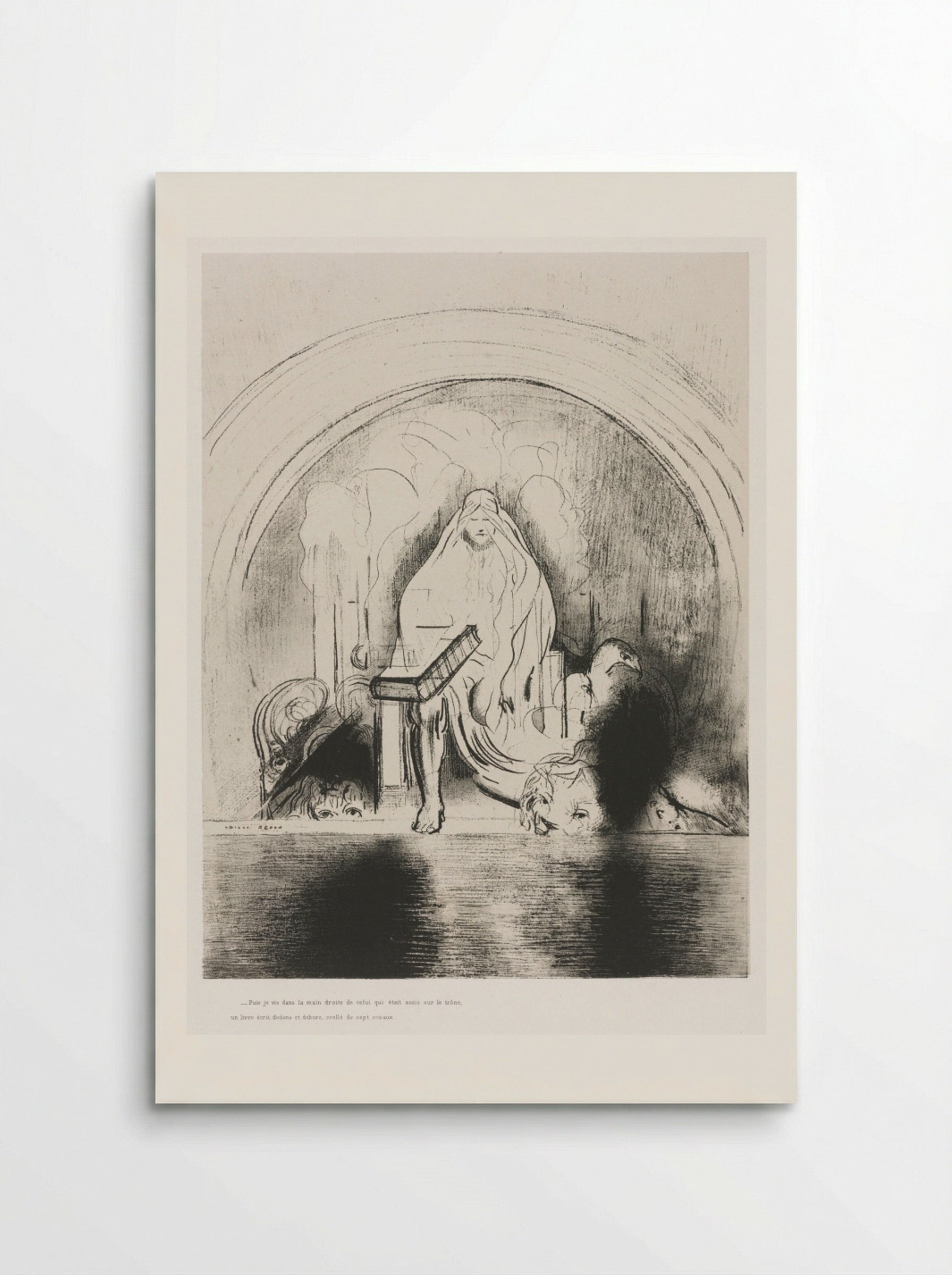
And I Saw in the Right Hand of Him that Sat on the Throne a Book Written within and on the Backside, Sealed with Seven Seals - Odilon Redon
Archival giclée
Frames arrive ready to hang
Secure checkout
Made to order
Description
A haunting lithograph from Odilon Redon's 1899 Apocalypse series, capturing a visionary scene through atmospheric light and shadow.
This lithograph by Odilon Redon forms part of his 1899 series, L'Apocalypse de Saint-Jean. The work depicts a central, ethereal figure seated upon a throne, holding a book that bears the seven seals mentioned in the biblical text. Redon employs his characteristic use of lithographic crayon to create a soft, atmospheric quality, where light and shadow merge to suggest a realm beyond the physical world. The figure is draped in flowing garments that seem to dissolve into the surrounding darkness, while the architectural arch above provides a sense of enclosure. Redon was a central figure in the Symbolist movement, known for his exploration of dreams, the subconscious, and the fantastic. Unlike his contemporaries who focused on the objective observation of nature, Redon looked inward, using his medium to translate internal visions into visual form. The stark contrast between the luminous, ghostly central figure and the deep, velvety blacks of the background is a hallmark of his technical approach to lithography. By manipulating the texture of the stone, he achieved a range of grey tones that evoke a sense of mystery and spiritual weight. This print demonstrates Redon's ability to interpret literary and religious themes through a personal, subjective lens. The composition is balanced yet unsettling, drawing the viewer into a quiet, meditative space. The inclusion of the French text at the base of the print, taken directly from the Book of Revelation, anchors the image in its source material while allowing the visual elements to operate with a degree of ambiguity. It is a fine example of the artist's mastery over the lithographic process, showing how he could transform a flat surface into a space of depth and psychological resonance.
Return policy
Because every print is made to order, we don't offer change-of-mind returns, refunds or exchanges. If your order arrives faulty, damaged or incorrect, we'll replace it free of charge — just contact us within 48 hours of delivery. See our refunds page for full details.
Shipping
We ship worldwide, printing at the production hub nearest to your delivery address. Delivery times and costs vary by destination — you'll see the options available to you at checkout.
Manufacturing
Each print is produced to order using 12-colour giclée printing on FSC-certified archival paper. Designed in Britain and printed at your nearest production hub to reduce waste and speed up delivery.
And I Saw in the Right Hand of Him that Sat on the Throne a Book Written within and on the Backside, Sealed with Seven Seals - Odilon Redon

Artist Biography
Odilon Redon
For the first two decades of his career he worked exclusively in black: charcoal drawings and lithographs he called his noirs. Floating eyeballs, severed heads with closed lids, spiders with human faces, plants that grow teeth. The images are hallucinatory but precisely rendered, closer to medical illustration than fantasy. He published his first lithograph album, Dans le Reve, in 1879. Nobody noticed.
Recognition came sideways. In 1884, Joris-Karl Huysmans published A rebours, a novel about a reclusive aesthete who decorates his rooms with Redon's prints. The book became a cult text for the Symbolist movement and Redon became famous by association. Stephane Mallarme, the Symbolist poet, became a close friend. Redon also completed a series of lithographs dedicated to Edgar Allan Poe, whose poems Mallarme and Baudelaire had translated into French.
After 1900 he stopped making noirs entirely and shifted to colour: pastels and oils of flowers, mythological figures and butterflies in palettes that anticipate Matisse. The transition was so complete that the Surrealists later claimed the black work while the Fauves claimed the colour, and neither group seemed to notice they were talking about the same person.
He studied under Jean-Leon Gerome at the Ecole des Beaux-Arts, which is an unlikely pairing: Gerome painted Roman gladiators with photographic precision. Redon painted eyeballs attached to balloons. Goya and Delacroix were the influences that actually stuck.
Our Features
Designed for Lasting Impact
Specific Features
Every Solis piece is made to order with archival, gallery-quality materials built to last.
- Museum-grade giclée printing for rich, fade-resistant colour
- Archival matte fine-art paper, FSC-certified
- Multiple sizes and framing options available
- Frames in black, natural wood, dark wood or white
- Framed prints arrive ready to hang
Care & Cleaning
To keep your artwork looking its best:
- Dust gently with a soft, dry cloth
- Avoid prolonged direct sunlight
- Never use liquid cleaners on the print or canvas surface
- Keep in a dry, room-temperature space
- Handle prints with clean, dry hands
Materials & Sizing
Museum-grade giclée on FSC-certified archival matte paper, with framed and canvas options.
- Paper sizes: A4, A3, A2, A1, A0 and B2 (50×70 cm)
- Canvas: XS (20×30 cm) to Large (60×90 cm)
- Frames: black, natural wood, dark wood or white
Why Choose Us ?
Damage-free delivery guarantee
Fast Shipping
Museum-Quality Materials
Artist Biography
Odilon Redon
For the first two decades of his career he worked exclusively in black: charcoal drawings and lithographs he called his noirs. Floating eyeballs, severed heads with closed lids, spiders with human faces, plants that grow teeth. The images are hallucinatory but precisely rendered, closer to medical illustration than fantasy. He published his first lithograph album, Dans le Reve, in 1879. Nobody noticed.
Recognition came sideways. In 1884, Joris-Karl Huysmans published A rebours, a novel about a reclusive aesthete who decorates his rooms with Redon's prints. The book became a cult text for the Symbolist movement and Redon became famous by association. Stephane Mallarme, the Symbolist poet, became a close friend. Redon also completed a series of lithographs dedicated to Edgar Allan Poe, whose poems Mallarme and Baudelaire had translated into French.
After 1900 he stopped making noirs entirely and shifted to colour: pastels and oils of flowers, mythological figures and butterflies in palettes that anticipate Matisse. The transition was so complete that the Surrealists later claimed the black work while the Fauves claimed the colour, and neither group seemed to notice they were talking about the same person.
He studied under Jean-Leon Gerome at the Ecole des Beaux-Arts, which is an unlikely pairing: Gerome painted Roman gladiators with photographic precision. Redon painted eyeballs attached to balloons. Goya and Delacroix were the influences that actually stuck.
You May Also Like