

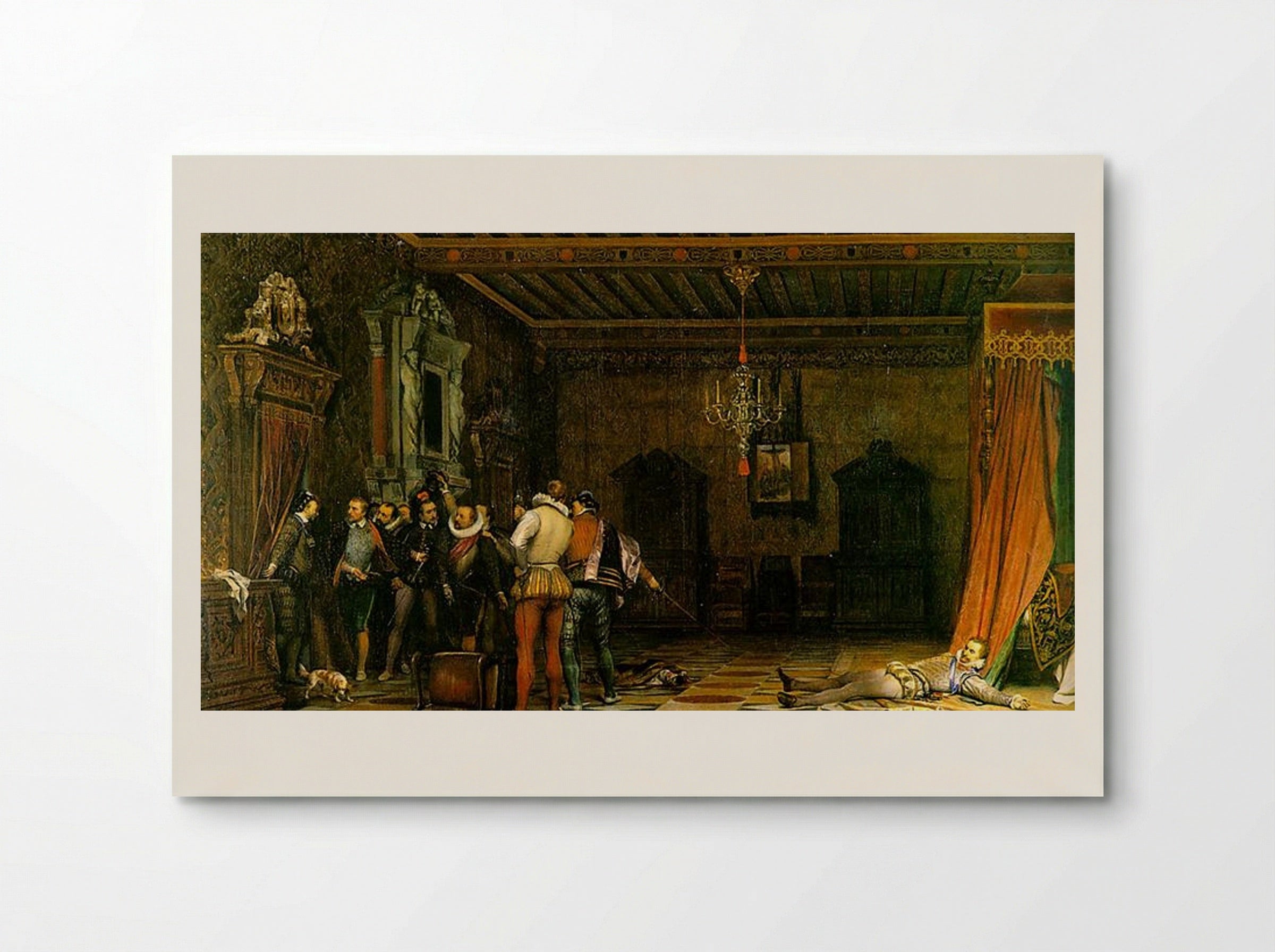
Assassination of Henry I, Duke of Guise - Paul Delaroche
Archival giclée
Frames arrive ready to hang
Secure checkout
Made to order
Description
A dramatic historical painting by Paul Delaroche depicting the aftermath of the 1588 assassination of the Duke of Guise.
Paul Delaroche, a central figure in the French Academic tradition, completed this work in 1834. It depicts the aftermath of the murder of Henry I, Duke of Guise, which occurred at the Château de Blois in 1588 on the orders of King Henry III. The painting captures the tension within the royal chambers, where the conspirators stand in the shadows, their task complete, while the body of the Duke lies prone on the floor near a heavy red curtain. Delaroche was known for his ability to render historical narratives with a focus on psychological realism rather than mere idealisation. The composition uses the dark, cavernous interior of the room to heighten the sense of isolation and impending doom. The lighting is directed to draw the eye toward the fallen figure, contrasting with the muted tones of the conspirators who remain partially obscured by the gloom. The attention to period-accurate costume and furniture reflects the artist's interest in historical authenticity, a hallmark of his approach to the genre. This work demonstrates the artist's skill in managing large-scale compositions while maintaining focus on individual character reactions. The conspirators display a range of expressions, from cold detachment to nervous agitation, providing a human dimension to the political violence. The painting remains a primary example of the nineteenth-century fascination with French history, presented with the technical precision expected of the École des Beaux-Arts. The muted palette, dominated by browns, deep reds, and ochres, reinforces the sombre nature of the subject matter, ensuring the viewer remains focused on the gravity of the event.
Return policy
Because every print is made to order, we don't offer change-of-mind returns, refunds or exchanges. If your order arrives faulty, damaged or incorrect, we'll replace it free of charge — just contact us within 48 hours of delivery. See our refunds page for full details.
Shipping
We ship worldwide, printing at the production hub nearest to your delivery address. Delivery times and costs vary by destination — you'll see the options available to you at checkout.
Manufacturing
Each print is produced to order using 12-colour giclée printing on FSC-certified archival paper. Designed in Britain and printed at your nearest production hub to reduce waste and speed up delivery.
Care and materials
Specific Features
Every Solis piece is made to order with archival, gallery-quality materials built to last.
- Museum-grade giclée printing for rich, fade-resistant colour
- Archival matte fine-art paper, FSC-certified
- Multiple sizes and framing options available
- Frames in black, natural wood, dark wood or white
- Framed prints arrive ready to hang
Care & Cleaning
To keep your artwork looking its best:
- Dust gently with a soft, dry cloth
- Avoid prolonged direct sunlight
- Never use liquid cleaners on the print or canvas surface
- Keep in a dry, room-temperature space
- Handle prints with clean, dry hands
Materials & Sizing
Museum-grade giclée on FSC-certified archival matte paper, with framed and canvas options.
- Paper sizes: A4, A3, A2, A1, A0 and B2 (50×70 cm)
- Canvas: XS (20×30 cm) to Large (60×90 cm)
- Frames: black, natural wood, dark wood or white
Assassination of Henry I, Duke of Guise - Paul Delaroche

Artist Biography
Paul Delaroche
He was born in 1797 in Paris and specialised in English and French history scenes because they sold well. In his own lifetime, his commercial success often exceeded both Ingres and Delacroix. Upon first seeing the daguerreotype in 1839, he reportedly declared: from today, painting is dead.
He married Louise Vernet, daughter of the painter Horace Vernet, in 1835. She was the absorbing passion of his life. She died in 1845, aged thirty-one. He sketched her on her deathbed; the drawing survives at the Walters Art Museum in Baltimore. He never recovered from the loss. His later work turned exclusively to religious subjects. He died in 1856.
Why Choose Us ?
Damage-free delivery guarantee
Fast Shipping
Museum-Quality Materials
You May Also Like