

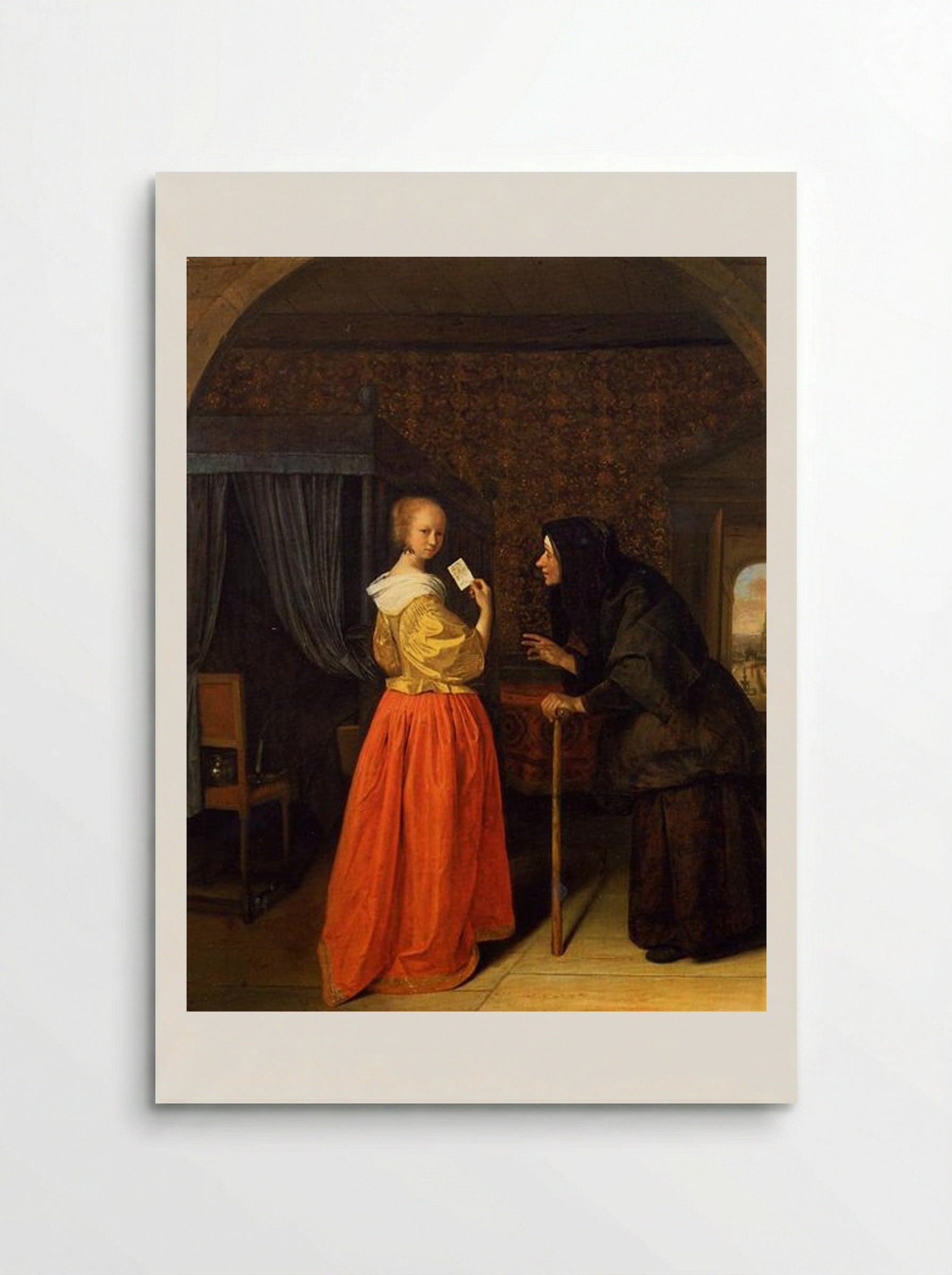
Bathsheba Receiving David's Letter - Jan Steen
Archival giclée
Frames arrive ready to hang
Secure checkout
Made to order
Description
In Jan Steen's 'Bathsheba Receiving David's Letter', the artist blends a biblical narrative with the domestic realism characteristic of the Dutch Golden Age. The painting captures a moment of quiet drama within a detailed interior setting.
Jan Steen, a leading figure of the Dutch Golden Age, was celebrated for his genre paintings that captured the everyday life of 17th-century Holland. His works often feature lively scenes, rich in detail and humour, reflecting the social customs and moral values of the time. Steen's ability to blend realism with a touch of theatricality made him one of the most beloved artists of his era. 'Bathsheba Receiving David's Letter' depicts a biblical scene with a domestic sensibility. Bathsheba, adorned in a golden bodice and red skirt, stands in an interior, receiving a letter from an elderly messenger. The composition is carefully arranged, with the figures positioned to draw the viewer's eye to the central action. The use of light and shadow adds depth to the scene, while the details of the interior, such as the patterned wall covering and the draped bed, provide a glimpse into the domestic setting. Steen's painting offers a window into both the biblical narrative and the cultural context of his time.
Return policy
Because every print is made to order, we don't offer change-of-mind returns, refunds or exchanges. If your order arrives faulty, damaged or incorrect, we'll replace it free of charge — just contact us within 48 hours of delivery. See our refunds page for full details.
Shipping
We ship worldwide, printing at the production hub nearest to your delivery address. Delivery times and costs vary by destination — you'll see the options available to you at checkout.
Manufacturing
Each print is produced to order using 12-colour giclée printing on FSC-certified archival paper. Designed in Britain and printed at your nearest production hub to reduce waste and speed up delivery.
Care and materials
Specific Features
Every Solis piece is made to order with archival, gallery-quality materials built to last.
- Museum-grade giclée printing for rich, fade-resistant colour
- Archival matte fine-art paper, FSC-certified
- Multiple sizes and framing options available
- Frames in black, natural wood, dark wood or white
- Framed prints arrive ready to hang
Care & Cleaning
To keep your artwork looking its best:
- Dust gently with a soft, dry cloth
- Avoid prolonged direct sunlight
- Never use liquid cleaners on the print or canvas surface
- Keep in a dry, room-temperature space
- Handle prints with clean, dry hands
Materials & Sizing
Museum-grade giclée on FSC-certified archival matte paper, with framed and canvas options.
- Paper sizes: A4, A3, A2, A1, A0 and B2 (50×70 cm)
- Canvas: XS (20×30 cm) to Large (60×90 cm)
- Frames: black, natural wood, dark wood or white
Bathsheba Receiving David's Letter - Jan Steen

Artist Biography
Jan Steen
He was born in Leiden around 1626 into a well-to-do Catholic family of brewers who ran the tavern The Red Halbert. In 1648 he and Gabriel Metsu co-founded the painters' Guild of Saint Luke in Leiden. He studied under Jan van Goyen, the landscape painter, and married Van Goyen's daughter Margriet in 1649. His father leased him a brewery in Delft from 1654 to 1657; when the art market collapsed in the Year of Disaster (1672), he opened a tavern in Leiden.
His painting drew heavily on the Rhetoricians, the amateur theatrical guilds whose public performances combined moralising with bawdy comedy. Steen treated his own family as a cast: he used relatives as models and painted himself repeatedly with no trace of vanity, often as the fool or the drunk. The Feast of Saint Nicholas and Girl Eating Oysters are among his most recognisable images, each balancing precise observation of Dutch domestic life with a theatrical sense of timing.
Despite enormous productivity he struggled financially throughout his career. His second wife was left with heavy debts and a large family after his death in Leiden in 1679, at fifty-two. Collectors valued him from early on, but the prices came after his lifetime.
Why Choose Us ?
Damage-free delivery guarantee
Fast Shipping
Museum-Quality Materials
You May Also Like