

Fine Art Poster
From $29
A giclée print on 200gsm matte fine art paper, using a twelve-colour process for accurate, fade-resistant colour. Supplied unframed, delivered flat or rolled.



Archival giclée
Frames arrive ready to hang
Secure checkout
Made to order
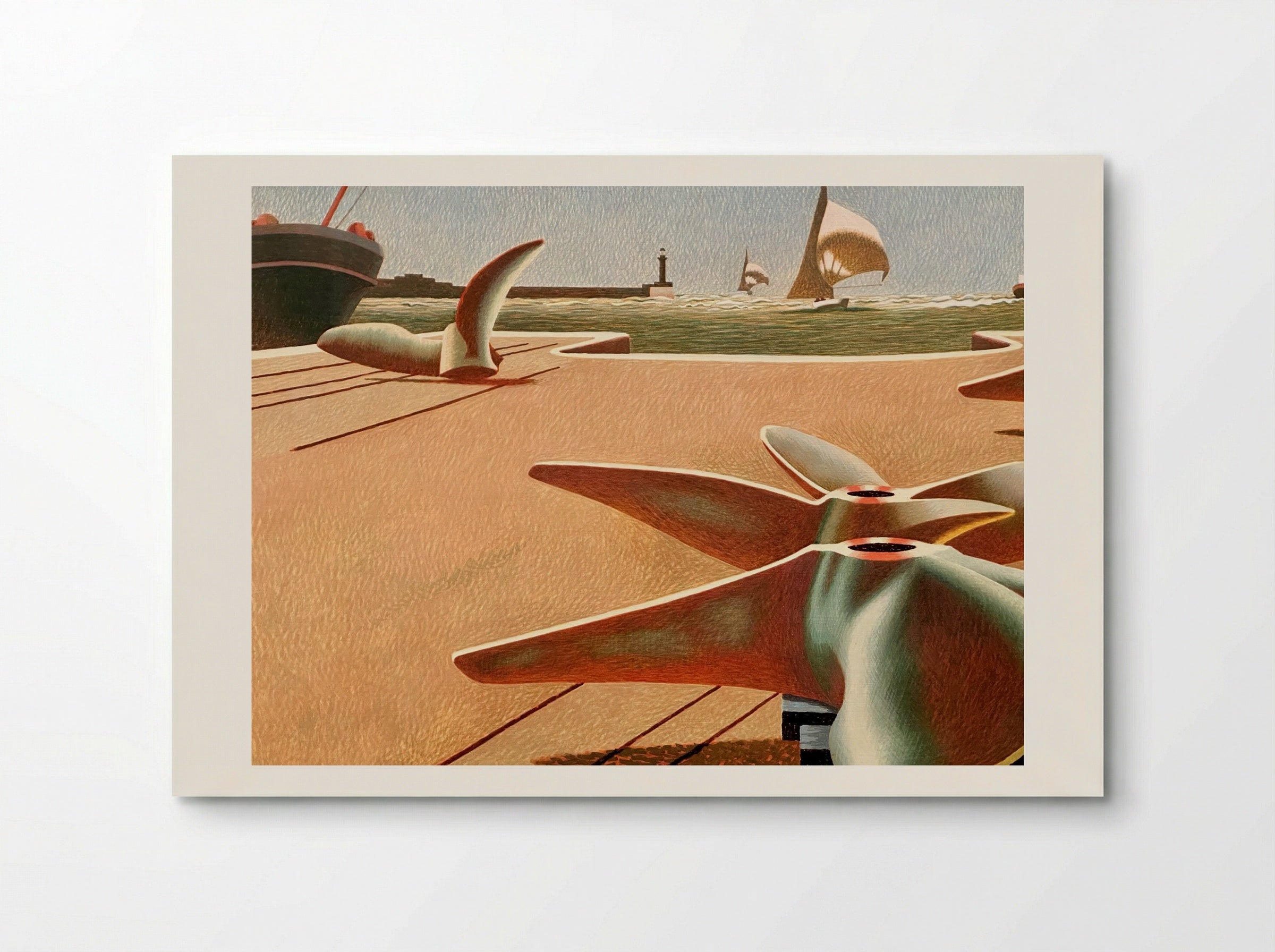
A precise, modernist study of ship propellers on a dock, painted by Edward Wadsworth in 1940.
Bronze Ballet, painted by Edward Wadsworth in 1940, captures the artist's fascination with maritime subjects and industrial forms. Wadsworth, a key figure in British modernism, often turned his attention to the nautical world, finding aesthetic order in the mechanical components of ships. In this composition, the foreground is dominated by large, metallic ship propellers resting on a dock. The smooth, sculptural quality of the bronze blades contrasts with the distant, calm harbour scene. The painting displays the characteristic precision and clarity of Wadsworth's later work. His technique, often involving tempera, allows for a crispness of line and a controlled application of colour. The composition is structured with a deliberate, almost architectural rigour. The propellers are arranged with a sense of rhythm, suggesting the title's reference to a choreographed movement. The background, featuring a lighthouse and sailing vessels, provides a sense of scale and spatial depth, yet the focus remains firmly on the inanimate objects in the foreground. Wadsworth's interest in the geometry of industrial objects is evident here. He treats the propellers not merely as functional parts, but as objects of aesthetic contemplation. The light catches the curved surfaces of the metal, creating subtle gradations of tone that define their volume. This work reflects the artist's transition from his earlier Vorticist experiments toward a more refined, representational style that maintained a strong sense of formal discipline. The palette is restrained, relying on earthy tones and metallic hues to convey the texture of the bronze and the surrounding dockside environment. It is a study of stillness and form, capturing a moment of quietude within a busy port setting.
Because every print is made to order, we don't offer change-of-mind returns, refunds or exchanges. If your order arrives faulty, damaged or incorrect, we'll replace it free of charge — just contact us within 48 hours of delivery. See our refunds page for full details.
We ship worldwide, printing at the production hub nearest to your delivery address. Delivery times and costs vary by destination — you'll see the options available to you at checkout.
Each print is produced to order using 12-colour giclée printing on FSC-certified archival paper. Designed in Britain and printed at your nearest production hub to reduce waste and speed up delivery.
Specific Features
Every Solis piece is made to order with archival, gallery-quality materials built to last.
Care & Cleaning
To keep your artwork looking its best:
Materials & Sizing
Museum-grade giclée on FSC-certified archival matte paper, with framed and canvas options.

Artist Biography
Made to order
Every piece is printed to order. These are the five finishes, and what makes each one different.
From $29
A giclée print on 200gsm matte fine art paper, using a twelve-colour process for accurate, fade-resistant colour. Supplied unframed, delivered flat or rolled.

From $89
The same fine art print in a solid wood frame with UV-protective acrylic glaze and rigid backing. Five frame colours. Arrives ready to hang.

From $169
A deeper solid wood frame: 33mm deep with a 20mm face and Perspex glaze. The print sits unmounted for a clean gallery presentation. Black, white or natural.

From $59
Hand-stretched canvas with neat gallery-wrapped edges, giving the artwork surface texture and depth. Arrives ready to hang.

From $175
Stretched canvas set in a floating wood frame, our most substantial finish. Arrives ready to hang.
Why Choose Us ?
Damage-free delivery guarantee
Fast Shipping
Museum-Quality Materials
You May Also Like
We use cookies to measure our marketing and see which prints people love.We use cookies to measure our marketing.
By continuing to browse, you agree · Privacy Policy