

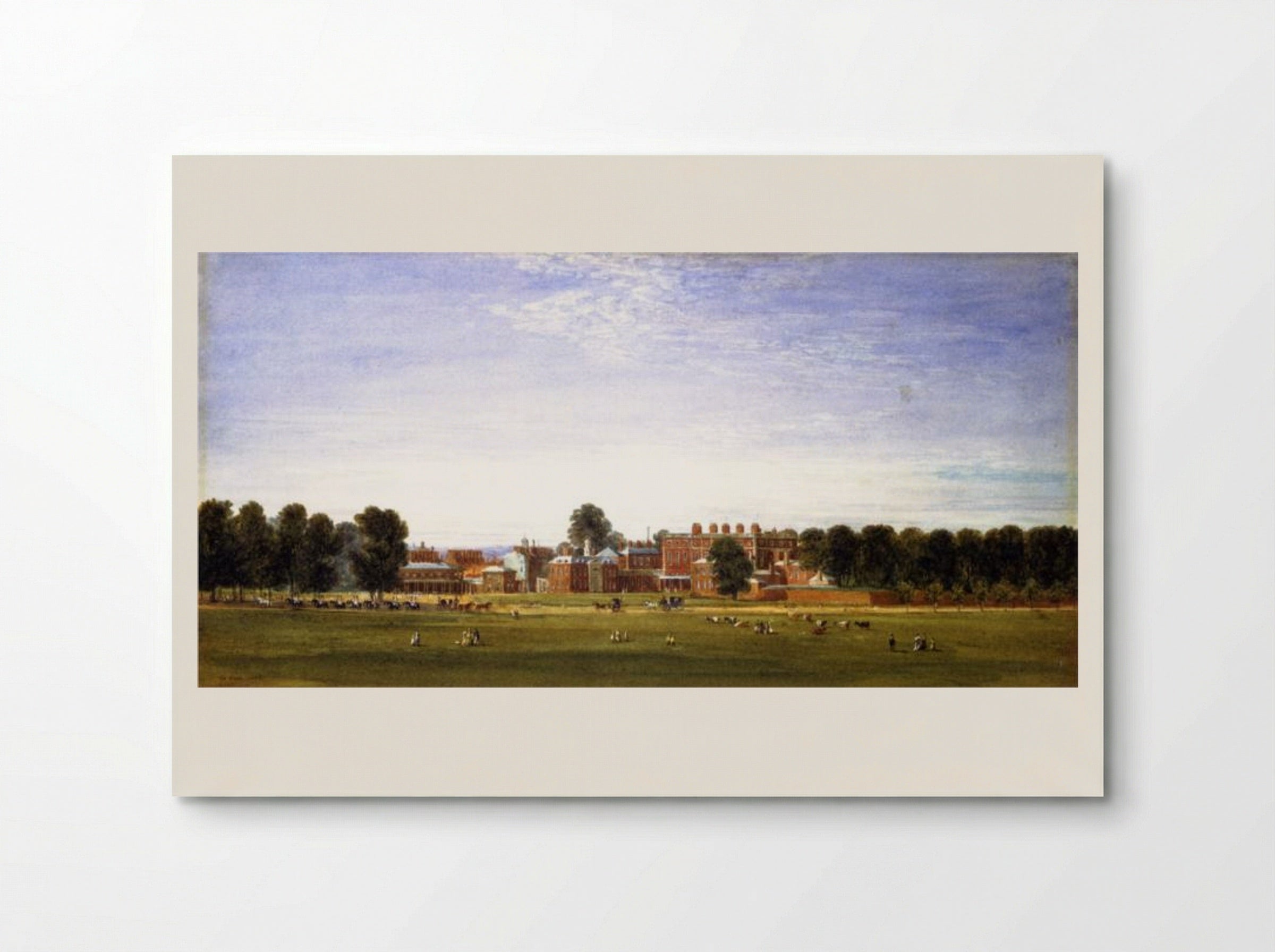
Buckingham House from the Green Park - David Cox
Archival giclée
Frames arrive ready to hang
Secure checkout
Made to order
Description
A topographical watercolour by David Cox showing Buckingham House from Green Park. This nineteenth-century view captures the original red brick residence and the surrounding parkland with grazing cattle and figures.
David Cox was a leading figure of the Birmingham School and a master of the English watercolour tradition. This work depicts Buckingham House as it appeared before its extensive reconstruction into Buckingham Palace. The view is taken from Green Park, showing the red brick structure that originally served as a private residence for the Duke of Buckingham before its purchase by George III in 1761. During this period, the house retained its domestic character, lacking the grand facades and marble arches added in later decades. The composition features a wide expanse of the park in the foreground. Small figures and grazing cattle occupy the grassy area, providing a sense of scale and everyday life in nineteenth-century London. A line of carriages and riders moves along the path in front of the house, suggesting the social activity associated with the royal residence. The sky occupies a large portion of the paper, rendered with broad washes of blue and white to suggest a bright, slightly clouded day. Cox often preferred these expansive skies to convey the shifting weather conditions of the British Isles. Cox used a loose, atmospheric technique. He avoided the rigid precision of earlier topographical artists, preferring to capture the effects of light and air. The trees on either side of the house are painted with soft, feathered brushstrokes, creating a natural frame for the central architecture. This piece captures a specific moment in London's urban history, documenting the appearance of the site before John Nash began his neoclassical additions for George IV. The use of light across the grass and the distant buildings demonstrates the artist's ability to create depth through subtle shifts in tone and colour.
Return policy
Because every print is made to order, we don't offer change-of-mind returns, refunds or exchanges. If your order arrives faulty, damaged or incorrect, we'll replace it free of charge — just contact us within 48 hours of delivery. See our refunds page for full details.
Shipping
We ship worldwide, printing at the production hub nearest to your delivery address. Delivery times and costs vary by destination — you'll see the options available to you at checkout.
Manufacturing
Each print is produced to order using 12-colour giclée printing on FSC-certified archival paper. Designed in Britain and printed at your nearest production hub to reduce waste and speed up delivery.
Buckingham House from the Green Park - David Cox

Artist Biography
David Cox
He was born in Birmingham in 1783 and was largely self-taught. He became one of the great masters of the English watercolour tradition, painting Welsh and English landscapes with a directness that his contemporaries found crude. He taught drawing for much of his life and published influential treatises on watercolour technique. He died in 1859.
Our Features
Designed for Lasting Impact
Specific Features
Every Solis piece is made to order with archival, gallery-quality materials built to last.
- Museum-grade giclée printing for rich, fade-resistant colour
- Archival matte fine-art paper, FSC-certified
- Multiple sizes and framing options available
- Frames in black, natural wood, dark wood or white
- Framed prints arrive ready to hang
Care & Cleaning
To keep your artwork looking its best:
- Dust gently with a soft, dry cloth
- Avoid prolonged direct sunlight
- Never use liquid cleaners on the print or canvas surface
- Keep in a dry, room-temperature space
- Handle prints with clean, dry hands
Materials & Sizing
Museum-grade giclée on FSC-certified archival matte paper, with framed and canvas options.
- Paper sizes: A4, A3, A2, A1, A0 and B2 (50×70 cm)
- Canvas: XS (20×30 cm) to Large (60×90 cm)
- Frames: black, natural wood, dark wood or white
Why Choose Us ?
Damage-free delivery guarantee
Fast Shipping
Museum-Quality Materials
Artist Biography
David Cox
He was born in Birmingham in 1783 and was largely self-taught. He became one of the great masters of the English watercolour tradition, painting Welsh and English landscapes with a directness that his contemporaries found crude. He taught drawing for much of his life and published influential treatises on watercolour technique. He died in 1859.
You May Also Like