

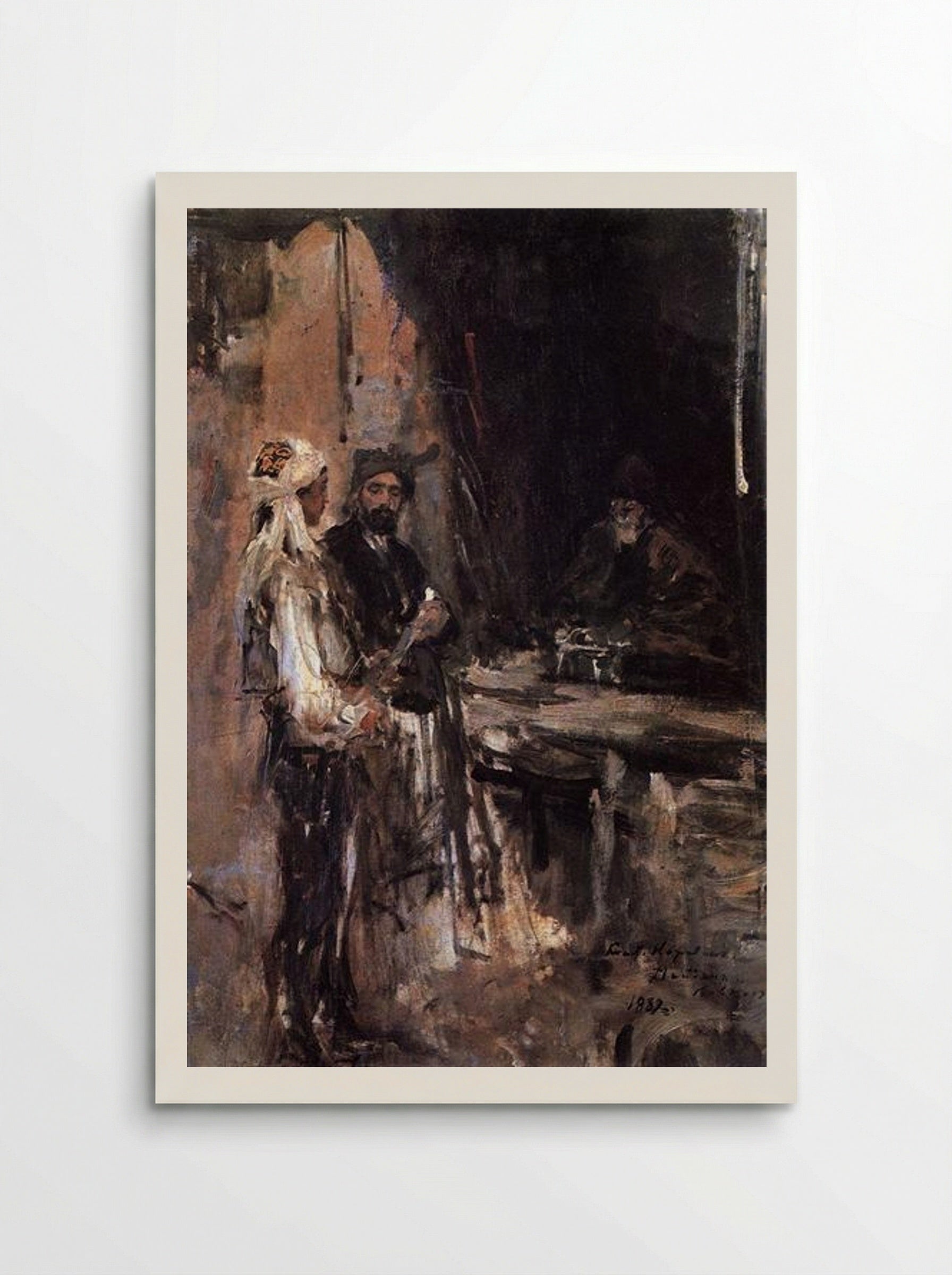
Buying a Dagger - Konstantin Korovin
Archival giclée
Frames arrive ready to hang
Secure checkout
Made to order
Description
A 1889 oil painting by Konstantin Korovin depicting a candid moment in a bazaar. The work uses loose brushwork and a muted palette to capture the play of light on traditional dress.
Konstantin Korovin painted this scene in 1889. It depicts a transaction in a dimly lit interior, likely a bazaar in the Caucasus. A man in a white headscarf stands in the foreground, holding a blade for inspection. Beside him, a bearded companion observes the object. A third figure, perhaps the merchant, sits behind a low wooden table in the background shadows. Korovin was a leading figure in the development of Impressionism in Russia. He used broad, rapid brushstrokes to capture the atmosphere of the scene. Light enters from the left side of the frame, illuminating the folds of the white garment and the metallic surface of the dagger. The rest of the room is obscured by dark, heavy shadows. This technique creates a sense of immediate observation rather than a staged studio composition. The artist travelled to the Caucasus during the late 1880s. These journeys provided him with new subjects and a different quality of light to study. In this work, he avoids a detailed narrative or moral message. Instead, he focuses on the textures of the fabric and the specific mood of the interior. The palette consists of earth tones, including burnt umber, ochre, and cream. The application of paint is thick in the areas of light and thin in the shadows. The vertical orientation of the canvas emphasises the standing figures. The dark background pushes the subjects forward, making the interaction the primary subject. Korovin's signature and the date are visible in the lower right corner, executed in a dark pigment that blends with the floor. The loose handling of the medium suggests the influence of French Impressionism, which Korovin encountered during his visits to Paris.
Return policy
Because every print is made to order, we don't offer change-of-mind returns, refunds or exchanges. If your order arrives faulty, damaged or incorrect, we'll replace it free of charge — just contact us within 48 hours of delivery. See our refunds page for full details.
Shipping
We ship worldwide, printing at the production hub nearest to your delivery address. Delivery times and costs vary by destination — you'll see the options available to you at checkout.
Manufacturing
Each print is produced to order using 12-colour giclée printing on FSC-certified archival paper. Designed in Britain and printed at your nearest production hub to reduce waste and speed up delivery.
Care and materials
Specific Features
Every Solis piece is made to order with archival, gallery-quality materials built to last.
- Museum-grade giclée printing for rich, fade-resistant colour
- Archival matte fine-art paper, FSC-certified
- Multiple sizes and framing options available
- Frames in black, natural wood, dark wood or white
- Framed prints arrive ready to hang
Care & Cleaning
To keep your artwork looking its best:
- Dust gently with a soft, dry cloth
- Avoid prolonged direct sunlight
- Never use liquid cleaners on the print or canvas surface
- Keep in a dry, room-temperature space
- Handle prints with clean, dry hands
Materials & Sizing
Museum-grade giclée on FSC-certified archival matte paper, with framed and canvas options.
- Paper sizes: A4, A3, A2, A1, A0 and B2 (50×70 cm)
- Canvas: XS (20×30 cm) to Large (60×90 cm)
- Frames: black, natural wood, dark wood or white
Buying a Dagger - Konstantin Korovin

Artist Biography
Konstantin Korovin
He was born in Moscow in 1861 and studied under Savrasov and Polenov at the Moscow School. He was close to Mamontov's Abramtsevo circle and designed prolifically for the Bolshoi and Mariinsky theatres. His Parisian cafe scenes and Crimean landscapes use loose, luminous brushwork. After the Revolution he emigrated to Paris in 1923. He died in Paris in 1939.
Why Choose Us ?
Damage-free delivery guarantee
Fast Shipping
Museum-Quality Materials
You May Also Like