



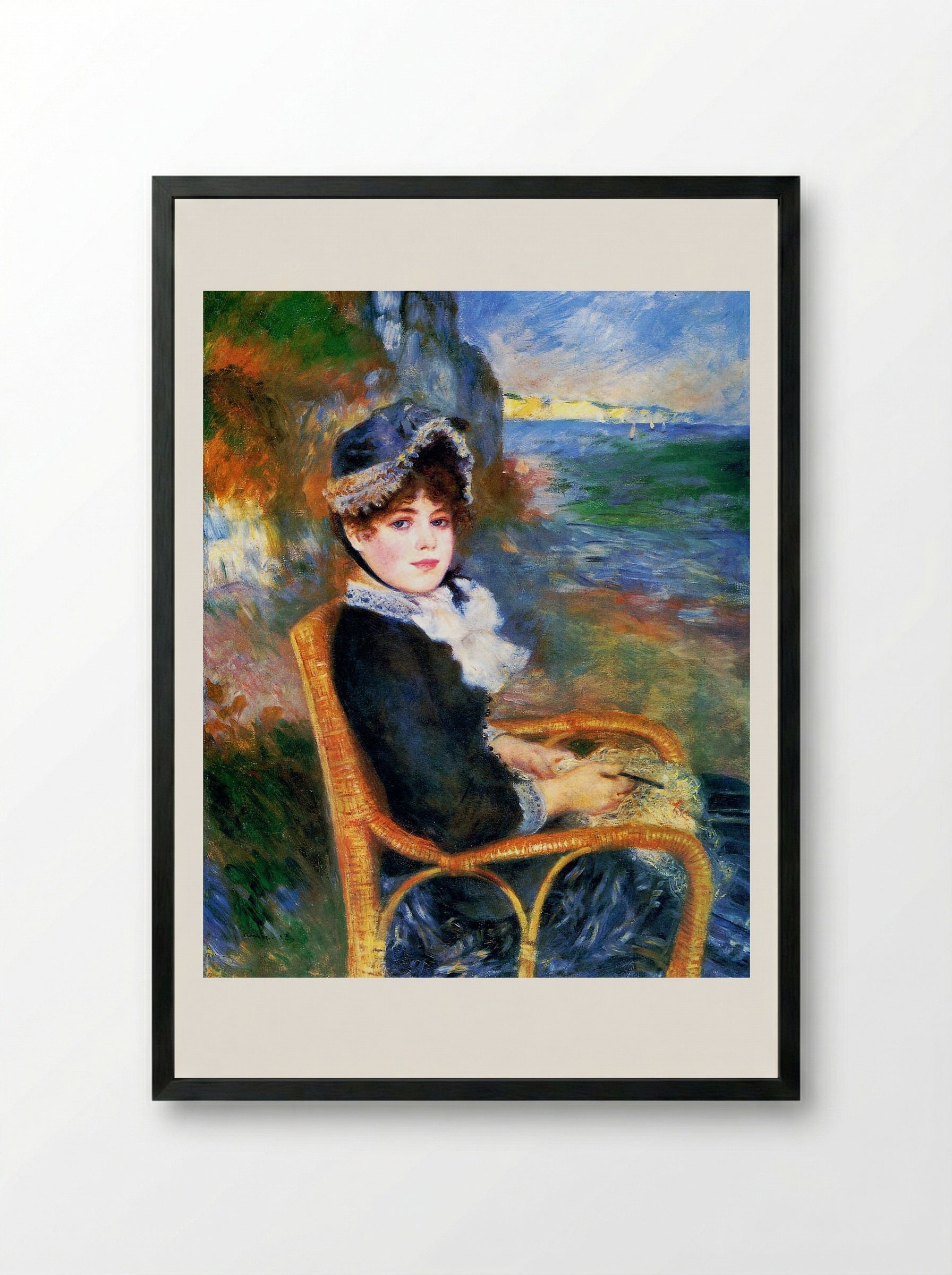


By the Seashore - Pierre-Auguste Renoir
Archival giclée
Ready to hang
Secure checkout
Made to order
Description
This portrait by Pierre-Auguste Renoir captures a woman seated by the sea, rendered in the soft light and loose brushstrokes characteristic of Impressionism. The painting evokes a sense of relaxed elegance and quiet contemplation.
Pierre-Auguste Renoir (1841-1919) was a French artist and a leading figure in the development of the Impressionist style. His paintings are notable for their soft light, saturated colour, and focus on people in intimate and candid compositions. Renoir's work often celebrated beauty, especially feminine beauty, and sensual pleasures. He is considered one of the most important painters in the history of art. 'By the Seashore' depicts a woman seated in a wicker chair, likely on a beach or near the coast. The scene is rendered with loose brushstrokes and a light, airy palette typical of Impressionism. The woman is dressed in a dark dress with a white lace collar and a bonnet, her gaze directed towards the viewer. The background shows a glimpse of the sea and sky, painted with broad strokes of blue and green. The overall effect is one of relaxed elegance and quiet contemplation.
Return policy
Because every print is made to order, we don't offer change-of-mind returns, refunds or exchanges. If your order arrives faulty, damaged or incorrect, we'll replace it free of charge — just contact us within 48 hours of delivery. EU customers have a 14-day cooling-off right. See our refunds page for full details.
Shipping
We ship worldwide, printing at the production hub nearest to your delivery address. Delivery times and costs vary by destination — you'll see the options available to you at checkout.
Manufacturing
Each print is produced to order using 12-colour giclée printing on FSC-certified archival paper. Designed in Britain and printed at your nearest production hub to reduce waste and speed up delivery.
By the Seashore - Pierre-Auguste Renoir
Our Features
Designed for Lasting Impact
Specific Features
Every Solis piece is made to order with archival, gallery-quality materials built to last.
- Museum-grade giclée printing for rich, fade-resistant colour
- Archival matte fine-art paper, FSC-certified
- Choose poster, framed print, canvas or framed canvas
- Frames in black, natural wood, dark wood or white
- Framed prints arrive ready to hang
Care & Cleaning
To keep your artwork looking its best:
- Dust gently with a soft, dry cloth
- Avoid prolonged direct sunlight
- Never use liquid cleaners on the print or canvas surface
- Keep in a dry, room-temperature space
- Handle prints with clean, dry hands
Materials & Sizing
Museum-grade giclée on FSC-certified archival matte paper, with framed and canvas options.
- Paper sizes: A4, A3, A2, A1, A0 and B2 (50×70 cm)
- Canvas: XS (20×30 cm) to Large (60×90 cm)
- Frames: black, natural wood, dark wood or white
Why Choose Us ?
100% Satisfaction Guarantee
Fast Shipping
Museum-Quality Materials

Artist Biography
Pierre-Auguste Renoir
He met Monet, Sisley, and Bazille at Charles Gleyre's studio in the early 1860s. In 1869, he and Monet painted side by side at La Grenouillere, a bathing spot on the Seine, producing some of the earliest distinctly Impressionist work. They co-founded the first Impressionist exhibition in April 1874 with Pissarro and others. Of the group, Renoir was the one most drawn to people. His subjects are eating, dancing, talking, sitting in the sun, doing very little. The paint itself seems warm.
Luncheon of the Boating Party, painted in 1881, includes his future wife Aline Charigot as the woman on the left playing with a small dog. She was a dressmaker, twenty years his junior. They married in 1890. The model Suzanne Valadon, later a significant painter in her own right, posed for several of his works during this period.
Rheumatoid arthritis set in around 1892 and progressively crippled his hands. In 1907 he moved south to Cagnes-sur-Mer, near the Mediterranean, seeking warmer air. The commonly repeated story is that brushes were strapped to his paralysed fingers. The reality is more precise: he could still grip a brush, but an assistant had to place it in his permanently clenched hand. Bandages visible in late photographs prevented skin irritation rather than holding brushes in place. Film footage from 1915 shows the seventy-four-year-old painting at his easel while his fourteen-year-old son Claude arranged the palette and placed brushes in his hand.
He kept painting until the day he died, in December 1919, at seventy-eight.
You May Also Like