

Café Music - Max Beckmann
Archival giclée
Ready to hang
Secure checkout
Made to order
Description
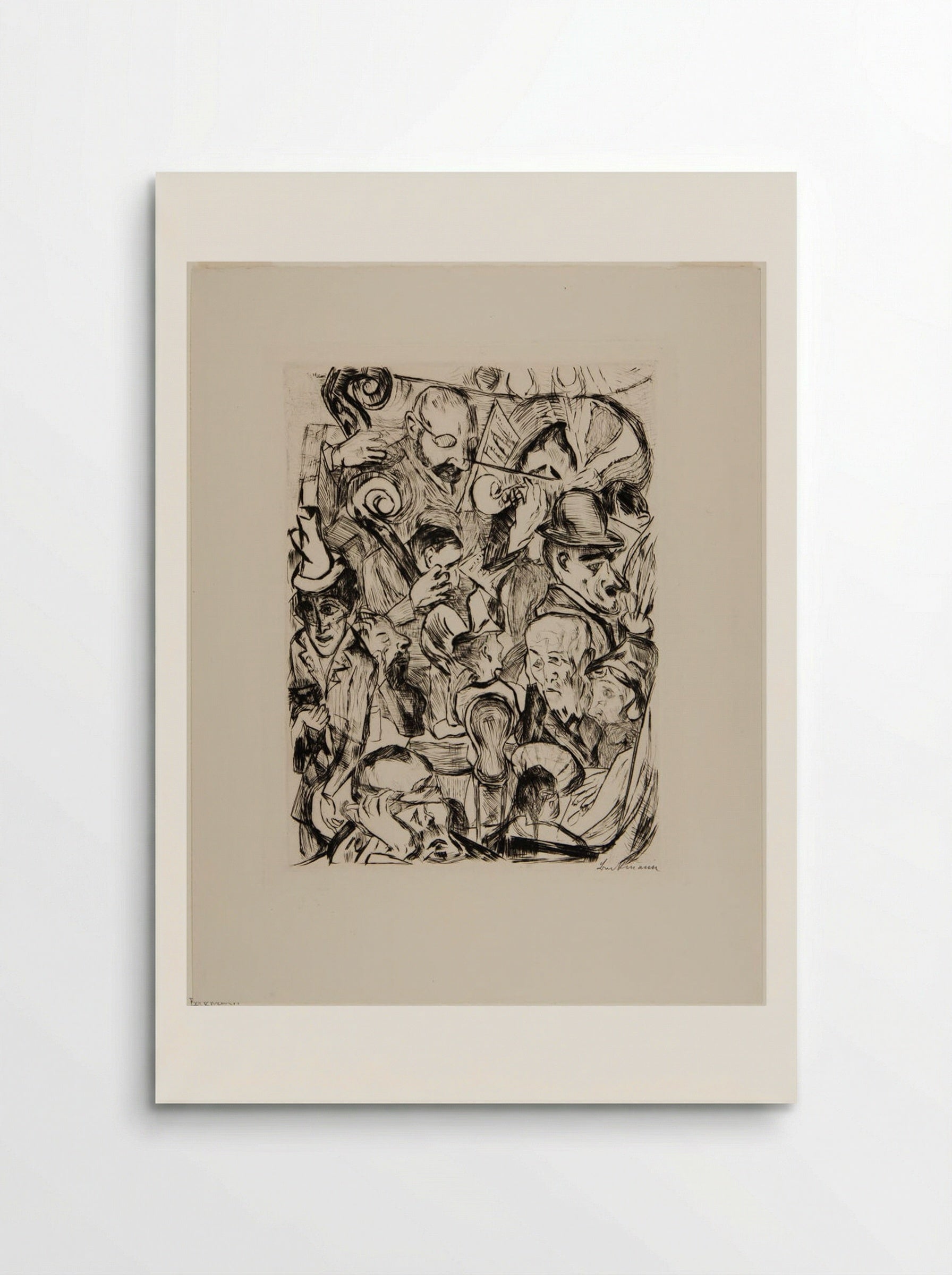
A 1918 drypoint by Max Beckmann depicting a crowded Frankfurt café. This German Expressionist print uses angular lines and compressed space to capture the atmosphere of post-war urban life.
Max Beckmann produced this drypoint, titled Cafémusik, in 1918. It belongs to a period of significant transition for the artist following his service in the First World War. The composition depicts a crowded interior of a Frankfurt café, filled with musicians and patrons. Beckmann uses sharp, angular lines to create a sense of physical compression. The figures are packed together, overlapping in a way that suggests the claustrophobic atmosphere of post-war urban life. The central focus includes a double bass player and a violinist at the top of the frame. Their instruments are rendered with heavy, dark strokes that dominate the upper third of the image. Below them, various figures sit at tables, their expressions ranging from weary to distracted. One man wears a bowler hat, his profile sharply defined against the busy background. Beckmann avoids traditional perspective, instead stacking the figures vertically to fill the entire pictorial space. This technique is characteristic of his work from the late 1910s, where he sought to capture the psychological tension of the Weimar Republic. The drypoint medium allows for burred, velvety lines that add a gritty texture to the scene. Beckmann’s use of distorted anatomy and exaggerated features aligns with the New Objectivity movement, though it retains the emotional intensity of Expressionism. This print is part of the Gesichter portfolio, which contained nineteen drypoints documenting the social types and environments Beckmann encountered in Frankfurt. The work is a record of the social friction and sensory overload found in the modern city. It reflects the artist's shift from his earlier, more traditional style toward a harsh, confrontational realism. The plate shows evidence of the artist's direct hand, with scratches and marks that contribute to the raw, unpolished aesthetic of the final print.
Return policy
Because every print is made to order, we don't offer change-of-mind returns, refunds or exchanges. If your order arrives faulty, damaged or incorrect, we'll replace it free of charge — just contact us within 48 hours of delivery. EU customers have a 14-day cooling-off right. See our refunds page for full details.
Shipping
We ship worldwide, printing at the production hub nearest to your delivery address. Delivery times and costs vary by destination — you'll see the options available to you at checkout.
Manufacturing
Each print is produced to order using 12-colour giclée printing on FSC-certified archival paper. Designed in Britain and printed at your nearest production hub to reduce waste and speed up delivery.
Café Music - Max Beckmann
Our Features
Designed for Lasting Impact
Specific Features
Every Solis piece is made to order with archival, gallery-quality materials built to last.
- Museum-grade giclée printing for rich, fade-resistant colour
- Archival matte fine-art paper, FSC-certified
- Choose poster, framed print, canvas or framed canvas
- Frames in black, natural wood, dark wood or white
- Framed prints arrive ready to hang
Care & Cleaning
To keep your artwork looking its best:
- Dust gently with a soft, dry cloth
- Avoid prolonged direct sunlight
- Never use liquid cleaners on the print or canvas surface
- Keep in a dry, room-temperature space
- Handle prints with clean, dry hands
Materials & Sizing
Museum-grade giclée on FSC-certified archival matte paper, with framed and canvas options.
- Paper sizes: A4, A3, A2, A1, A0 and B2 (50×70 cm)
- Canvas: XS (20×30 cm) to Large (60×90 cm)
- Frames: black, natural wood, dark wood or white
Why Choose Us ?
100% Satisfaction Guarantee
Fast Shipping
Museum-Quality Materials

Artist Biography
Max Beckmann
He was born in Leipzig in 1884 and trained at the Weimar Academy. His early work was relatively conventional; the First World War, where he served as a medical orderly, shattered both his style and his psychology. The paintings that followed, dense, allegorical, packed with symbolic figures in compressed, claustrophobic spaces, resist easy classification. His monumental triptychs, painted in exile in Amsterdam and later St Louis, combine mythology, autobiography and contemporary history.
He remains one of the twentieth century's most ambitious figurative painters, comparable in scale and intention to Picasso but less interested in formal innovation than in moral weight. He died in New York in 1950, at sixty-five.
You May Also Like