

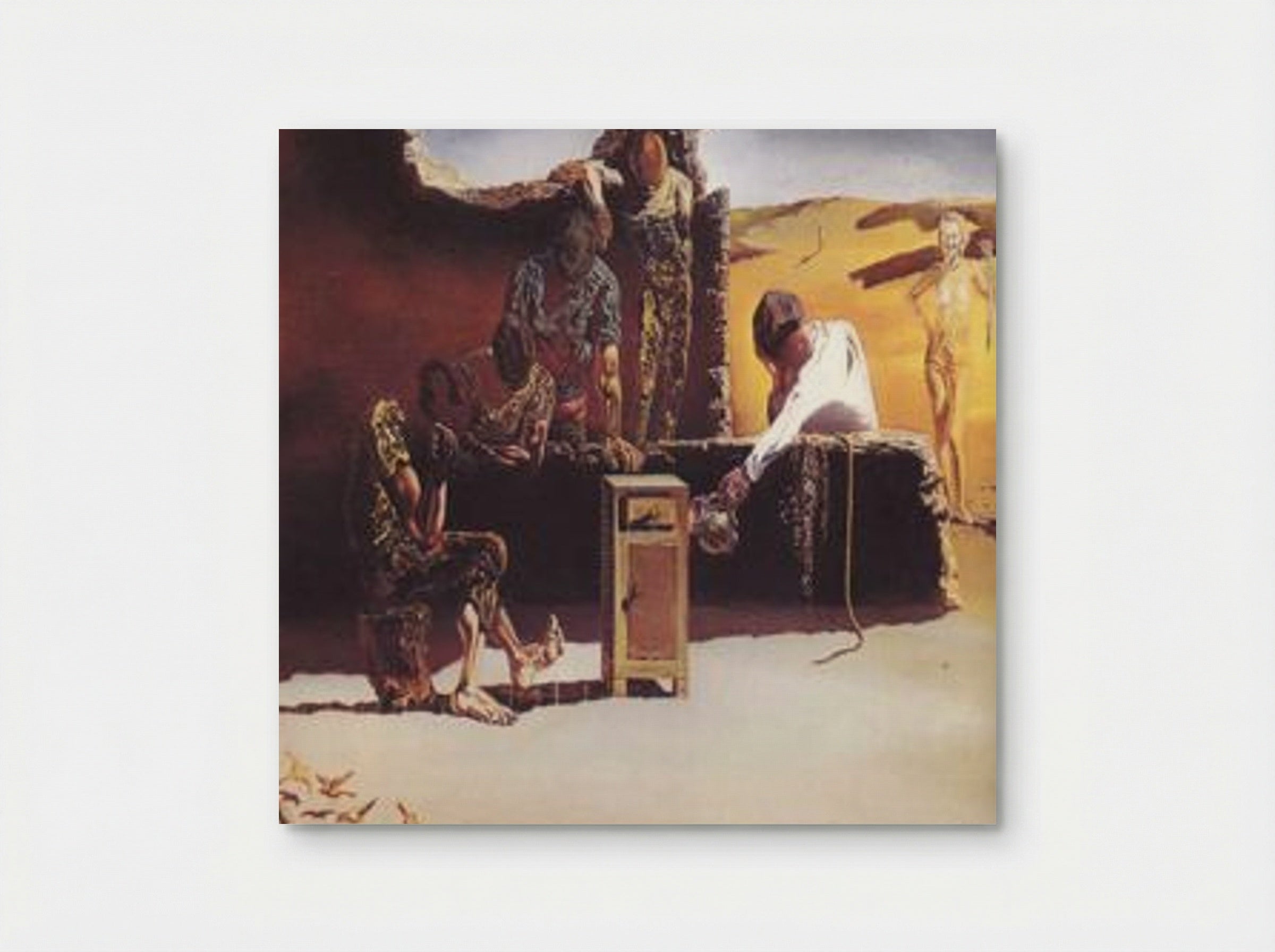
Cardinal, Cardinal - Salvador Dalí
Archival giclée
Frames arrive ready to hang
Secure checkout
Made to order
Description
A haunting Surrealist composition by Salvador Dalí, featuring elongated figures in a desolate, dreamlike interior.
Cardinal, Cardinal, painted in 1939, is a characteristic example of Salvador Dalí's mature Surrealist period. The composition features a desolate, dreamlike setting, typical of the artist's exploration of the subconscious. Figures are arranged in a sparse, architectural space that suggests a ruin or an abandoned interior, opening onto a barren, sun-drenched exterior. The figures themselves are rendered with the precise, academic technique that Dalí employed to make his irrational subjects appear tangible. The central element is a small, wooden cabinet, which acts as a strange, domestic anchor within the otherwise unsettling scene. The figures, draped in tattered, organic-looking garments, possess the elongated, attenuated limbs often found in Dalí's work from this era. Their postures are static, suggesting a state of suspended animation or psychological stasis. The colour palette is dominated by earthy ochres, deep browns, and shadows, which contrast with the stark, bright light of the background. This use of light creates a sense of theatricality, as if the scene is a stage set for a private, inexplicable ritual. Dalí's work from the late 1930s often reflected the political instability of Europe, and the title itself, Cardinal, Cardinal, hints at ecclesiastical themes, though these are presented through a lens of decay and ambiguity. The figures appear to be engaged in a quiet, perhaps futile, interaction with the cabinet. The painting invites the viewer to observe the tension between the solid, recognisable objects and the distorted, dream-logic of the human forms. It is a work that prioritises the creation of an atmosphere of unease over a clear narrative, relying on the juxtaposition of disparate elements to provoke a visceral response.
Return policy
Because every print is made to order, we don't offer change-of-mind returns, refunds or exchanges. If your order arrives faulty, damaged or incorrect, we'll replace it free of charge — just contact us within 48 hours of delivery. See our refunds page for full details.
Shipping
We ship worldwide, printing at the production hub nearest to your delivery address. Delivery times and costs vary by destination — you'll see the options available to you at checkout.
Manufacturing
Each print is produced to order using 12-colour giclée printing on FSC-certified archival paper. Designed in Britain and printed at your nearest production hub to reduce waste and speed up delivery.
Cardinal, Cardinal - Salvador Dalí

Artist Biography
Salvador Dali
He entered the Royal Academy of Fine Arts in Madrid at seventeen and was expelled twice. The first time for inciting a student riot. The second time, in 1926, for announcing that none of the faculty were competent to examine him. While in Madrid he read Freud's The Interpretation of Dreams and later called it one of the most important discoveries of his life. He began inducing hallucinatory states through a method he called 'paranoiac-critical': staring at objects until they transformed into something else, then painting what he saw.
The Persistence of Memory, the one with the melting clocks, was painted in 1931. He was twenty-seven. The clocks were not, as commonly assumed, a reference to Einstein. Dali said they were inspired by Camembert cheese melting in the sun. He joined the Surrealists in Paris but was eventually expelled by Andre Breton (Dali attracted expulsions) for political ambiguity and, more practically, for being impossible to control.
Gala Eluard became his wife, manager, muse, and business partner. She had previously been married to the poet Paul Eluard, and her departure for Dali divided the Surrealist circle. Together they built a career that crossed painting, film (Un Chien Andalou with Bunuel), fashion (the lobster telephone, Mae West's lips sofa), advertising, and later the Chupa Chups lollipop logo. He designed the Dali Theatre-Museum in Figueres on the ruins of the town theatre that had been destroyed in the Civil War. He is buried there, beneath the stage.
Our Features
Designed for Lasting Impact
Specific Features
Every Solis piece is made to order with archival, gallery-quality materials built to last.
- Museum-grade giclée printing for rich, fade-resistant colour
- Archival matte fine-art paper, FSC-certified
- Multiple sizes and framing options available
- Frames in black, natural wood, dark wood or white
- Framed prints arrive ready to hang
Care & Cleaning
To keep your artwork looking its best:
- Dust gently with a soft, dry cloth
- Avoid prolonged direct sunlight
- Never use liquid cleaners on the print or canvas surface
- Keep in a dry, room-temperature space
- Handle prints with clean, dry hands
Materials & Sizing
Museum-grade giclée on FSC-certified archival matte paper, with framed and canvas options.
- Paper sizes: A4, A3, A2, A1, A0 and B2 (50×70 cm)
- Canvas: XS (20×30 cm) to Large (60×90 cm)
- Frames: black, natural wood, dark wood or white
Why Choose Us ?
Damage-free delivery guarantee
Fast Shipping
Museum-Quality Materials
Artist Biography
Salvador Dalí
He entered the Royal Academy of Fine Arts in Madrid at seventeen and was expelled twice. The first time for inciting a student riot. The second time, in 1926, for announcing that none of the faculty were competent to examine him. While in Madrid he read Freud's The Interpretation of Dreams and later called it one of the most important discoveries of his life. He began inducing hallucinatory states through a method he called 'paranoiac-critical': staring at objects until they transformed into something else, then painting what he saw.
The Persistence of Memory, the one with the melting clocks, was painted in 1931. He was twenty-seven. The clocks were not, as commonly assumed, a reference to Einstein. Dali said they were inspired by Camembert cheese melting in the sun. He joined the Surrealists in Paris but was eventually expelled by Andre Breton (Dali attracted expulsions) for political ambiguity and, more practically, for being impossible to control.
Gala Eluard became his wife, manager, muse, and business partner. She had previously been married to the poet Paul Eluard, and her departure for Dali divided the Surrealist circle. Together they built a career that crossed painting, film (Un Chien Andalou with Bunuel), fashion (the lobster telephone, Mae West's lips sofa), advertising, and later the Chupa Chups lollipop logo. He designed the Dali Theatre-Museum in Figueres on the ruins of the town theatre that had been destroyed in the Civil War. He is buried there, beneath the stage.
You May Also Like