

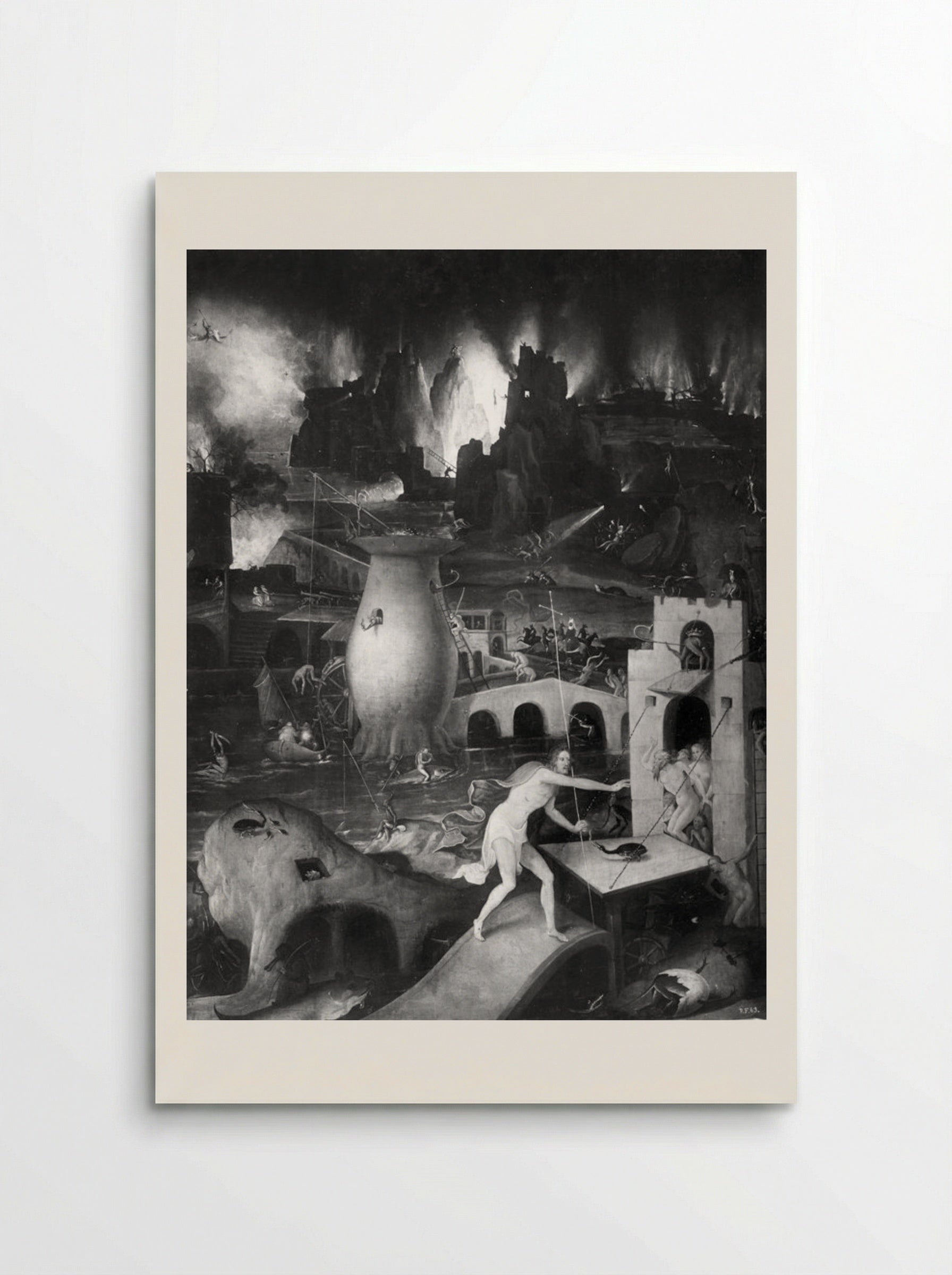
Christ's Descent into Hell - Hieronymus Bosch
Archival giclée
Frames arrive ready to hang
Secure checkout
Made to order
Description
A detailed reproduction of Hieronymus Bosch's depiction of the harrowing of hell, featuring his signature surreal iconography and dramatic lighting.
This composition depicts the harrowing of hell, a subject drawn from apocryphal Christian tradition. Hieronymus Bosch presents a scene defined by his characteristic visual vocabulary, where the spiritual narrative merges with surreal, nightmarish imagery. The figure of Christ occupies the foreground, acting as the primary agent of liberation as he approaches the gates of the underworld to release the souls of the righteous. The background is dominated by a burning, cavernous structure that suggests a city in flames, casting a glow over the surrounding water and rocky terrain. Bosch populates this space with an array of hybrid creatures, strange mechanical apparatuses, and figures engaged in various states of torment or activity. The scale of these elements varies, creating a sense of chaotic depth that draws the viewer across the panel. The contrast between the central, heroic figure of Christ and the surrounding disorder is a hallmark of the artist's approach to moralising themes. Technically, the work demonstrates the fine brushwork and attention to detail typical of the Early Netherlandish tradition. The lighting is dramatic, with the fire providing a source of illumination that creates deep shadows and highlights the textures of the rock formations and the figures. While the subject matter is theological, the execution reflects the imaginative freedom that defines the work of Bosch. This print captures the atmospheric tension of the original, preserving the fine lines and tonal shifts that define the composition. It offers a view into the complex, often unsettling world of late medieval religious art, where the boundaries between the physical and the supernatural are blurred through meticulous observation and inventive iconography.
Return policy
Because every print is made to order, we don't offer change-of-mind returns, refunds or exchanges. If your order arrives faulty, damaged or incorrect, we'll replace it free of charge — just contact us within 48 hours of delivery. See our refunds page for full details.
Shipping
We ship worldwide, printing at the production hub nearest to your delivery address. Delivery times and costs vary by destination — you'll see the options available to you at checkout.
Manufacturing
Each print is produced to order using 12-colour giclée printing on FSC-certified archival paper. Designed in Britain and printed at your nearest production hub to reduce waste and speed up delivery.
Christ's Descent into Hell - Hieronymus Bosch

Artist Biography
Hieronymus Bosch
When he was about thirteen, a fire destroyed 4,000 houses in the town. He almost certainly watched it. Scholars point to this event when explaining why flames appear so insistently in his later work, licking across panels of the damned and the disobedient, painted with a specificity that suggests memory rather than imagination.
He came from painters. His grandfather Jan van Aken had been one; four of Jan's five sons were painters too, though none of their work survives. Bosch married Aleyt Goyaerts van den Meervenne, a woman who was older than him and considerably wealthier. Her money meant he did not depend on commissions. He could paint what interested him, and what interested him was the full catalogue of human foolishness.
Only about 25 paintings are confidently attributed to him today. He signed just seven of them and dated none. The Garden of Earthly Delights, his best-known work, is a triptych tracing the arc from paradise to damnation, packed with hundreds of nude figures, hybrid creatures, and objects that resist easy interpretation. In 2014, someone noticed what appeared to be musical notes written on a tortured figure's backside in the hell panel. They transcribed and recorded the result. It sounds roughly as you would expect music from hell to sound.
His technique was unusual for the period. Where his Netherlandish contemporaries built up smooth, translucent glazes that concealed all brushwork, Bosch painted in thin, loose layers. The chalk underdrawing sometimes shows through. The effect is closer to drawing than to the polished surfaces of van Eyck or Memling.
He joined the Brotherhood of Our Lady in the late 1480s, a prestigious local confraternity with about 40 primary members and 7,000 associates across Europe. His father had served as their artistic adviser. The Brotherhood connected him to wealthy, orthodox Catholic patrons, and his paintings were collected across the Netherlands, Austria, and Spain during his lifetime. Philip II of Spain amassed so many that the Prado remains the richest repository of his work. The Surrealists claimed him centuries later. Leonora Carrington called him the first modern artist.
Our Features
Designed for Lasting Impact
Specific Features
Every Solis piece is made to order with archival, gallery-quality materials built to last.
- Museum-grade giclée printing for rich, fade-resistant colour
- Archival matte fine-art paper, FSC-certified
- Multiple sizes and framing options available
- Frames in black, natural wood, dark wood or white
- Framed prints arrive ready to hang
Care & Cleaning
To keep your artwork looking its best:
- Dust gently with a soft, dry cloth
- Avoid prolonged direct sunlight
- Never use liquid cleaners on the print or canvas surface
- Keep in a dry, room-temperature space
- Handle prints with clean, dry hands
Materials & Sizing
Museum-grade giclée on FSC-certified archival matte paper, with framed and canvas options.
- Paper sizes: A4, A3, A2, A1, A0 and B2 (50×70 cm)
- Canvas: XS (20×30 cm) to Large (60×90 cm)
- Frames: black, natural wood, dark wood or white
Why Choose Us ?
Damage-free delivery guarantee
Fast Shipping
Museum-Quality Materials
Artist Biography
Hieronymus Bosch
When he was about thirteen, a fire destroyed 4,000 houses in the town. He almost certainly watched it. Scholars point to this event when explaining why flames appear so insistently in his later work, licking across panels of the damned and the disobedient, painted with a specificity that suggests memory rather than imagination.
He came from painters. His grandfather Jan van Aken had been one; four of Jan's five sons were painters too, though none of their work survives. Bosch married Aleyt Goyaerts van den Meervenne, a woman who was older than him and considerably wealthier. Her money meant he did not depend on commissions. He could paint what interested him, and what interested him was the full catalogue of human foolishness.
Only about 25 paintings are confidently attributed to him today. He signed just seven of them and dated none. The Garden of Earthly Delights, his best-known work, is a triptych tracing the arc from paradise to damnation, packed with hundreds of nude figures, hybrid creatures, and objects that resist easy interpretation. In 2014, someone noticed what appeared to be musical notes written on a tortured figure's backside in the hell panel. They transcribed and recorded the result. It sounds roughly as you would expect music from hell to sound.
His technique was unusual for the period. Where his Netherlandish contemporaries built up smooth, translucent glazes that concealed all brushwork, Bosch painted in thin, loose layers. The chalk underdrawing sometimes shows through. The effect is closer to drawing than to the polished surfaces of van Eyck or Memling.
He joined the Brotherhood of Our Lady in the late 1480s, a prestigious local confraternity with about 40 primary members and 7,000 associates across Europe. His father had served as their artistic adviser. The Brotherhood connected him to wealthy, orthodox Catholic patrons, and his paintings were collected across the Netherlands, Austria, and Spain during his lifetime. Philip II of Spain amassed so many that the Prado remains the richest repository of his work. The Surrealists claimed him centuries later. Leonora Carrington called him the first modern artist.
You May Also Like