

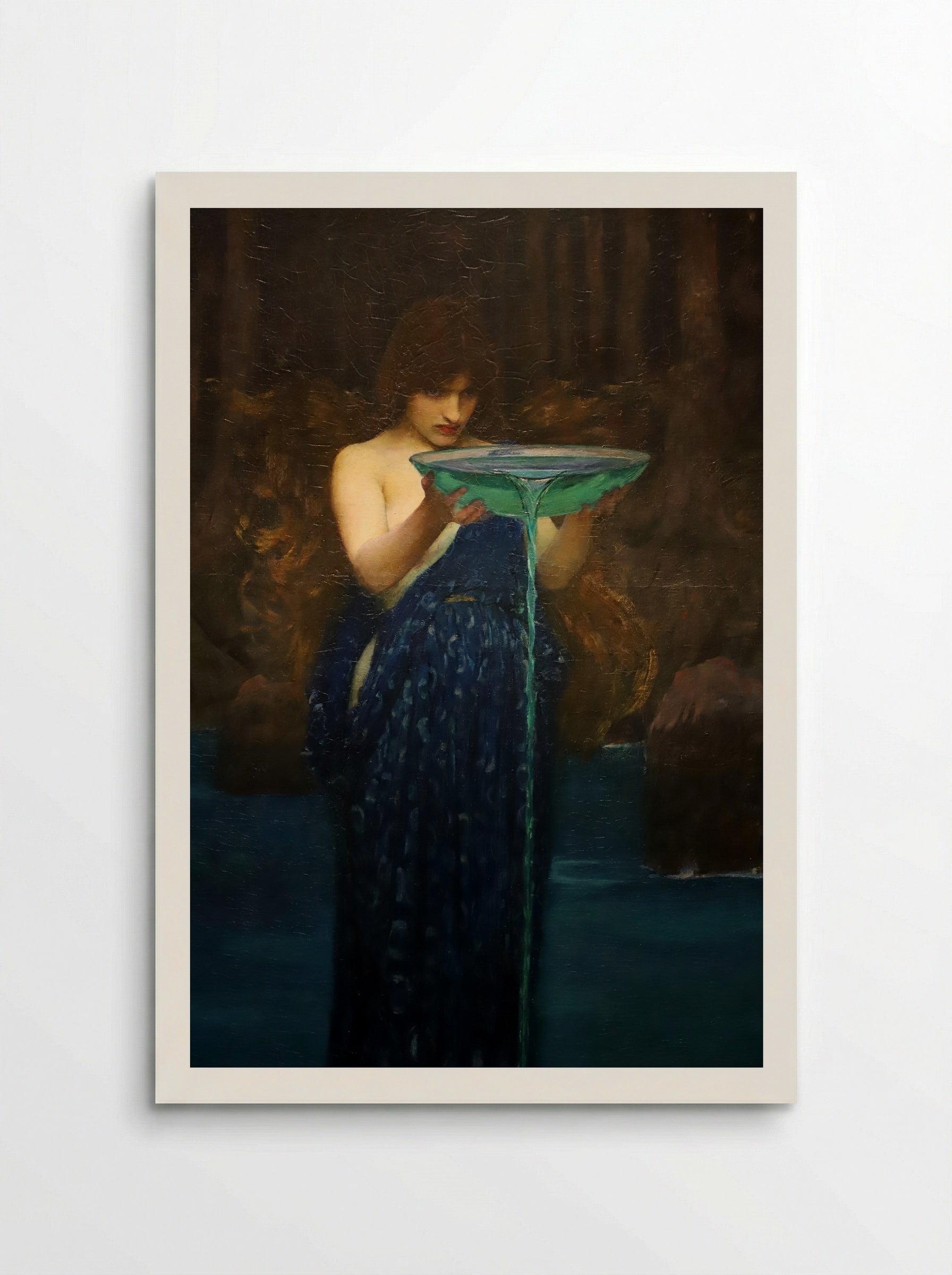
Circe Invidiosa - John William Waterhouse
Archival giclée
Frames arrive ready to hang
Secure checkout
Made to order
Description
A 1892 oil painting by John William Waterhouse depicting the sorceress Circe pouring a potion into the sea.
Circe Invidiosa, painted by John William Waterhouse in 1892, depicts the sorceress from Homer's Odyssey. The subject stands knee-deep in water, pouring a potion into the sea to transform her rival, Scylla, into a sea monster. This work is part of a series of paintings by Waterhouse exploring the character of Circe, a figure who frequently appeared in late nineteenth-century art. The composition focuses on the figure of Circe, whose expression is one of cold determination. She wears a deep blue robe that contrasts with the luminous green of the liquid spilling from her bowl. The background is dark and indistinct, suggesting a secluded, watery environment. Waterhouse employs a controlled colour palette, using the emerald green of the potion to draw the eye toward the centre of the frame. The light catches the surface of the water and the fabric of her dress, creating a sense of volume and texture. Waterhouse was associated with the later phase of the Pre-Raphaelite movement, often drawing inspiration from classical mythology and literature. His approach to this subject avoids the more decorative tendencies of his contemporaries, opting instead for a psychological portrayal of the sorceress. The painting is currently held in the collection of the Art Gallery of South Australia. This museum-grade print captures the subtle tonal shifts and the specific quality of light that defines the original oil painting, providing a clear view of the brushwork and the atmospheric depth of the scene.
Return policy
Because every print is made to order, we don't offer change-of-mind returns, refunds or exchanges. If your order arrives faulty, damaged or incorrect, we'll replace it free of charge — just contact us within 48 hours of delivery. See our refunds page for full details.
Shipping
We ship worldwide, printing at the production hub nearest to your delivery address. Delivery times and costs vary by destination — you'll see the options available to you at checkout.
Manufacturing
Each print is produced to order using 12-colour giclée printing on FSC-certified archival paper. Designed in Britain and printed at your nearest production hub to reduce waste and speed up delivery.
Care and materials
Specific Features
Every Solis piece is made to order with archival, gallery-quality materials built to last.
- Museum-grade giclée printing for rich, fade-resistant colour
- Archival matte fine-art paper, FSC-certified
- Multiple sizes and framing options available
- Frames in black, natural wood, dark wood or white
- Framed prints arrive ready to hang
Care & Cleaning
To keep your artwork looking its best:
- Dust gently with a soft, dry cloth
- Avoid prolonged direct sunlight
- Never use liquid cleaners on the print or canvas surface
- Keep in a dry, room-temperature space
- Handle prints with clean, dry hands
Materials & Sizing
Museum-grade giclée on FSC-certified archival matte paper, with framed and canvas options.
- Paper sizes: A4, A3, A2, A1, A0 and B2 (50×70 cm)
- Canvas: XS (20×30 cm) to Large (60×90 cm)
- Frames: black, natural wood, dark wood or white
Circe Invidiosa - John William Waterhouse
The Artwork
Circe Invidiosa
Our guide to the original work behind this print.

Artist Biography
John William Waterhouse
He was born in Rome to English parents (both painters) and grew up surrounded by Italian art before moving to London as a child. He studied at the Royal Academy Schools and exhibited there from 1874 until his death in 1917. He was a Royal Academician, successful, respected, and thoroughly Victorian.
His technique is Pre-Raphaelite in spirit but Impressionist in handling. The early works are tighter, more archaeological, influenced by Alma-Tadema's classical scenes. The later paintings are looser, with broader brushwork and richer colour. The Lady of Shalott (1888) combines both: precise detail in the boat and tapestry, atmospheric softness in the trees and water.
He painted several versions of the same subjects. Two versions of The Lady of Shalott. Two of Ophelia. Multiple paintings of Circe. He returned to the same stories because the stories gave him what he needed: a beautiful woman in a dramatic landscape at a moment of transformation. The formula was reliable and the execution was consistently good.
He is sometimes grouped with the Pre-Raphaelites but was a generation younger than Rossetti, Millais, and Hunt. He was closer to the Aesthetic Movement and to late Victorian narrative painting. He is one of the most reproduced painters in the history of art prints, which would have pleased him.
Why Choose Us ?
Damage-free delivery guarantee
Fast Shipping
Museum-Quality Materials
You May Also Like