

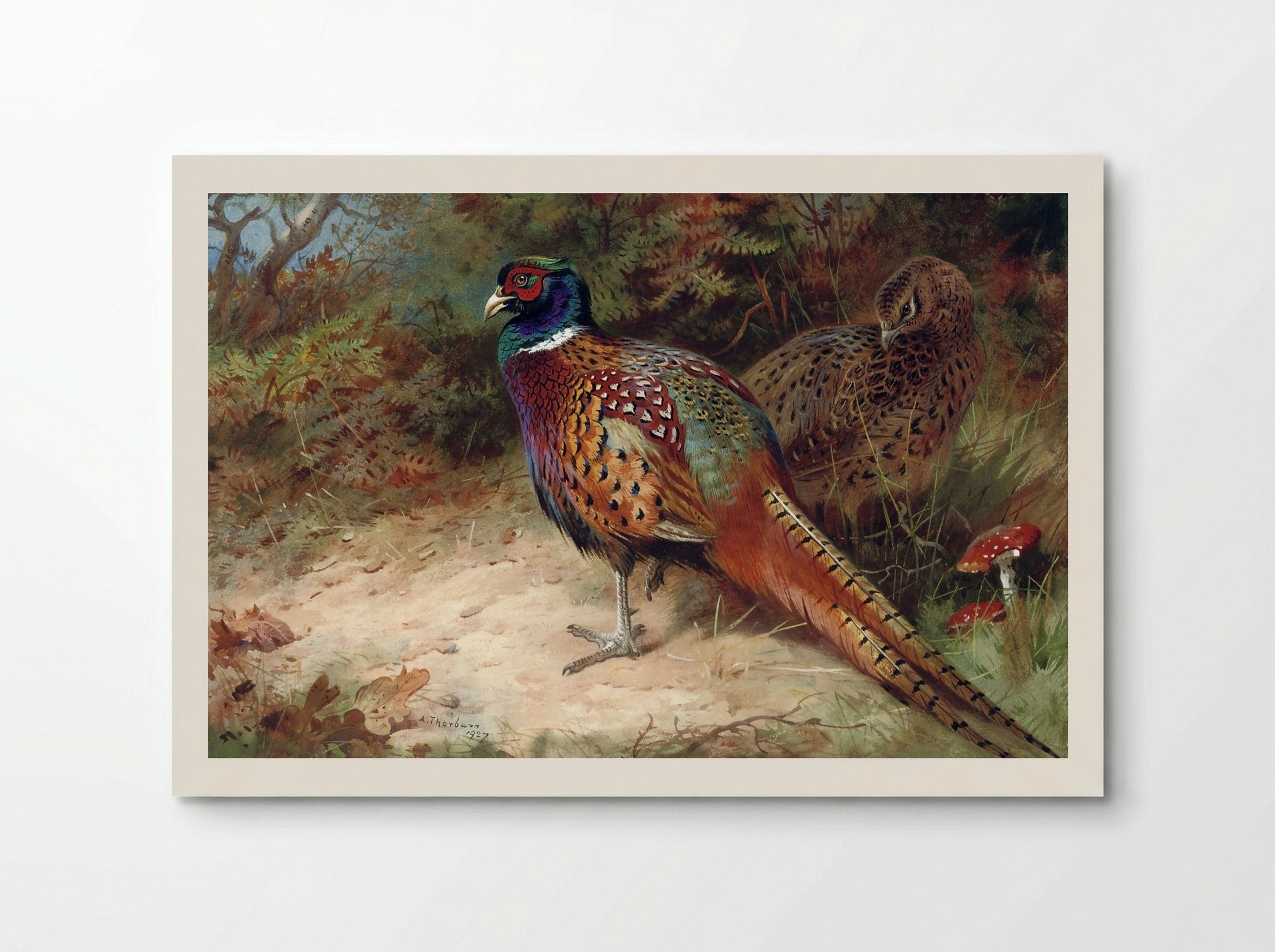
Cock and hen pheasant in the undergrowth - Archibald Thorburn
Archival giclée
Frames arrive ready to hang
Secure checkout
Made to order
Description
A detailed 1927 watercolour by Archibald Thorburn depicting a cock and hen pheasant within a natural woodland setting.
Archibald Thorburn, a Scottish artist known for his precise depictions of British wildlife, produced this watercolour in 1927. The composition features a male common pheasant in the foreground, displaying the characteristic iridescent plumage of the species. Beside him, a female pheasant remains partially obscured by the surrounding foliage, demonstrating the natural camouflage of her mottled brown feathers. Thorburn demonstrates his technical proficiency through the careful application of watercolour, layering pigments to capture the texture of the birds' feathers and the varied vegetation of the woodland floor. The background consists of ferns and autumnal undergrowth, rendered with a focus on botanical accuracy that aligns with the artist's long career as a natural history illustrator. The inclusion of fly agaric mushrooms in the lower right corner provides a specific environmental context, grounding the subjects within a realistic habitat. Unlike many of his contemporaries who favoured dramatic or anthropomorphic portrayals of animals, Thorburn maintained a disciplined approach to observation. His work often appeared in ornithological publications and books, where clarity and anatomical correctness were required. This piece reflects his ability to balance scientific detail with a composed, painterly aesthetic. The lighting is soft, suggesting a woodland setting during the day, which allows the colours of the cock pheasant to remain the primary focus of the viewer's attention. The work remains a representative example of early twentieth-century British wildlife art, documenting the species with a level of fidelity that continues to inform modern naturalists and collectors alike.
Return policy
Because every print is made to order, we don't offer change-of-mind returns, refunds or exchanges. If your order arrives faulty, damaged or incorrect, we'll replace it free of charge — just contact us within 48 hours of delivery. See our refunds page for full details.
Shipping
We ship worldwide, printing at the production hub nearest to your delivery address. Delivery times and costs vary by destination — you'll see the options available to you at checkout.
Manufacturing
Each print is produced to order using 12-colour giclée printing on FSC-certified archival paper. Designed in Britain and printed at your nearest production hub to reduce waste and speed up delivery.
Care and materials
Specific Features
Every Solis piece is made to order with archival, gallery-quality materials built to last.
- Museum-grade giclée printing for rich, fade-resistant colour
- Archival matte fine-art paper, FSC-certified
- Multiple sizes and framing options available
- Frames in black, natural wood, dark wood or white
- Framed prints arrive ready to hang
Care & Cleaning
To keep your artwork looking its best:
- Dust gently with a soft, dry cloth
- Avoid prolonged direct sunlight
- Never use liquid cleaners on the print or canvas surface
- Keep in a dry, room-temperature space
- Handle prints with clean, dry hands
Materials & Sizing
Museum-grade giclée on FSC-certified archival matte paper, with framed and canvas options.
- Paper sizes: A4, A3, A2, A1, A0 and B2 (50×70 cm)
- Canvas: XS (20×30 cm) to Large (60×90 cm)
- Frames: black, natural wood, dark wood or white
Cock and hen pheasant in the undergrowth - Archibald Thorburn

Artist Biography
Archibald Thorburn
He began as a sportsman, attending shooting parties at Sandringham and sketching the birds he helped kill. Sometime before the turn of the century he wounded a hare and heard it scream. He hung up his gun permanently and spent the rest of his career painting the wildlife he had previously hunted. The shift from sportsman to conservationist is the central event of his life, though he rarely discussed it publicly.
He worked almost exclusively in watercolour, deeming oils too heavy and lifeless for the task of rendering a bird in its habitat. He enhanced his watercolours with tempera and Chinese white, achieving a luminosity that made the feathers glow. Each painting is a field study: the bird is anatomically correct, the vegetation is botanically identifiable, and the light belongs to a specific time of day in a specific season. His favourite haunt was the Forest of Gaick near Kingussie in the Scottish Highlands, where he first saw ptarmigan in 1883.
In his last years he refused electric lighting in his studio, preferring natural light and candles. He illustrated several editions of Swaysland's Familiar Wild Birds, produced Christmas cards that sold in enormous quantities, and became the most commercially successful wildlife painter in British history.
He taught Otto Murray Dixon and Philip Rickman, and when the young Donald Watson visited him in Dumfries and Galloway, Thorburn encouraged him to continue. The tradition of British bird painting runs through his studio.
Why Choose Us ?
Damage-free delivery guarantee
Fast Shipping
Museum-Quality Materials
You May Also Like