

Fine Art Poster
From $39
A giclée print on 200gsm matte fine art paper, using a twelve-colour process for accurate, fade-resistant colour. Supplied unframed, delivered flat or rolled.



Archival giclée
Frames arrive ready to hang
Secure checkout
Made to order
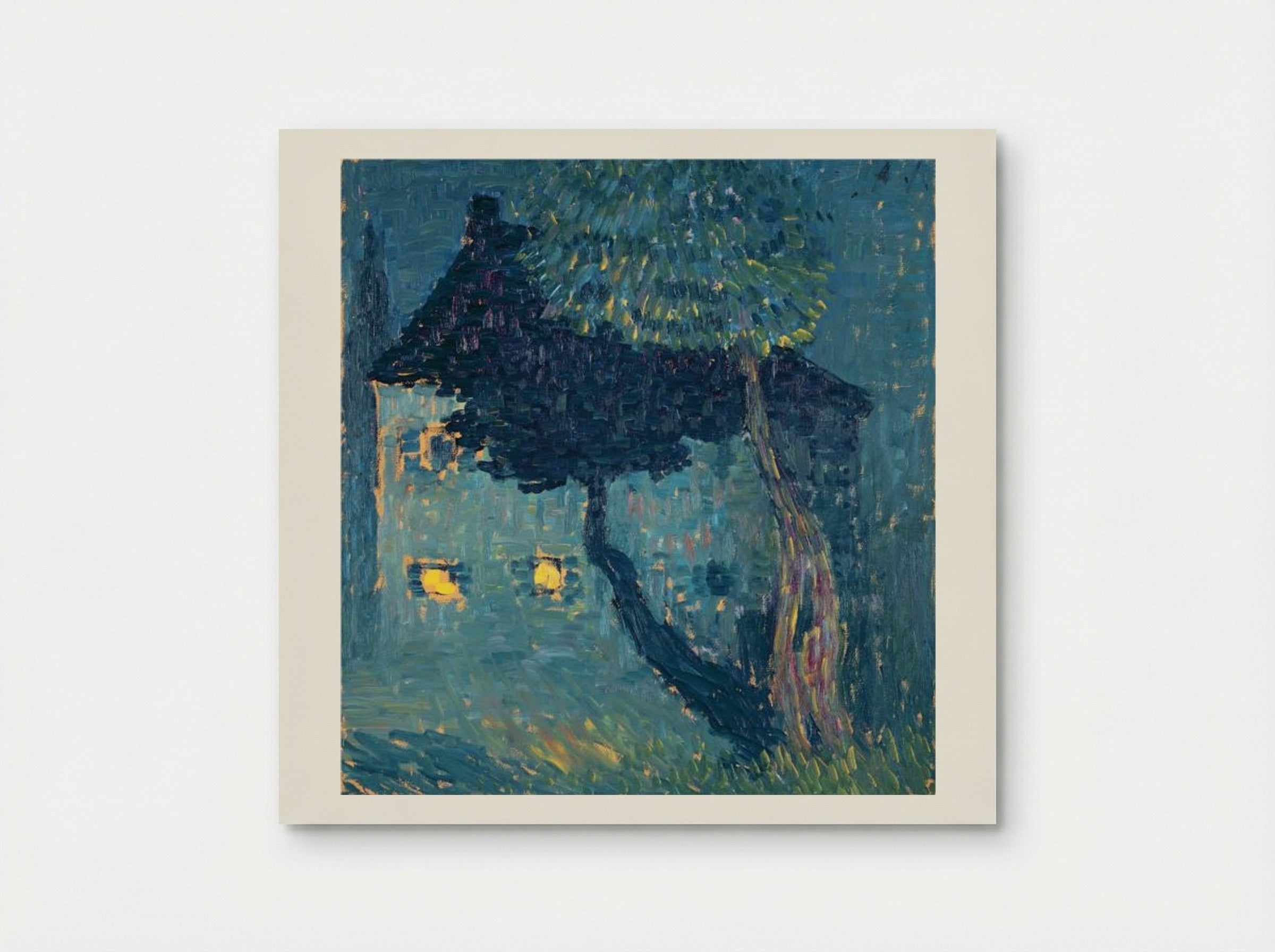
A nocturnal landscape by Alexej von Jawlensky, 'Cottage in the Woods' features a small house illuminated against a dark, expressive background of blues and greens.
Alexej von Jawlensky, a Russian Expressionist painter active in Germany, is known for his intense, spiritual portraits and landscapes. His work often explores colour and form to convey emotion and inner states. Jawlensky's style evolved from representational to more abstract forms, influenced by artists like Matisse and the Fauves. He was a member of the Neue Künstlervereinigung München (New Artists' Association of Munich) and later Der Blaue Reiter (The Blue Rider), groups that championed avant-garde art in Germany. 'Cottage in the Woods' presents a nocturnal scene dominated by cool blues and greens. A small cottage is partially obscured by a large tree, its windows glowing with warm yellow light, creating a contrast against the surrounding darkness. The brushwork is visible and expressive, with short, thick strokes building up the forms. The composition is simple, focusing on the interplay between light and shadow, and the relationship between the natural and the man-made. The overall mood is one of quiet solitude and mystery.
Because every print is made to order, we don't offer change-of-mind returns, refunds or exchanges. If your order arrives faulty, damaged or incorrect, we'll replace it free of charge — just contact us within 48 hours of delivery. See our refunds page for full details.
We ship worldwide, printing at the production hub nearest to your delivery address. Delivery times and costs vary by destination — you'll see the options available to you at checkout.
Each print is produced to order using 12-colour giclée printing on FSC-certified archival paper. Designed in Britain and printed at your nearest production hub to reduce waste and speed up delivery.
Specific Features
Every Solis piece is made to order with archival, gallery-quality materials built to last.
Care & Cleaning
To keep your artwork looking its best:
Materials & Sizing
Museum-grade giclée on FSC-certified archival matte paper, with framed and canvas options.

Artist Biography
Made to order
Every piece is printed to order. These are the five finishes, and what makes each one different.
From $39
A giclée print on 200gsm matte fine art paper, using a twelve-colour process for accurate, fade-resistant colour. Supplied unframed, delivered flat or rolled.

From $119
The same fine art print in a solid wood frame with UV-protective acrylic glaze and rigid backing. Five frame colours. Arrives ready to hang.

From $189
A deeper solid wood frame: 33mm deep with a 20mm face and Perspex glaze. The print sits unmounted for a clean gallery presentation. Black, white or natural.

From $59
Hand-stretched canvas with neat gallery-wrapped edges, giving the artwork surface texture and depth. Arrives ready to hang.

From $175
Stretched canvas set in a floating wood frame, our most substantial finish. Arrives ready to hang.
Why Choose Us ?
Damage-free delivery guarantee
Fast Shipping
Museum-Quality Materials
You May Also Like
We use cookies to measure our marketing and see which prints people love.We use cookies to measure our marketing.
By continuing to browse, you agree · Privacy Policy