

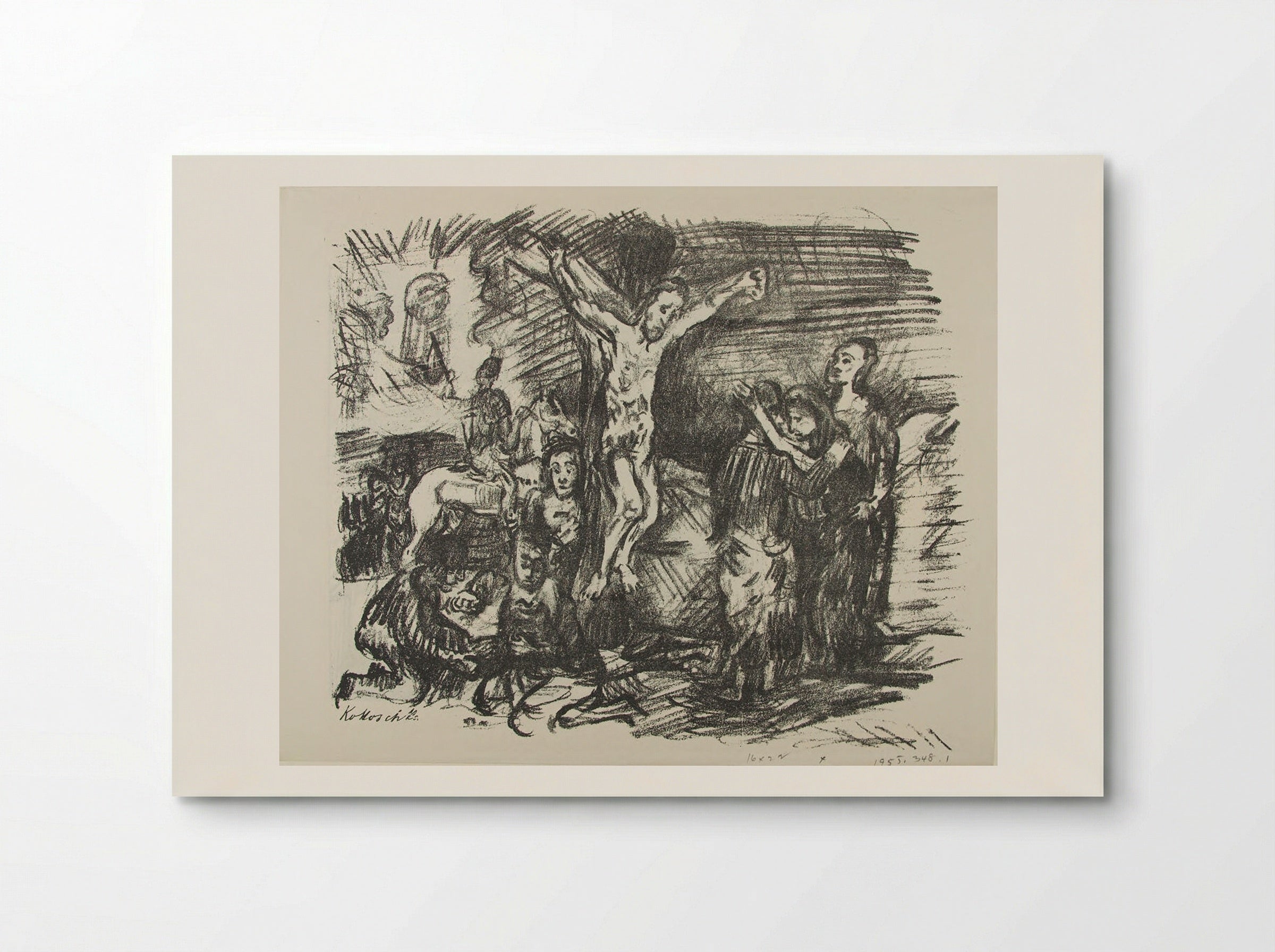
Crucifixion, from Der Bildermann - Oskar Kokoschka
Archival giclée
Frames arrive ready to hang
Secure checkout
Made to order
Description
A powerful 1915 lithograph by Oskar Kokoschka, capturing the raw emotional intensity of the Crucifixion through gestural, expressive lines.
This lithograph by Oskar Kokoschka, published in the periodical Der Bildermann on 20 September 1915, captures the raw emotional intensity characteristic of the artist's early twentieth-century work. During this period, Kokoschka moved away from the decorative tendencies of the Vienna Secession, favouring a more visceral and psychological approach to form. The composition depicts the central figure of Christ on the cross, surrounded by mourning figures whose distorted features and agitated postures convey a sense of collective grief. Kokoschka utilises a frenetic, calligraphic line quality to construct the scene. The figures appear to emerge from a dark, turbulent background, with the artist employing heavy, gestural marks to create a sense of atmospheric pressure. The lack of traditional perspective forces the viewer to focus on the immediate, raw interaction between the figures, rather than the spatial environment. This work reflects the broader European preoccupation with themes of suffering and mortality during the First World War, a period in which Kokoschka served as an officer in the Austro-Hungarian army. The lithographic process allows for a texture that mimics charcoal or crayon, providing a tactile quality to the print. The stark contrast between the light-toned paper and the dense, dark ink creates a dramatic visual tension. By stripping away extraneous detail, Kokoschka directs attention to the expressive potential of the human form. This print is an example of the artist's ability to transform traditional religious iconography into a vehicle for modern existential anxiety. It remains a significant piece for those interested in the development of Expressionist printmaking and the intersection of personal trauma with historical subject matter.
Return policy
Because every print is made to order, we don't offer change-of-mind returns, refunds or exchanges. If your order arrives faulty, damaged or incorrect, we'll replace it free of charge — just contact us within 48 hours of delivery. See our refunds page for full details.
Shipping
We ship worldwide, printing at the production hub nearest to your delivery address. Delivery times and costs vary by destination — you'll see the options available to you at checkout.
Manufacturing
Each print is produced to order using 12-colour giclée printing on FSC-certified archival paper. Designed in Britain and printed at your nearest production hub to reduce waste and speed up delivery.
Crucifixion, from Der Bildermann - Oskar Kokoschka

Artist Biography
Oskar Kokoschka
He was born in 1886 in Pochlarn, Austria. He was shot through the head in Ukraine and bayoneted in the chest in Russia. He survived both.
After the war, he commissioned a Munich dollmaker named Hermine Moos to create a life-size replica of Alma, sending detailed instructions about the feel of her skin and the weight of her body. Moos covered the figure in feathers instead. Kokoschka eventually staged a public execution: he decapitated the doll and smashed a bottle of wine over its head on his lawn. The police arrived the next morning, thinking he had murdered a woman.
The Nazis declared him a degenerate artist. He fled Czechoslovakia for London after the Munich Agreement and became a British citizen in 1947. His Expressionist portraits are among the most psychologically penetrating of the twentieth century: raw, agitated surfaces that seem to expose the sitter's interior state. He lived to ninety-four.
Our Features
Designed for Lasting Impact
Specific Features
Every Solis piece is made to order with archival, gallery-quality materials built to last.
- Museum-grade giclée printing for rich, fade-resistant colour
- Archival matte fine-art paper, FSC-certified
- Multiple sizes and framing options available
- Frames in black, natural wood, dark wood or white
- Framed prints arrive ready to hang
Care & Cleaning
To keep your artwork looking its best:
- Dust gently with a soft, dry cloth
- Avoid prolonged direct sunlight
- Never use liquid cleaners on the print or canvas surface
- Keep in a dry, room-temperature space
- Handle prints with clean, dry hands
Materials & Sizing
Museum-grade giclée on FSC-certified archival matte paper, with framed and canvas options.
- Paper sizes: A4, A3, A2, A1, A0 and B2 (50×70 cm)
- Canvas: XS (20×30 cm) to Large (60×90 cm)
- Frames: black, natural wood, dark wood or white
Why Choose Us ?
Damage-free delivery guarantee
Fast Shipping
Museum-Quality Materials
Artist Biography
Oskar Kokoschka
He was born in 1886 in Pochlarn, Austria. He was shot through the head in Ukraine and bayoneted in the chest in Russia. He survived both.
After the war, he commissioned a Munich dollmaker named Hermine Moos to create a life-size replica of Alma, sending detailed instructions about the feel of her skin and the weight of her body. Moos covered the figure in feathers instead. Kokoschka eventually staged a public execution: he decapitated the doll and smashed a bottle of wine over its head on his lawn. The police arrived the next morning, thinking he had murdered a woman.
The Nazis declared him a degenerate artist. He fled Czechoslovakia for London after the Munich Agreement and became a British citizen in 1947. His Expressionist portraits are among the most psychologically penetrating of the twentieth century: raw, agitated surfaces that seem to expose the sitter's interior state. He lived to ninety-four.
You May Also Like