

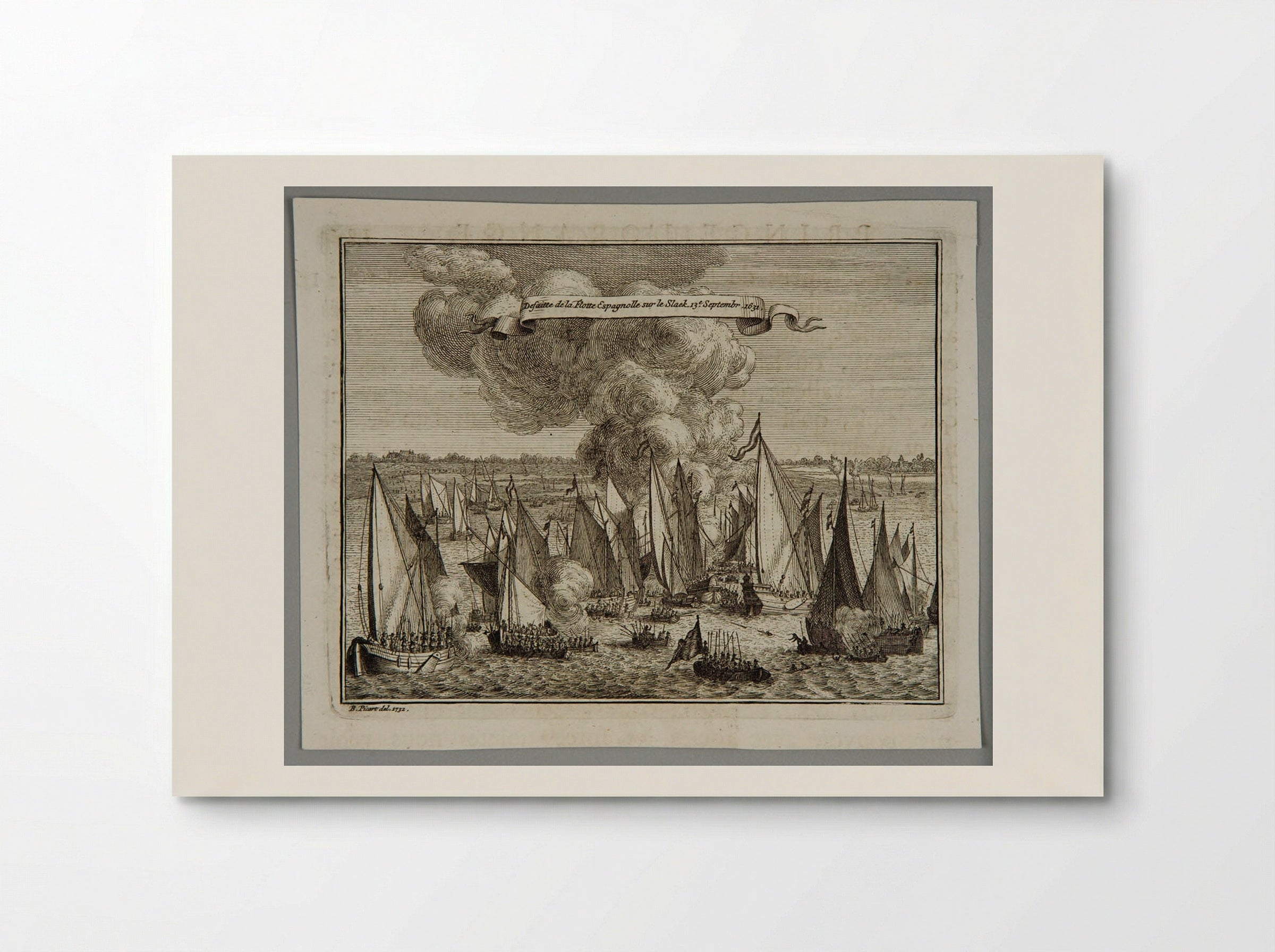
Defeat of the Spanish Fleet on the River Slack, September 13, 1631 - Bernard Picart
Archival giclée
Frames arrive ready to hang
Secure checkout
Made to order
Description
A detailed historical etching by Bernard Picart depicting the 1631 naval Battle of the Slaak, rendered with precise line work and atmospheric detail.
This detailed etching by Bernard Picart depicts the naval engagement known as the Battle of the Slaak, which occurred on 13 September 1631. As a prominent engraver active in the early eighteenth century, Picart produced this work as part of a larger historical series documenting significant events in European history. The composition captures the chaos of the conflict, with numerous Dutch and Spanish vessels engaged in close-quarters combat upon the water. Picart employs precise line work to delineate the rigging, sails, and hulls of the various ships. A large, billowing cloud of smoke dominates the upper centre of the frame, providing a sense of the intensity of the artillery fire. The artist uses varied hatching techniques to suggest the texture of the water and the atmospheric conditions of the day. A cartouche at the top of the print provides the title in French, framed by decorative scrolls that reflect the aesthetic sensibilities of the period. The lower left corner bears the artist's signature and the date of the print's creation, 1732, indicating that this work was produced a century after the actual event took place. This print serves as a record of maritime warfare during the Eighty Years' War. The focus on the arrangement of the fleet and the specific tactical positioning of the ships demonstrates the interest in military history that characterised much of the era's illustrative output. The work is executed with a clarity typical of Picart's style, ensuring that the viewer can distinguish the individual vessels despite the crowded nature of the scene. It remains a fine example of the technical skill involved in eighteenth-century printmaking, where historical narratives were translated into visual form for a wider audience of collectors and scholars.
Return policy
Because every print is made to order, we don't offer change-of-mind returns, refunds or exchanges. If your order arrives faulty, damaged or incorrect, we'll replace it free of charge — just contact us within 48 hours of delivery. See our refunds page for full details.
Shipping
We ship worldwide, printing at the production hub nearest to your delivery address. Delivery times and costs vary by destination — you'll see the options available to you at checkout.
Manufacturing
Each print is produced to order using 12-colour giclée printing on FSC-certified archival paper. Designed in Britain and printed at your nearest production hub to reduce waste and speed up delivery.
Care and materials
Specific Features
Every Solis piece is made to order with archival, gallery-quality materials built to last.
- Museum-grade giclée printing for rich, fade-resistant colour
- Archival matte fine-art paper, FSC-certified
- Multiple sizes and framing options available
- Frames in black, natural wood, dark wood or white
- Framed prints arrive ready to hang
Care & Cleaning
To keep your artwork looking its best:
- Dust gently with a soft, dry cloth
- Avoid prolonged direct sunlight
- Never use liquid cleaners on the print or canvas surface
- Keep in a dry, room-temperature space
- Handle prints with clean, dry hands
Materials & Sizing
Museum-grade giclée on FSC-certified archival matte paper, with framed and canvas options.
- Paper sizes: A4, A3, A2, A1, A0 and B2 (50×70 cm)
- Canvas: XS (20×30 cm) to Large (60×90 cm)
- Frames: black, natural wood, dark wood or white
Defeat of the Spanish Fleet on the River Slack, September 13, 1631 - Bernard Picart

Artist Biography
Bernard Picart
His work focuses on precise linework and mythological subjects. Picart moved away from the heavy styles of the previous century. He preferred clarity and proportion in his compositions. His etchings, such as "Althaea Putting the Fatal Log on the Fire" or his studies of antique gems, show a controlled hand. He often used vignettes and ornaments, including skulls and griffins, to frame larger narratives or to stand as independent decorative elements.
Modern collectors value Picart for his balance of classical themes and clean graphic sensibility. His prints work well in contemporary spaces because they offer historical depth without visual clutter. The monochrome compositions provide a sharp contrast for minimalist or traditional interiors. His focus on symbolic ornaments like the two-headed eagle or Mercury makes his work feel like a curated collection of curiosities for the home.
Why Choose Us ?
Damage-free delivery guarantee
Fast Shipping
Museum-Quality Materials
You May Also Like