

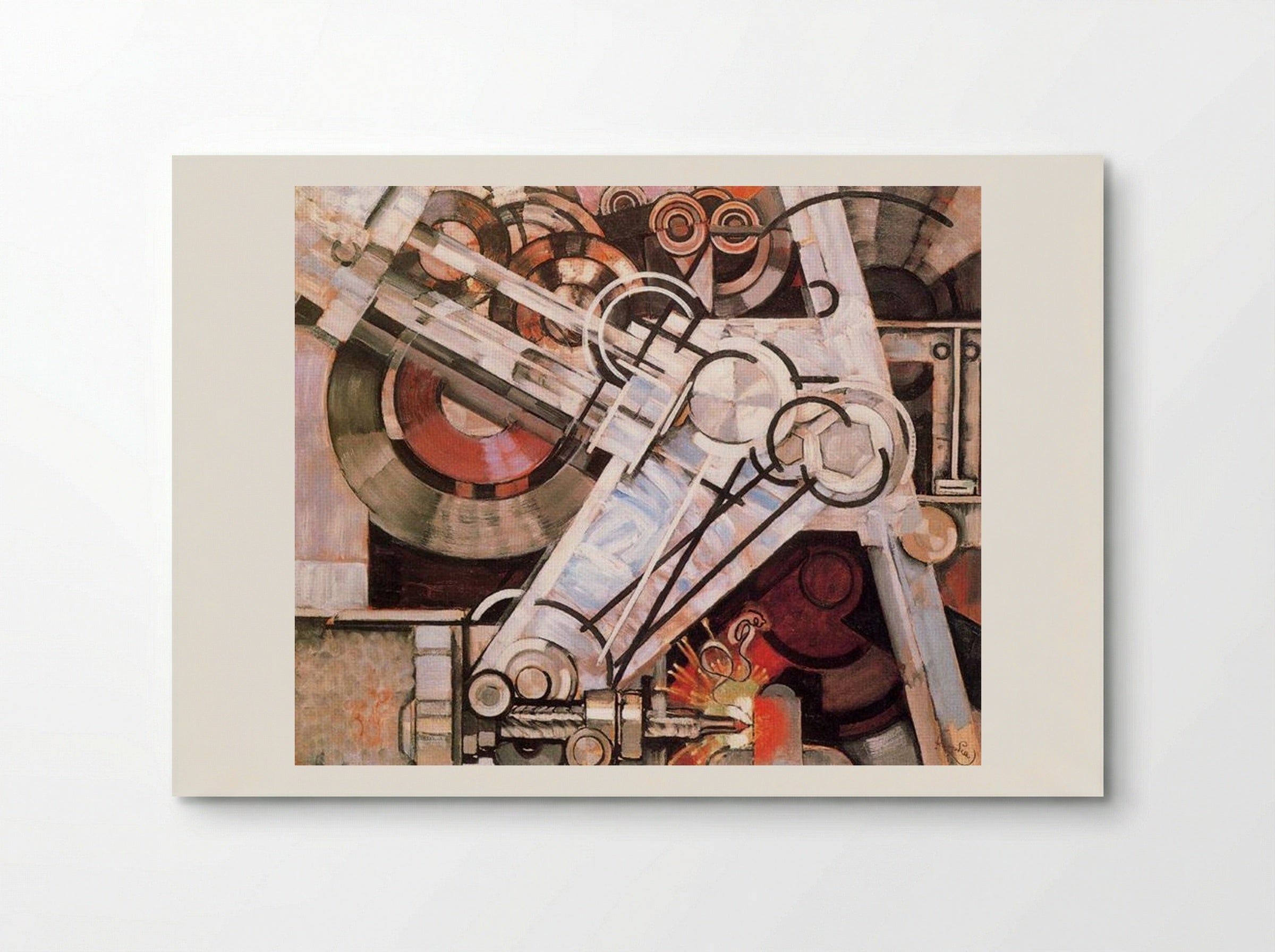
Drill - František Kupka
Archival giclée
Ready to hang
Secure checkout
Made to order
Description
A study of mechanical form and motion, this work by František Kupka deconstructs an industrial drill into rhythmic geometric planes and lines.
František Kupka, a pioneer of abstract art, produced this work during a period when his interest shifted towards the mechanical and industrial. In Drill, the artist deconstructs the physical form of a machine into a series of geometric planes, circular rhythms, and intersecting lines. The composition focuses on the functional components of the drill, yet it avoids a purely representational approach. Instead, Kupka prioritises the visual energy of the mechanical process. The painting reflects the early twentieth-century fascination with technology and the speed of the modern era. Kupka employs a palette of muted greys, browns, and metallic tones, punctuated by small, intense bursts of colour that suggest the heat and friction of the drilling action. The overlapping shapes create a sense of depth, while the repetitive circular motifs evoke the constant rotation of the machinery. By breaking down the object into its constituent parts, the artist invites the viewer to consider the rhythm and structure inherent in industrial tools. Kupka was deeply involved in the development of abstract painting in Paris, often moving between figurative roots and pure abstraction. This work sits at a point of transition, where the subject remains recognisable but is treated with the formal rigour of an abstract composition. The precision of the lines and the calculated placement of the geometric elements demonstrate his analytical approach to painting. Rather than capturing a static image, the work conveys the kinetic potential of the machine. It is a study of form, movement, and the intersection of human invention with geometric order. The work remains a clear example of how the artist applied his theories of colour and motion to the subject of industrial technology, creating a visual language that balances mechanical reality with artistic abstraction.
Return policy
Because every print is made to order, we don't offer change-of-mind returns, refunds or exchanges. If your order arrives faulty, damaged or incorrect, we'll replace it free of charge — just contact us within 48 hours of delivery. EU customers have a 14-day cooling-off right. See our refunds page for full details.
Shipping
We ship worldwide, printing at the production hub nearest to your delivery address. Delivery times and costs vary by destination — you'll see the options available to you at checkout.
Manufacturing
Each print is produced to order using 12-colour giclée printing on FSC-certified archival paper. Designed in Britain and printed at your nearest production hub to reduce waste and speed up delivery.
Drill - František Kupka
Our Features
Designed for Lasting Impact
Specific Features
Every Solis piece is made to order with archival, gallery-quality materials built to last.
- Museum-grade giclée printing for rich, fade-resistant colour
- Archival matte fine-art paper, FSC-certified
- Choose poster, framed print, canvas or framed canvas
- Frames in black, natural wood, dark wood or white
- Framed prints arrive ready to hang
Care & Cleaning
To keep your artwork looking its best:
- Dust gently with a soft, dry cloth
- Avoid prolonged direct sunlight
- Never use liquid cleaners on the print or canvas surface
- Keep in a dry, room-temperature space
- Handle prints with clean, dry hands
Materials & Sizing
Museum-grade giclée on FSC-certified archival matte paper, with framed and canvas options.
- Paper sizes: A4, A3, A2, A1, A0 and B2 (50×70 cm)
- Canvas: XS (20×30 cm) to Large (60×90 cm)
- Frames: black, natural wood, dark wood or white
Why Choose Us ?
100% Satisfaction Guarantee
Fast Shipping
Museum-Quality Materials

Artist Biography
František Kupka
Kupka's artistic approach involved a synthesis of Symbolism and abstraction, evident in works such as "Danse Macabre" and "Ballad of Epona". He sought to capture movement and energy through colour and form, often drawing inspiration from music and mathematics. His Orphist style, characterised by its use of vibrant colours and geometric shapes, aimed to evoke spiritual and emotional responses in the viewer, rather than depicting the external world.
Today, Kupka's art appeals to collectors seeking pieces that bridge the gap between historical movements and contemporary sensibilities. His works offer a unique combination of intellectual depth and visual appeal, making them a compelling addition to modern collections. The enduring quality of Kupka's vision lies in his ability to transform complex ideas into visually arresting compositions.
You May Also Like