

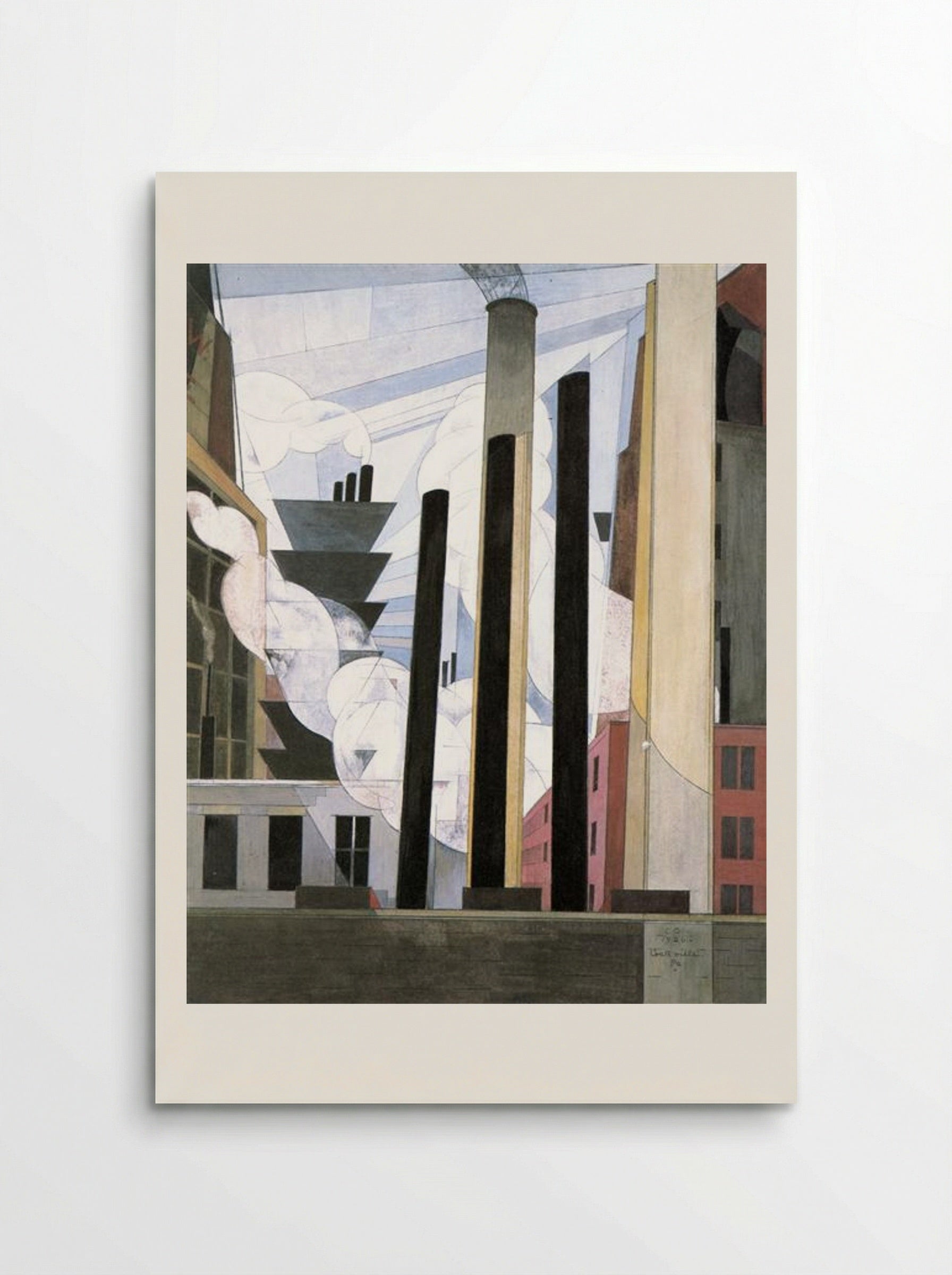
End of the Parade, Coatesville, Pa. - Charles Demuth
Archival giclée
Frames arrive ready to hang
Secure checkout
Made to order
Description
Charles Demuth's "End of the Parade, Coatesville, Pa." is a Precisionist painting from 1920, depicting the industrial architecture of Coatesville, Pennsylvania, with geometric forms and a muted colour palette.
Charles Demuth's 1920 painting, "End of the Parade, Coatesville, Pa.", exemplifies Precisionism, an American art movement that emerged after World War I. Precisionist artists depicted industrial and urban subjects with sharp, geometric forms and a sense of order. Demuth, along with artists like Charles Sheeler and Georgia O'Keeffe, sought to capture the beauty and dynamism of the modern American landscape. This work portrays the industrial architecture of Coatesville, Pennsylvania, Demuth's birthplace. The composition features a series of towering smokestacks and factory buildings rendered in a simplified, almost abstract style. The artist uses a muted colour palette of greys, blacks, and whites to convey the industrial atmosphere. The geometric shapes and clean lines create a sense of precision and clarity, reflecting the Precisionist aesthetic. The plumes of smoke rising from the smokestacks add a dynamic element to the otherwise static composition. Demuth's painting offers a visual interpretation of the industrial age, capturing both its grandeur and its potential for alienation.
Return policy
Because every print is made to order, we don't offer change-of-mind returns, refunds or exchanges. If your order arrives faulty, damaged or incorrect, we'll replace it free of charge — just contact us within 48 hours of delivery. See our refunds page for full details.
Shipping
We ship worldwide, printing at the production hub nearest to your delivery address. Delivery times and costs vary by destination — you'll see the options available to you at checkout.
Manufacturing
Each print is produced to order using 12-colour giclée printing on FSC-certified archival paper. Designed in Britain and printed at your nearest production hub to reduce waste and speed up delivery.
Care and materials
Specific Features
Every Solis piece is made to order with archival, gallery-quality materials built to last.
- Museum-grade giclée printing for rich, fade-resistant colour
- Archival matte fine-art paper, FSC-certified
- Multiple sizes and framing options available
- Frames in black, natural wood, dark wood or white
- Framed prints arrive ready to hang
Care & Cleaning
To keep your artwork looking its best:
- Dust gently with a soft, dry cloth
- Avoid prolonged direct sunlight
- Never use liquid cleaners on the print or canvas surface
- Keep in a dry, room-temperature space
- Handle prints with clean, dry hands
Materials & Sizing
Museum-grade giclée on FSC-certified archival matte paper, with framed and canvas options.
- Paper sizes: A4, A3, A2, A1, A0 and B2 (50×70 cm)
- Canvas: XS (20×30 cm) to Large (60×90 cm)
- Frames: black, natural wood, dark wood or white
End of the Parade, Coatesville, Pa. - Charles Demuth

Artist Biography
Charles Demuth
Demuth's art is characterised by its clean lines, geometric forms, and a cool, detached observation of the modern world. He found beauty in the industrial landscape of America, transforming factories, skyscrapers, and bridges into elegant compositions. Works such as 'The Figure 5 in Gold' exemplify his Precisionist style, blending abstract elements with recognisable imagery. His delicate watercolours, often depicting flowers and fruits, reveal a more sensual and intimate side to his artistic practice.
Today, Charles Demuth's art continues to captivate collectors with its timeless elegance and subtle commentary on the machine age. His Precisionist vision paved the way for later movements like Minimalism, and his influence can be seen in the work of contemporary artists who explore the intersection of art and technology. Owning a Demuth print is owning a piece of American modernism.
Why Choose Us ?
Damage-free delivery guarantee
Fast Shipping
Museum-Quality Materials
You May Also Like