

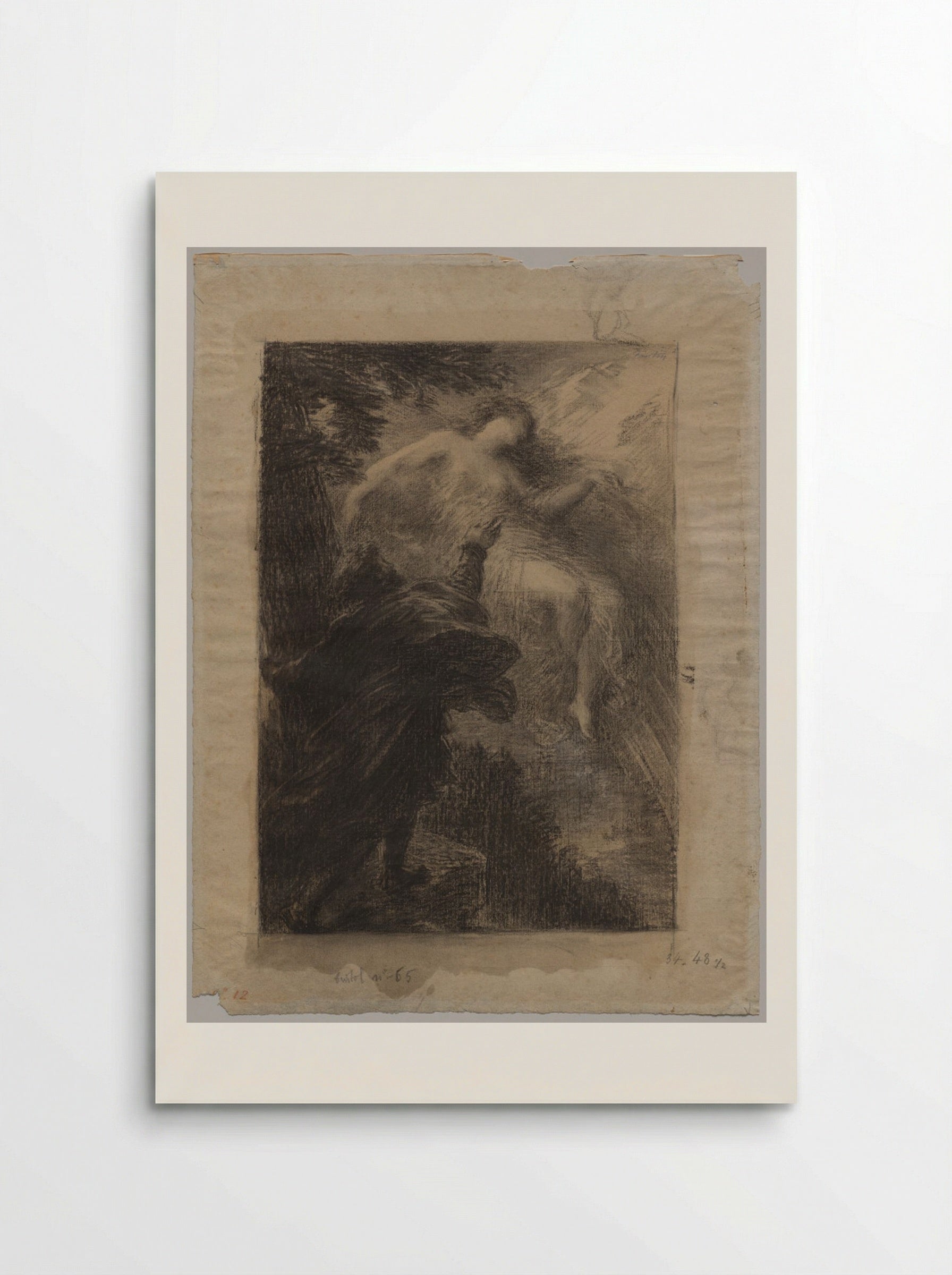
Fairy of the Alps - Henri Fantin-Latour
Archival giclée
Frames arrive ready to hang
Secure checkout
Made to order
Description
A haunting lithograph by Henri Fantin-Latour, capturing a spectral encounter between a cloaked figure and an ethereal spirit.
Henri Fantin-Latour, a French artist known for his technical precision in portraiture and still-life, also produced a significant body of imaginative lithographic work. This piece, Fairy of the Alps, demonstrates his interest in the ethereal and the dreamlike qualities of Symbolism. The composition depicts a cloaked figure reaching towards a luminous, spectral presence, a common motif in his explorations of Wagnerian themes and literary subjects. Fantin-Latour utilised the medium of lithography to achieve soft, atmospheric effects that would be difficult to replicate in other printmaking techniques. The tonal range is muted, relying on subtle gradations of charcoal-like greys to define the contrast between the solid, grounded observer and the intangible, floating figure. The edges of the forms are blurred, suggesting movement and the transient nature of the vision. This approach creates a sense of mystery, drawing the viewer into a narrative that remains ambiguous and open to interpretation. Unlike his more formal oil paintings, these prints reveal a more experimental side of his practice. He often revisited these themes, refining the interplay of light and shadow to evoke a specific mood rather than a literal depiction of a scene. The paper texture and the visible marks of the lithographic stone contribute to the tactile quality of the work, grounding the otherworldly subject in a physical, material reality. This print is a representative example of how Fantin-Latour moved away from the strict realism of his earlier career to embrace the suggestive power of the imagination, a shift that aligned him with the broader Symbolist movement in late nineteenth-century France.
Return policy
Because every print is made to order, we don't offer change-of-mind returns, refunds or exchanges. If your order arrives faulty, damaged or incorrect, we'll replace it free of charge — just contact us within 48 hours of delivery. See our refunds page for full details.
Shipping
We ship worldwide, printing at the production hub nearest to your delivery address. Delivery times and costs vary by destination — you'll see the options available to you at checkout.
Manufacturing
Each print is produced to order using 12-colour giclée printing on FSC-certified archival paper. Designed in Britain and printed at your nearest production hub to reduce waste and speed up delivery.
Care and materials
Specific Features
Every Solis piece is made to order with archival, gallery-quality materials built to last.
- Museum-grade giclée printing for rich, fade-resistant colour
- Archival matte fine-art paper, FSC-certified
- Multiple sizes and framing options available
- Frames in black, natural wood, dark wood or white
- Framed prints arrive ready to hang
Care & Cleaning
To keep your artwork looking its best:
- Dust gently with a soft, dry cloth
- Avoid prolonged direct sunlight
- Never use liquid cleaners on the print or canvas surface
- Keep in a dry, room-temperature space
- Handle prints with clean, dry hands
Materials & Sizing
Museum-grade giclée on FSC-certified archival matte paper, with framed and canvas options.
- Paper sizes: A4, A3, A2, A1, A0 and B2 (50×70 cm)
- Canvas: XS (20×30 cm) to Large (60×90 cm)
- Frames: black, natural wood, dark wood or white
Fairy of the Alps - Henri Fantin-Latour

Artist Biography
Henri Fantin Latour
His flower paintings are the opposite. They are quiet, domestic, technically precise, and painted without any obvious agenda. Roses in a glass bowl. Peonies on a table. He exhibited them in England, where they sold steadily to collectors who had no interest in Parisian literary politics. In France, during his lifetime, the flowers were practically unknown. The irony is that they are what most people now associate with his name.
He trained under Horace Lecoq de Boisbaudran, an unorthodox teacher who had his students draw from memory rather than from the model. His classmates at the Ecole des Beaux-Arts included Degas and Alphonse Legros. He was friends with Manet, Whistler, Morisot and most of the painters who became the Impressionists, but his own style remained conservative: careful drawing, smooth finish, traditional composition. He stood at the centre of the avant-garde and painted like an old master, which is an unusual position to occupy for forty years.
He was also a member of the Jinglar Society, a nine-person dining club devoted to Japanese art and ceramics, which met to eat food off Japanese plates.
Why Choose Us ?
Damage-free delivery guarantee
Fast Shipping
Museum-Quality Materials
You May Also Like