

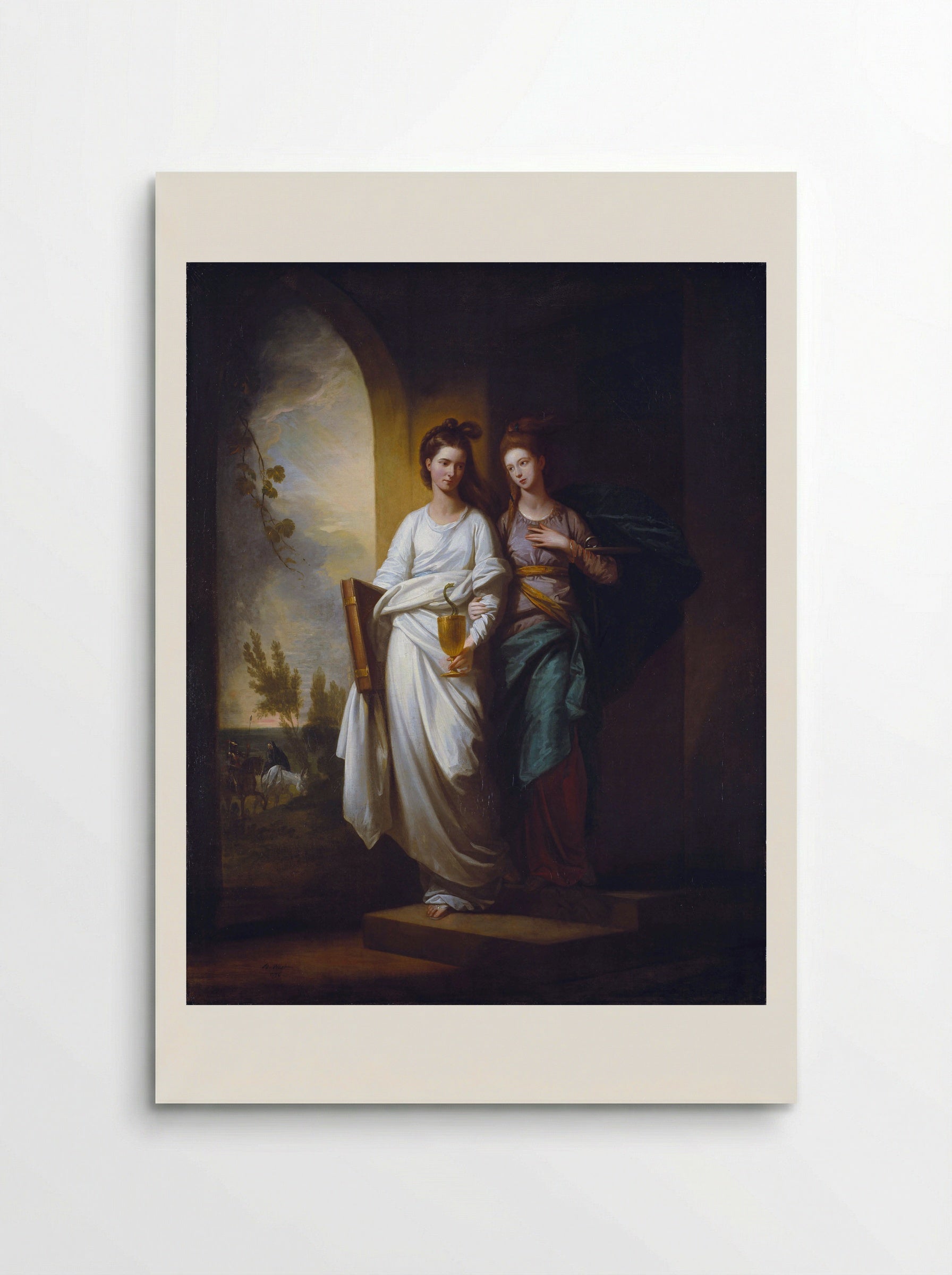
Fidelia and Speranza - Benjamin West
Archival giclée
Frames arrive ready to hang
Secure checkout
Made to order
Description
A Neoclassical allegorical painting by Benjamin West, depicting the figures of Faith and Hope from Edmund Spenser's The Faerie Queene.
Benjamin West, an American painter who spent much of his career in London, produced this allegorical work in 1776. The painting draws its subject matter from Edmund Spenser's epic poem, The Faerie Queene. It depicts two figures, Fidelia and Speranza, who represent the virtues of Faith and Hope respectively. Fidelia is positioned on the left, dressed in white robes and holding a book and a chalice containing a serpent, traditional symbols of her identity. Beside her stands Speranza, whose posture and expression convey a sense of anticipation and trust. The figures are framed within an architectural opening, which provides a transition between the interior space and a distant, atmospheric view of a landscape. West employs a controlled colour palette, using the stark white of Fidelia's garments to draw the eye, while the muted tones of the background and the darker drapery of Speranza provide balance. The lighting is theatrical, casting a soft glow upon the faces of the two women, which creates a sense of quiet contemplation. The composition reflects the influence of classical art, which West studied extensively during his time in Italy and later in England. The painting demonstrates his ability to translate literary themes into visual narratives, a practice common among artists of the late eighteenth century who sought to elevate painting through historical and moral subjects. The work remains a clear example of the Neoclassical interest in allegory and the human form, rendered with the technical precision characteristic of West's mature period.
Return policy
Because every print is made to order, we don't offer change-of-mind returns, refunds or exchanges. If your order arrives faulty, damaged or incorrect, we'll replace it free of charge — just contact us within 48 hours of delivery. See our refunds page for full details.
Shipping
We ship worldwide, printing at the production hub nearest to your delivery address. Delivery times and costs vary by destination — you'll see the options available to you at checkout.
Manufacturing
Each print is produced to order using 12-colour giclée printing on FSC-certified archival paper. Designed in Britain and printed at your nearest production hub to reduce waste and speed up delivery.
Fidelia and Speranza - Benjamin West

Artist Biography
Benjamin West
He was born in Springfield, Pennsylvania, in 1738, a Quaker-raised boy from the colonies who became the second president of the Royal Academy in London, holding the post for twenty-eight years. He arrived in England in 1763 after studying in Italy and quickly gained the patronage of George III, serving as the king's historical painter from 1772 to 1801.
He trained a generation of American painters in London, including Gilbert Stuart, Charles Willson Peale, Samuel Morse and John Trumbull. Each returned to America and shaped the new nation's visual culture. West stayed in London and died there in 1820, at eighty-one.
Our Features
Designed for Lasting Impact
Specific Features
Every Solis piece is made to order with archival, gallery-quality materials built to last.
- Museum-grade giclée printing for rich, fade-resistant colour
- Archival matte fine-art paper, FSC-certified
- Multiple sizes and framing options available
- Frames in black, natural wood, dark wood or white
- Framed prints arrive ready to hang
Care & Cleaning
To keep your artwork looking its best:
- Dust gently with a soft, dry cloth
- Avoid prolonged direct sunlight
- Never use liquid cleaners on the print or canvas surface
- Keep in a dry, room-temperature space
- Handle prints with clean, dry hands
Materials & Sizing
Museum-grade giclée on FSC-certified archival matte paper, with framed and canvas options.
- Paper sizes: A4, A3, A2, A1, A0 and B2 (50×70 cm)
- Canvas: XS (20×30 cm) to Large (60×90 cm)
- Frames: black, natural wood, dark wood or white
Why Choose Us ?
Damage-free delivery guarantee
Fast Shipping
Museum-Quality Materials
Artist Biography
Benjamin West
He was born in Springfield, Pennsylvania, in 1738, a Quaker-raised boy from the colonies who became the second president of the Royal Academy in London, holding the post for twenty-eight years. He arrived in England in 1763 after studying in Italy and quickly gained the patronage of George III, serving as the king's historical painter from 1772 to 1801.
He trained a generation of American painters in London, including Gilbert Stuart, Charles Willson Peale, Samuel Morse and John Trumbull. Each returned to America and shaped the new nation's visual culture. West stayed in London and died there in 1820, at eighty-one.
You May Also Like