

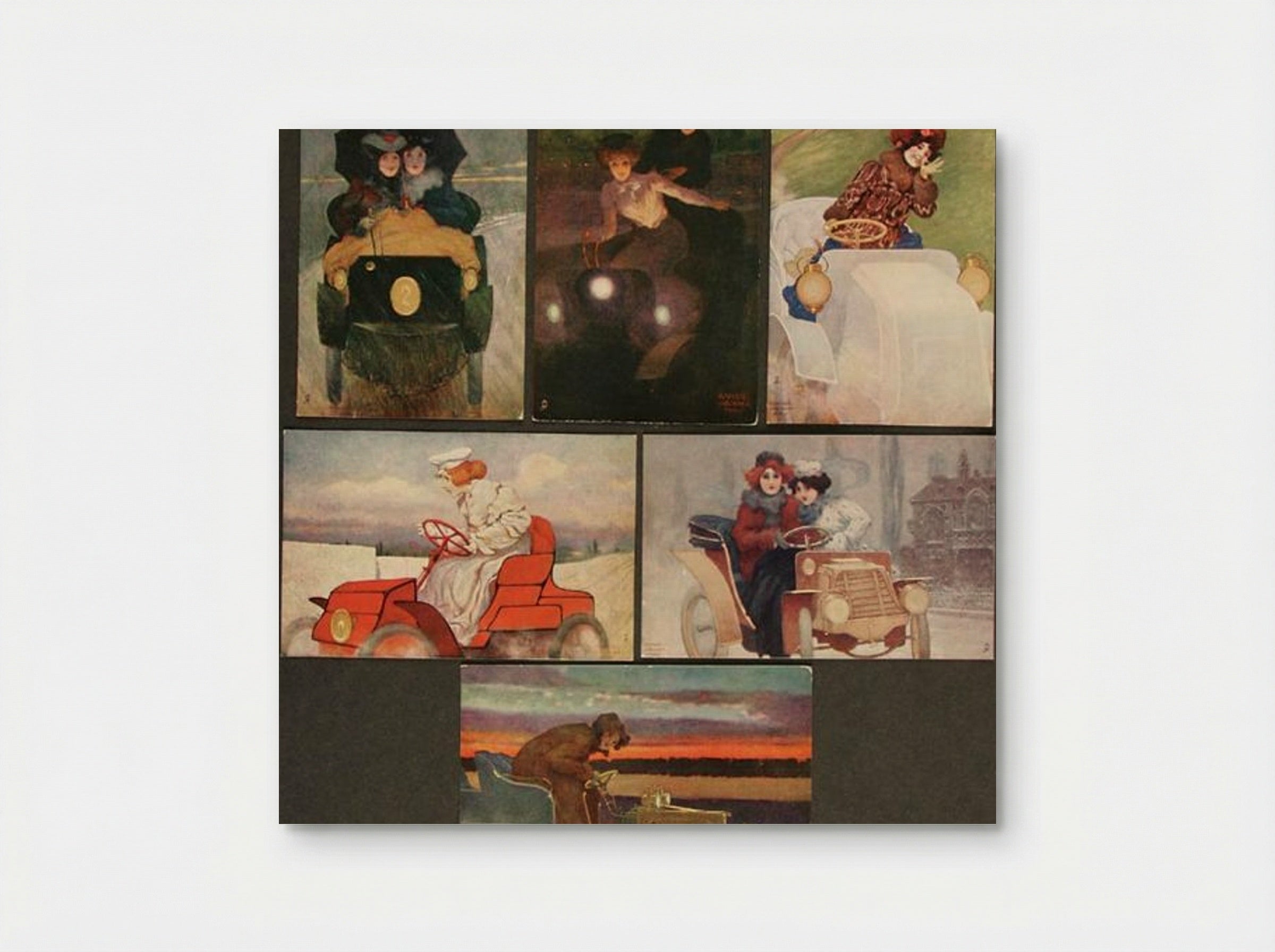
Flashing Motorists - Raphael Kirchner
Archival giclée
Frames arrive ready to hang
Secure checkout
Made to order
Description
A series of six Belle Époque illustrations by Raphael Kirchner depicting women driving early automobiles. These works capture the fashion and excitement of the Edwardian motoring era.
Raphael Kirchner was an Austrian artist who became a leading figure in the golden age of postcards during the early twentieth century. This series, titled Flashing Motorists, depicts women at the wheel of early automobiles. These illustrations were produced during a period when the motor car was a new symbol of speed and modernity. Kirchner moved to Paris in 1900, where his work gained popularity for its depiction of the Parisienne woman. The images show various scenes of Edwardian motoring. In one panel, two women sit under an umbrella in an open-top carriage. Another shows a driver navigating at night with glowing headlamps. The figures wear the fashionable attire of the day, including heavy coats, hats, and protective veils designed to shield against dust and wind. Kirchner uses a soft, painterly approach that contrasts with the mechanical nature of the vehicles. The compositions often place the car at an angle to suggest movement and momentum. The red car in the centre left panel is shown in profile, its driver leaning forward with focus. The background is a simple wash of sky and distant trees, which keeps the attention on the vehicle and its occupant. In the bottom panel, a driver is silhouetted against a darkening sky, the brass components of the car catching the last light of day. This use of light and shadow is a recurring element in Kirchner's commercial work. Kirchner's style is characteristic of the Belle Époque. He focuses on the elegance of his subjects while incorporating the technological advancements of the era. These works were originally published as a set of postcards by Theo Stroefer in Nuremberg. They represent a shift in social norms, as women were increasingly portrayed in active, independent roles. The colour palette is varied, ranging from the cool greys of a winter drive to the warm oranges of a sunset.
Return policy
Because every print is made to order, we don't offer change-of-mind returns, refunds or exchanges. If your order arrives faulty, damaged or incorrect, we'll replace it free of charge — just contact us within 48 hours of delivery. See our refunds page for full details.
Shipping
We ship worldwide, printing at the production hub nearest to your delivery address. Delivery times and costs vary by destination — you'll see the options available to you at checkout.
Manufacturing
Each print is produced to order using 12-colour giclée printing on FSC-certified archival paper. Designed in Britain and printed at your nearest production hub to reduce waste and speed up delivery.
Care and materials
Specific Features
Every Solis piece is made to order with archival, gallery-quality materials built to last.
- Museum-grade giclée printing for rich, fade-resistant colour
- Archival matte fine-art paper, FSC-certified
- Multiple sizes and framing options available
- Frames in black, natural wood, dark wood or white
- Framed prints arrive ready to hang
Care & Cleaning
To keep your artwork looking its best:
- Dust gently with a soft, dry cloth
- Avoid prolonged direct sunlight
- Never use liquid cleaners on the print or canvas surface
- Keep in a dry, room-temperature space
- Handle prints with clean, dry hands
Materials & Sizing
Museum-grade giclée on FSC-certified archival matte paper, with framed and canvas options.
- Paper sizes: A4, A3, A2, A1, A0 and B2 (50×70 cm)
- Canvas: XS (20×30 cm) to Large (60×90 cm)
- Frames: black, natural wood, dark wood or white
Flashing Motorists - Raphael Kirchner

Artist Biography
Raphael Kirchner
He was born in Vienna in 1875, studied at the Academy of Fine Arts there, and moved to Paris in 1900. At the outbreak of the First World War he relocated to New York, where he spent his final years designing panels, costumes and programmes for Florenz Ziegfeld's Follies at the Century Theatre. He died in New York in 1917, at forty-two.
Why Choose Us ?
Damage-free delivery guarantee
Fast Shipping
Museum-Quality Materials
You May Also Like