

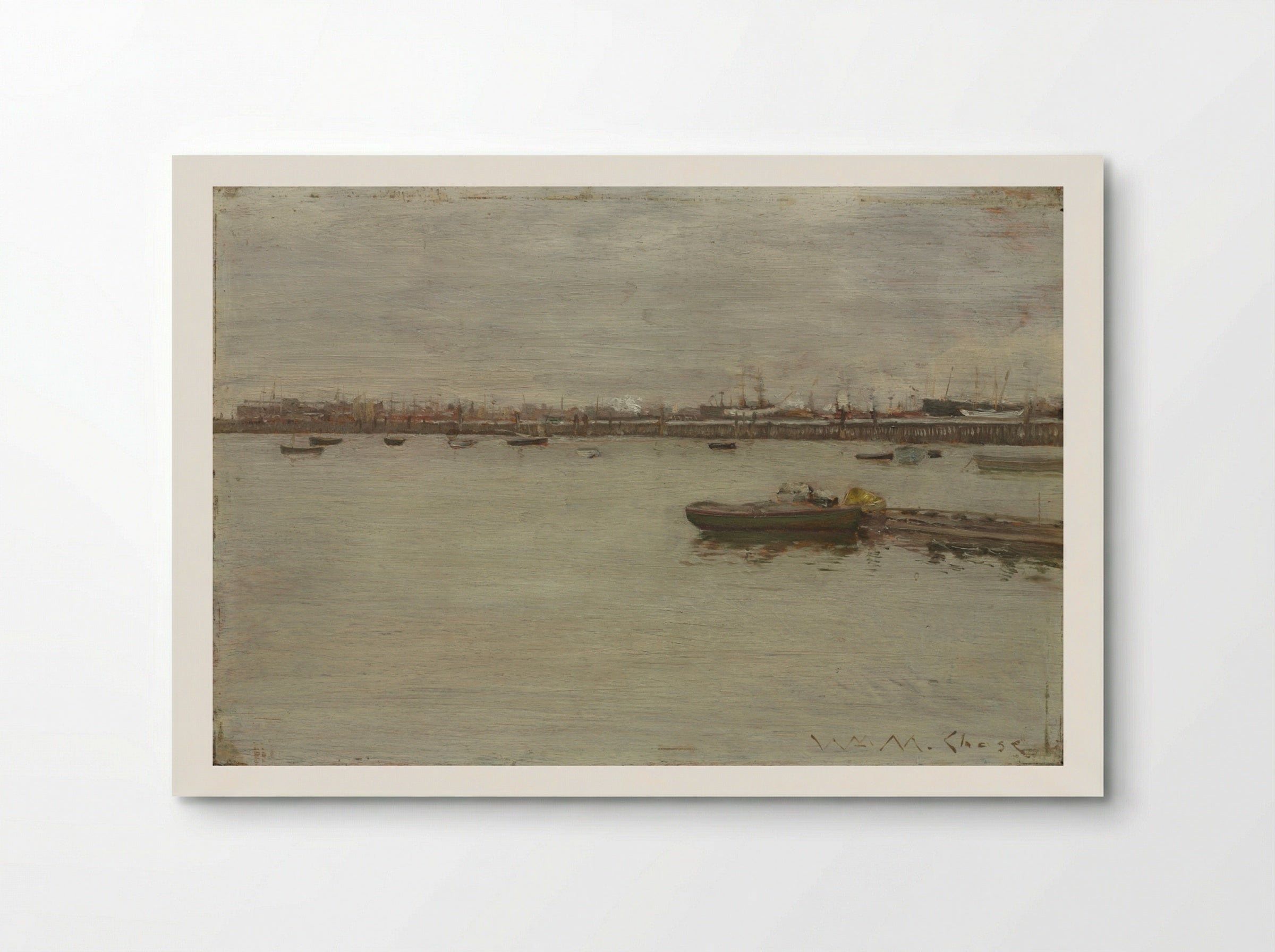
Gray Day on the Bay - William Merritt Chase
Archival giclée
Frames arrive ready to hang
Secure checkout
Made to order
Description
A serene marine study by William Merritt Chase, capturing the atmospheric light and muted tones of a quiet harbour scene.
William Merritt Chase, a central figure in American art during the late nineteenth century, produced this study of a harbour scene with a focus on atmospheric conditions. The work captures the muted, silver-grey light typical of a coastal day, demonstrating the artist's ability to render subtle tonal shifts within a restricted palette. Chase was known for his technical proficiency and his interest in the effects of light on water, a subject he explored frequently during his time in New York and his travels abroad. The composition is horizontal and expansive, drawing the eye across the calm surface of the water toward the distant, hazy shoreline. Small vessels are scattered across the bay, their forms simplified into quick, confident brushstrokes that suggest rather than define their structure. The foreground features a single boat moored near a wooden pier, providing a sense of scale and proximity to the viewer. The paint application is direct and fluid, characteristic of the artist's approach to plein air painting, where the goal was to record the immediate visual impression of the scene. This piece reflects the influence of European training on American painters of the period, particularly the interest in tonalism and the observation of nature. By focusing on the interplay between the sky and the water, Chase creates a quiet, contemplative atmosphere. The lack of dramatic narrative allows the viewer to focus on the texture of the paint and the subtle variations in colour, from cool greys to soft ochres. It is a representative example of the artist's smaller, more intimate works, which often served as studies for larger compositions or as independent exercises in capturing the fleeting qualities of light and weather.
Return policy
Because every print is made to order, we don't offer change-of-mind returns, refunds or exchanges. If your order arrives faulty, damaged or incorrect, we'll replace it free of charge — just contact us within 48 hours of delivery. See our refunds page for full details.
Shipping
We ship worldwide, printing at the production hub nearest to your delivery address. Delivery times and costs vary by destination — you'll see the options available to you at checkout.
Manufacturing
Each print is produced to order using 12-colour giclée printing on FSC-certified archival paper. Designed in Britain and printed at your nearest production hub to reduce waste and speed up delivery.
Gray Day on the Bay - William Merritt Chase

Artist Biography
William Merritt Chase
He studied at the Royal Academy of Munich, came home with a technique influenced by Velazquez and the dark tonalities of the old Dutch masters, and became one of the most important art teachers in American history. His pupils included Georgia O'Keeffe, Edward Hopper, Charles Sheeler, Joseph Stella, Marsden Hartley and Rockwell Kent. The list reads like a syllabus for twentieth-century American art.
In 1891 he founded the Shinnecock Hills Summer School on Long Island, the first plein-air painting school in the United States. His friend Stanford White designed his summer house there, with an integral studio. He taught outdoors, painting the dunes and scrubland of the South Fork with a luminous palette that anticipated the Impressionism he would later formally adopt. He was invited to join The Ten, the leading American Impressionist group, in 1902.
His most famous still-life subject was dead fish: whole fish lying on a plate against a dark background, painted with the same tonal precision he brought to landscapes and portraits. The subject sounds monotonous but the paintings are extraordinary, each fish rendered as an individual study in colour and light.
He was not modest. He decorated his studio with antiques and costumes and posed for photographs wearing a top hat. He believed art was a serious profession that deserved serious presentation, which for Chase meant looking like he meant it.
Our Features
Designed for Lasting Impact
Specific Features
Every Solis piece is made to order with archival, gallery-quality materials built to last.
- Museum-grade giclée printing for rich, fade-resistant colour
- Archival matte fine-art paper, FSC-certified
- Multiple sizes and framing options available
- Frames in black, natural wood, dark wood or white
- Framed prints arrive ready to hang
Care & Cleaning
To keep your artwork looking its best:
- Dust gently with a soft, dry cloth
- Avoid prolonged direct sunlight
- Never use liquid cleaners on the print or canvas surface
- Keep in a dry, room-temperature space
- Handle prints with clean, dry hands
Materials & Sizing
Museum-grade giclée on FSC-certified archival matte paper, with framed and canvas options.
- Paper sizes: A4, A3, A2, A1, A0 and B2 (50×70 cm)
- Canvas: XS (20×30 cm) to Large (60×90 cm)
- Frames: black, natural wood, dark wood or white
Why Choose Us ?
Damage-free delivery guarantee
Fast Shipping
Museum-Quality Materials
Artist Biography
William Merritt Chase
He studied at the Royal Academy of Munich, came home with a technique influenced by Velazquez and the dark tonalities of the old Dutch masters, and became one of the most important art teachers in American history. His pupils included Georgia O'Keeffe, Edward Hopper, Charles Sheeler, Joseph Stella, Marsden Hartley and Rockwell Kent. The list reads like a syllabus for twentieth-century American art.
In 1891 he founded the Shinnecock Hills Summer School on Long Island, the first plein-air painting school in the United States. His friend Stanford White designed his summer house there, with an integral studio. He taught outdoors, painting the dunes and scrubland of the South Fork with a luminous palette that anticipated the Impressionism he would later formally adopt. He was invited to join The Ten, the leading American Impressionist group, in 1902.
His most famous still-life subject was dead fish: whole fish lying on a plate against a dark background, painted with the same tonal precision he brought to landscapes and portraits. The subject sounds monotonous but the paintings are extraordinary, each fish rendered as an individual study in colour and light.
He was not modest. He decorated his studio with antiques and costumes and posed for photographs wearing a top hat. He believed art was a serious profession that deserved serious presentation, which for Chase meant looking like he meant it.
You May Also Like