

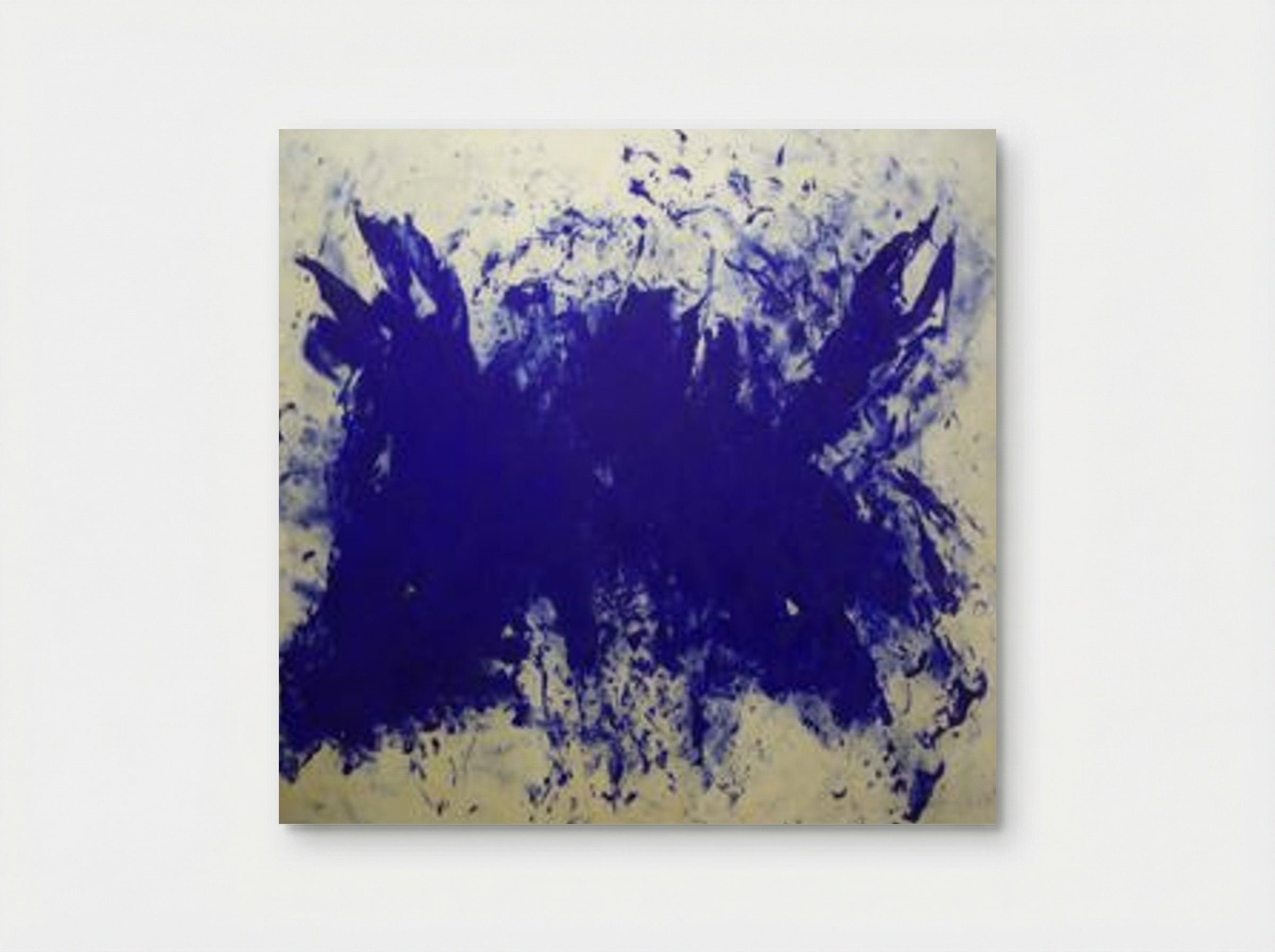
Great Blue Cannibalism, Tribute to Tennessee Williams - Yves Klein
Archival giclée
Frames arrive ready to hang
Secure checkout
Made to order
Description
A striking abstract work by Yves Klein, featuring his signature International Klein Blue pigment applied with gestural intensity.
Yves Klein, a central figure in the post-war European avant-garde, is synonymous with his development of International Klein Blue (IKB). This specific pigment, patented by the artist, possesses a unique matte quality that maintains the intensity of the colour by avoiding the binding agents that typically dull the finish. In this work, the application of the pigment suggests a visceral, performative process, aligning with Klein's interest in the immaterial and the physical trace of the artist's presence. The composition features a central, dense mass of blue pigment that appears to radiate outward, with splattered edges suggesting rapid, energetic movement. The title, referencing the playwright Tennessee Williams, adds a layer of conceptual weight to the work, linking the visual intensity of the blue to the dramatic and often turbulent themes found in Williams's literary output. Klein often engaged with the idea of the void and the infinite, using his signature blue to create a space that exists beyond traditional representation. Unlike his more controlled 'Anthropometry' series, where models were used as living brushes, this piece displays a more direct, gestural application of paint. The contrast between the stark, unprimed canvas and the saturated blue creates a tension that draws the viewer into the centre of the work. Klein's practice was frequently concerned with the spiritual and the metaphysical, and here, the blue acts as a medium for pure sensation. By stripping away figurative elements, the artist forces an encounter with the colour itself, allowing the viewer to experience the pigment as a physical entity rather than a tool for depiction. This work remains a clear example of Klein's ability to transform simple materials into objects of intense visual focus, reflecting his broader ambition to dissolve the boundaries between art and life.
Return policy
Because every print is made to order, we don't offer change-of-mind returns, refunds or exchanges. If your order arrives faulty, damaged or incorrect, we'll replace it free of charge — just contact us within 48 hours of delivery. See our refunds page for full details.
Shipping
We ship worldwide, printing at the production hub nearest to your delivery address. Delivery times and costs vary by destination — you'll see the options available to you at checkout.
Manufacturing
Each print is produced to order using 12-colour giclée printing on FSC-certified archival paper. Designed in Britain and printed at your nearest production hub to reduce waste and speed up delivery.
Care and materials
Specific Features
Every Solis piece is made to order with archival, gallery-quality materials built to last.
- Museum-grade giclée printing for rich, fade-resistant colour
- Archival matte fine-art paper, FSC-certified
- Multiple sizes and framing options available
- Frames in black, natural wood, dark wood or white
- Framed prints arrive ready to hang
Care & Cleaning
To keep your artwork looking its best:
- Dust gently with a soft, dry cloth
- Avoid prolonged direct sunlight
- Never use liquid cleaners on the print or canvas surface
- Keep in a dry, room-temperature space
- Handle prints with clean, dry hands
Materials & Sizing
Museum-grade giclée on FSC-certified archival matte paper, with framed and canvas options.
- Paper sizes: A4, A3, A2, A1, A0 and B2 (50×70 cm)
- Canvas: XS (20×30 cm) to Large (60×90 cm)
- Frames: black, natural wood, dark wood or white
Great Blue Cannibalism, Tribute to Tennessee Williams - Yves Klein

Artist Biography
Yves Klein
He was born in Nice to artist parents and grew up between France, England, and Spain. He studied judo seriously, earning a fourth-degree black belt in Tokyo, and considered martial arts and art as related disciplines: both requiring control, precision, and the projection of force.
He exhibited an empty gallery in 1958 and called it Le Vide (The Void). Over three thousand people attended the opening. The gallery walls were painted white. There was nothing else. He served blue cocktails at the door. He sold invisible paintings (Zones of Immaterial Pictorial Sensibility) for gold, then threw half the gold into the Seine and burned the receipt.
He died of a heart attack in 1962, at thirty-four. His career lasted roughly eight years. In that time he made the monochromes, the Anthropometries, the fire paintings, the sponge sculptures, the void exhibitions, and enough theoretical writing to fill several volumes. He remains one of the most influential artists of the post-war period, which he would have considered insufficient recognition.
Why Choose Us ?
Damage-free delivery guarantee
Fast Shipping
Museum-Quality Materials
You May Also Like