

Fine Art Poster
From $29
A giclée print on 200gsm matte fine art paper, using a twelve-colour process for accurate, fade-resistant colour. Supplied unframed, delivered flat or rolled.



Archival giclée
Frames arrive ready to hang
Secure checkout
Made to order
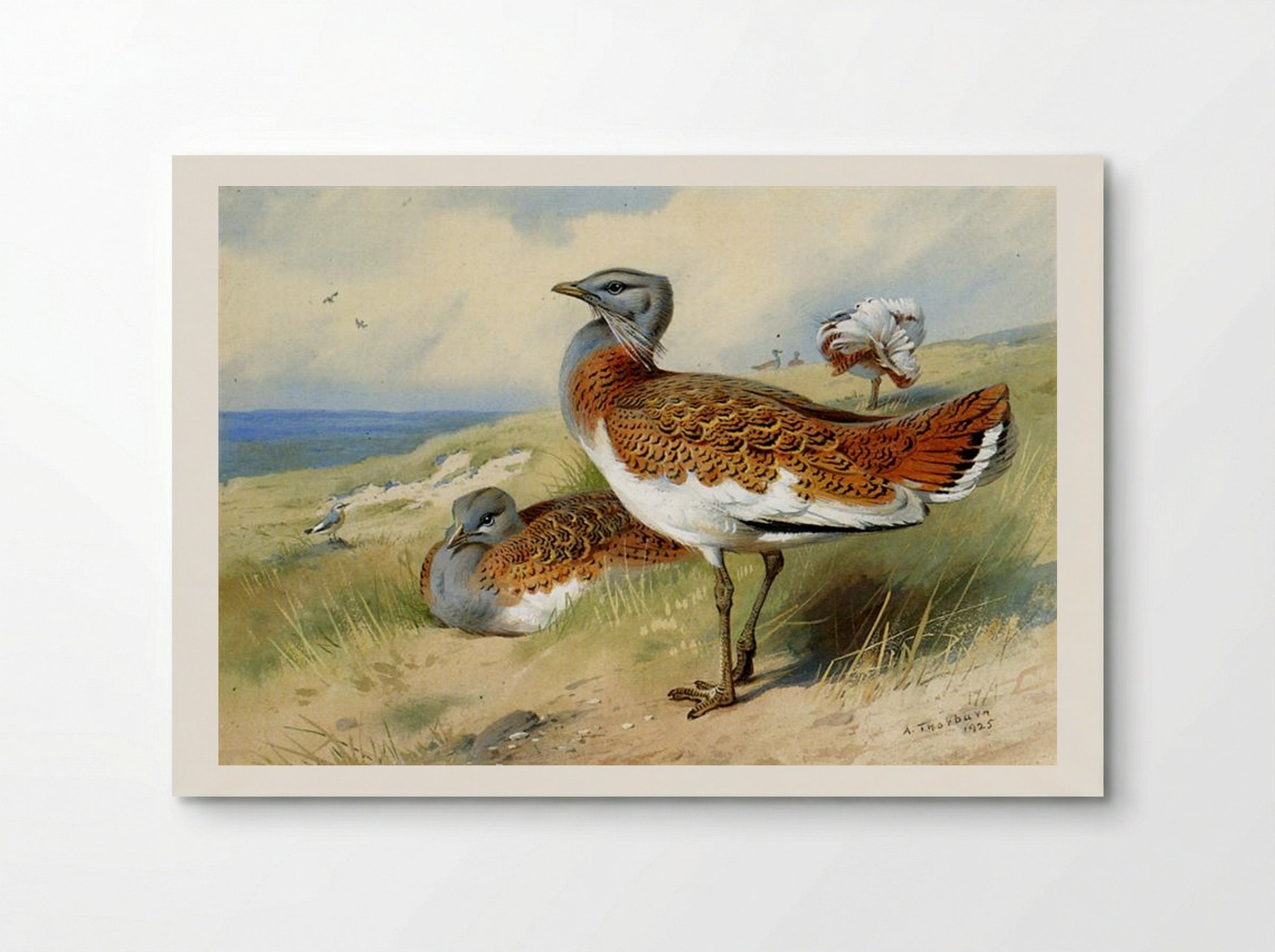
A precise watercolour study of great bustards by Archibald Thorburn, dated 1925, capturing the birds in their natural habitat with scientific accuracy.
Archibald Thorburn, a Scottish artist known for his precise ornithological illustrations, produced this watercolour in 1925. The work depicts the great bustard, a bird that had become extinct as a breeding species in Britain by the mid-nineteenth century. Thorburn often worked from specimens or field observations, and his technique here demonstrates the meticulous attention to feather texture and anatomical accuracy that defined his career. The composition places the birds within a sparse, open environment, typical of the bustard's preferred habitat. One bird stands in the foreground, displaying the characteristic plumage patterns of the species, while another rests in the grass nearby. A third individual is visible in the distance, partially obscured by the terrain. Thorburn uses a controlled palette of ochre, grey, and white to render the birds, allowing the natural colours of their feathers to provide the primary visual interest. The sky is rendered with soft, muted tones, suggesting an overcast day on the open plains. Thorburn was a frequent contributor to scientific publications and bird books, including Lord Lilford's 'Coloured Figures of the Birds of the British Islands'. His work is valued for its combination of scientific observation and artistic skill. By the time this piece was created, Thorburn had established a reputation for his ability to capture the specific posture and character of his subjects. This watercolour remains a clear example of his approach to wildlife art, prioritising clarity and observational detail over stylistic interpretation. The work is signed and dated in the lower right corner, consistent with his practice of documenting his finished studies.
Because every print is made to order, we don't offer change-of-mind returns, refunds or exchanges. If your order arrives faulty, damaged or incorrect, we'll replace it free of charge — just contact us within 48 hours of delivery. See our refunds page for full details.
We ship worldwide, printing at the production hub nearest to your delivery address. Delivery times and costs vary by destination — you'll see the options available to you at checkout.
Each print is produced to order using 12-colour giclée printing on FSC-certified archival paper. Designed in Britain and printed at your nearest production hub to reduce waste and speed up delivery.
Specific Features
Every Solis piece is made to order with archival, gallery-quality materials built to last.
Care & Cleaning
To keep your artwork looking its best:
Materials & Sizing
Museum-grade giclée on FSC-certified archival matte paper, with framed and canvas options.

Artist Biography
Made to order
Every piece is printed to order. These are the five finishes, and what makes each one different.
From $29
A giclée print on 200gsm matte fine art paper, using a twelve-colour process for accurate, fade-resistant colour. Supplied unframed, delivered flat or rolled.

From $89
The same fine art print in a solid wood frame with UV-protective acrylic glaze and rigid backing. Five frame colours. Arrives ready to hang.

From $169
A deeper solid wood frame: 33mm deep with a 20mm face and Perspex glaze. The print sits unmounted for a clean gallery presentation. Black, white or natural.

From $59
Hand-stretched canvas with neat gallery-wrapped edges, giving the artwork surface texture and depth. Arrives ready to hang.

From $175
Stretched canvas set in a floating wood frame, our most substantial finish. Arrives ready to hang.
Why Choose Us ?
Damage-free delivery guarantee
Fast Shipping
Museum-Quality Materials
You May Also Like
We use cookies to measure our marketing and see which prints people love.We use cookies to measure our marketing.
By continuing to browse, you agree · Privacy Policy