

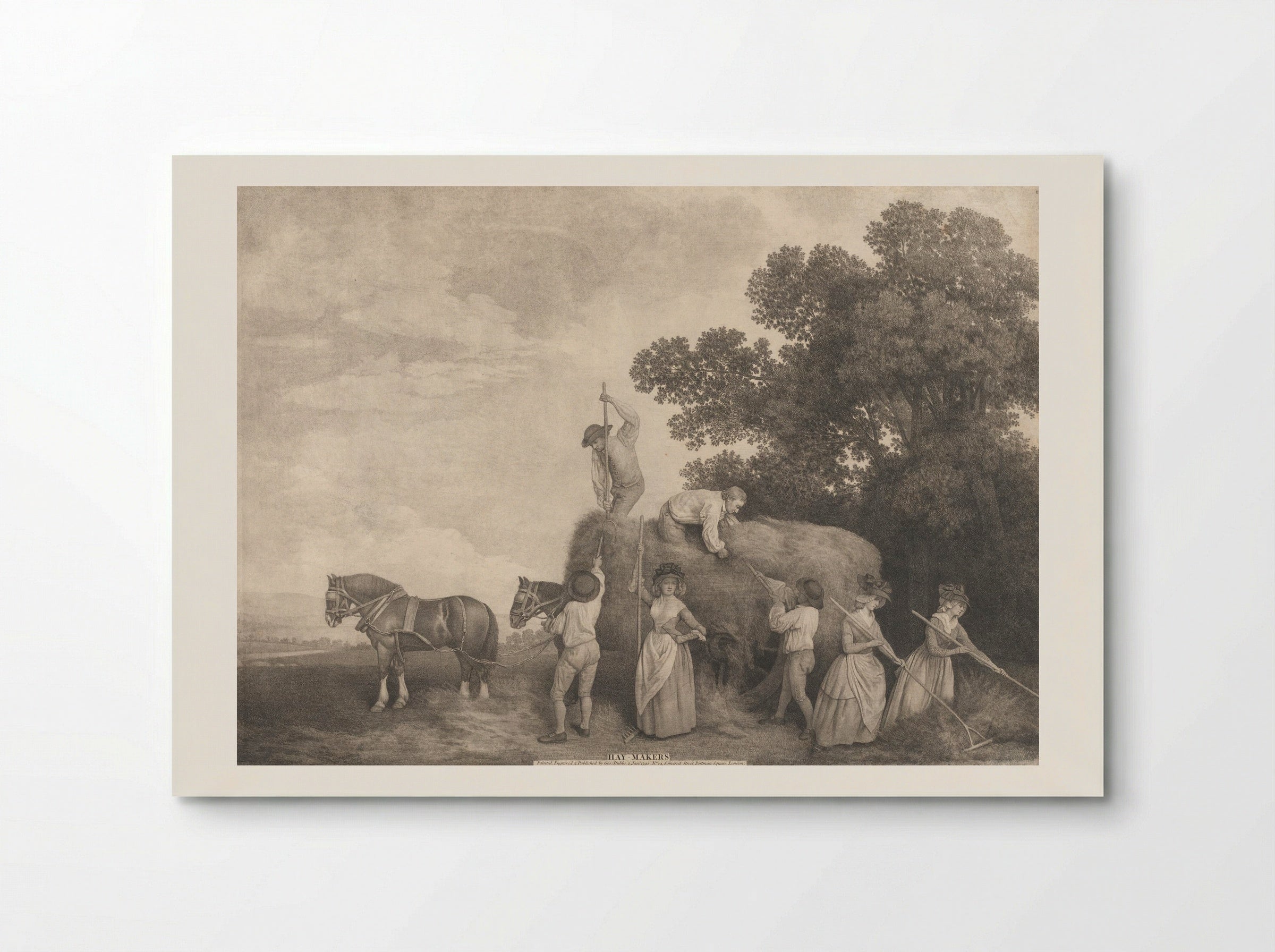
Hay Makers - George Stubbs
Archival giclée
Frames arrive ready to hang
Secure checkout
Made to order
Description
A detailed stipple engraving by George Stubbs depicting rural labourers at work in a hay field, capturing the textures and atmosphere of eighteenth-century agricultural life.
George Stubbs, primarily recognised for his anatomical precision and equine studies, demonstrates a different facet of his technical ability in this stipple engraving. Published in 1791, the work depicts a group of labourers engaged in the seasonal task of haymaking. The composition is balanced, with the figures arranged in a rhythmic sequence that guides the eye across the scene, from the horse on the left to the women raking the field on the right. Stubbs employs the stipple technique to achieve subtle gradations of tone, which provides a soft, atmospheric quality to the print. Unlike his more rigid anatomical works, this image captures a sense of quiet industry. The figures are rendered with a focus on their posture and the tools they handle, reflecting the social structure of the rural workforce in eighteenth-century Britain. The large, leafy trees provide a dark, textured backdrop that contrasts with the lighter, open field, creating a sense of depth without relying on complex perspective. This print is an example of the artist's foray into printmaking, a medium he adopted later in his career to disseminate his work to a wider audience. The attention to the texture of the hay and the folds in the clothing reveals the same observational rigour found in his paintings of animals. By focusing on the daily activities of rural life, Stubbs provides a record of agricultural practices during the period. The work remains a clear representation of the artist's skill in translating the nuances of light and shadow into the medium of engraving, resulting in a balanced and composed scene that avoids unnecessary ornamentation while maintaining a high degree of descriptive accuracy.
Return policy
Because every print is made to order, we don't offer change-of-mind returns, refunds or exchanges. If your order arrives faulty, damaged or incorrect, we'll replace it free of charge — just contact us within 48 hours of delivery. See our refunds page for full details.
Shipping
We ship worldwide, printing at the production hub nearest to your delivery address. Delivery times and costs vary by destination — you'll see the options available to you at checkout.
Manufacturing
Each print is produced to order using 12-colour giclée printing on FSC-certified archival paper. Designed in Britain and printed at your nearest production hub to reduce waste and speed up delivery.
Hay Makers - George Stubbs

Artist Biography
George Stubbs
He was born in Liverpool, the son of a currier (a leather worker). He was largely self-taught. In his twenties he spent eighteen months in a farmhouse in Horkstow, Lincolnshire, dissecting horses. He suspended the carcasses from the ceiling using hooks and pulleys, peeled back the layers of skin and muscle, and drew every stage. The results were published as The Anatomy of the Horse (1766), one of the most accurate anatomical studies ever produced by an artist. The book established his reputation.
His horse portraits are commissioned works: wealthy landowners wanted their racehorses painted. Stubbs obliged, but his understanding of equine anatomy gave the paintings a presence that other sporting painters could not match. Whistlejacket, a life-size portrait of a chestnut stallion rearing against a plain background, is among the most striking animal paintings ever made. There is no landscape, no rider, no context. Just the horse.
He also painted dogs, exotic animals (a zebra, a rhinoceros, a moose), and rural scenes with labourers and haymakers. He experimented with enamel painting on ceramic tablets made by Josiah Wedgwood. He was elected to the Royal Academy but refused to submit a diploma piece, which meant he was never made a full Academician. He died in 1806, at eighty-one.
Our Features
Designed for Lasting Impact
Specific Features
Every Solis piece is made to order with archival, gallery-quality materials built to last.
- Museum-grade giclée printing for rich, fade-resistant colour
- Archival matte fine-art paper, FSC-certified
- Multiple sizes and framing options available
- Frames in black, natural wood, dark wood or white
- Framed prints arrive ready to hang
Care & Cleaning
To keep your artwork looking its best:
- Dust gently with a soft, dry cloth
- Avoid prolonged direct sunlight
- Never use liquid cleaners on the print or canvas surface
- Keep in a dry, room-temperature space
- Handle prints with clean, dry hands
Materials & Sizing
Museum-grade giclée on FSC-certified archival matte paper, with framed and canvas options.
- Paper sizes: A4, A3, A2, A1, A0 and B2 (50×70 cm)
- Canvas: XS (20×30 cm) to Large (60×90 cm)
- Frames: black, natural wood, dark wood or white
Why Choose Us ?
Damage-free delivery guarantee
Fast Shipping
Museum-Quality Materials
Artist Biography
George Stubbs
He was born in Liverpool, the son of a currier (a leather worker). He was largely self-taught. In his twenties he spent eighteen months in a farmhouse in Horkstow, Lincolnshire, dissecting horses. He suspended the carcasses from the ceiling using hooks and pulleys, peeled back the layers of skin and muscle, and drew every stage. The results were published as The Anatomy of the Horse (1766), one of the most accurate anatomical studies ever produced by an artist. The book established his reputation.
His horse portraits are commissioned works: wealthy landowners wanted their racehorses painted. Stubbs obliged, but his understanding of equine anatomy gave the paintings a presence that other sporting painters could not match. Whistlejacket, a life-size portrait of a chestnut stallion rearing against a plain background, is among the most striking animal paintings ever made. There is no landscape, no rider, no context. Just the horse.
He also painted dogs, exotic animals (a zebra, a rhinoceros, a moose), and rural scenes with labourers and haymakers. He experimented with enamel painting on ceramic tablets made by Josiah Wedgwood. He was elected to the Royal Academy but refused to submit a diploma piece, which meant he was never made a full Academician. He died in 1806, at eighty-one.
You May Also Like