

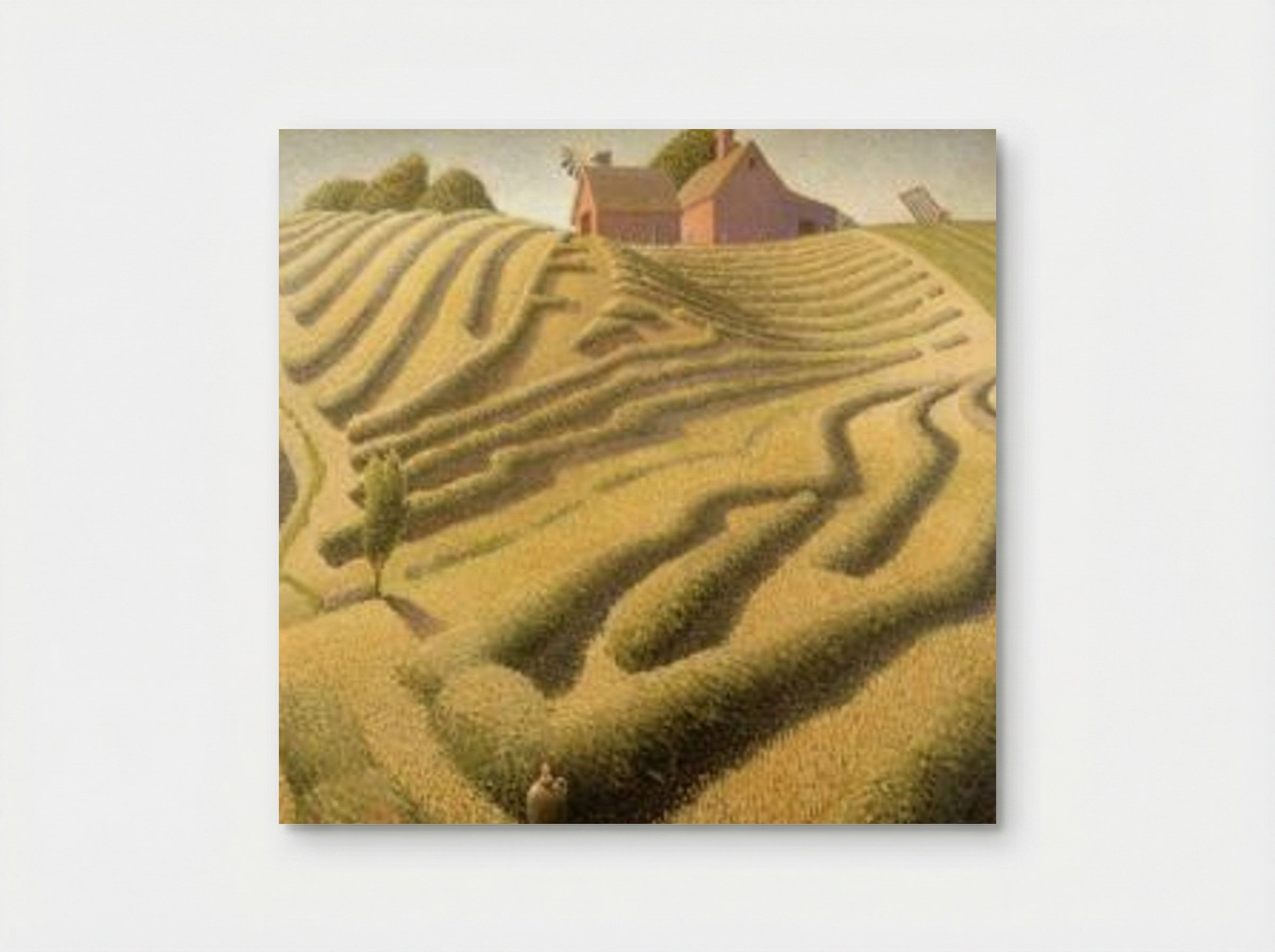
Haying - Grant Wood
Archival giclée
Frames arrive ready to hang
Secure checkout
Made to order
Description
A classic American Regionalist work by Grant Wood, depicting the rhythmic, golden hills of the Iowa countryside in 1939.
Grant Wood, a central figure in the American Regionalist movement, produced Haying in 1939. This work captures the rolling topography of the Iowa countryside, rendered with the artist's characteristic precision and stylised geometry. Wood often looked to his native Midwest for subject matter, seeking to document the rural experience during the interwar period. The composition relies on a rhythmic arrangement of fields, where the contours of the earth are exaggerated into smooth, wave-like forms. This approach creates a sense of order and permanence, reflecting the agricultural cycles of the region. The farm buildings, situated at the crest of the hill, are depicted with clean lines and a simplified structure, typical of Wood's mature style. The palette is dominated by golden hues, suggesting the warmth of late summer and the harvest season. Wood's technique involves a meticulous application of paint, resulting in a smooth surface that minimises visible brushwork. This finish contributes to the clarity of the forms and the overall sense of stillness within the scene. By focusing on the patterns created by cultivation, Wood transforms a functional agricultural space into a structured visual arrangement. The work avoids the sentimentality often associated with rural depictions, opting instead for a formalised interpretation of the land. The shadows cast by the undulating hills provide a sense of depth, guiding the viewer's eye across the terrain toward the farmstead. This piece remains a clear example of how Wood utilised his surroundings to explore themes of regional identity and the relationship between human labour and the natural environment.
Return policy
Because every print is made to order, we don't offer change-of-mind returns, refunds or exchanges. If your order arrives faulty, damaged or incorrect, we'll replace it free of charge — just contact us within 48 hours of delivery. See our refunds page for full details.
Shipping
We ship worldwide, printing at the production hub nearest to your delivery address. Delivery times and costs vary by destination — you'll see the options available to you at checkout.
Manufacturing
Each print is produced to order using 12-colour giclée printing on FSC-certified archival paper. Designed in Britain and printed at your nearest production hub to reduce waste and speed up delivery.
Haying - Grant Wood

Artist Biography
Grant Wood
As a key figure in the Regionalism movement, Grant Wood rejected European abstraction in favour of celebrating rural American life. His most famous painting, *American Gothic* (1930), became an iconic, and often parodied, representation of the American character. Other notable works, like *The Midnight Ride of Paul Revere* (1931) and *Stone City, Iowa* (1930), further cemented his reputation as a painter of the American heartland. These paintings weren't simply landscapes; they were imbued with a sense of nostalgia, social commentary, and a deep connection to the land.
Despite his relatively short career, Grant Wood left an indelible mark on American art. His paintings continue to resonate with viewers today, offering a glimpse into a specific time and place, while simultaneously exploring universal themes of identity, community, and the relationship between humanity and nature. His work serves as a reminder of the beauty and complexity that can be found in the everyday, and the enduring power of art to capture the spirit of a nation.
Our Features
Designed for Lasting Impact
Specific Features
Every Solis piece is made to order with archival, gallery-quality materials built to last.
- Museum-grade giclée printing for rich, fade-resistant colour
- Archival matte fine-art paper, FSC-certified
- Multiple sizes and framing options available
- Frames in black, natural wood, dark wood or white
- Framed prints arrive ready to hang
Care & Cleaning
To keep your artwork looking its best:
- Dust gently with a soft, dry cloth
- Avoid prolonged direct sunlight
- Never use liquid cleaners on the print or canvas surface
- Keep in a dry, room-temperature space
- Handle prints with clean, dry hands
Materials & Sizing
Museum-grade giclée on FSC-certified archival matte paper, with framed and canvas options.
- Paper sizes: A4, A3, A2, A1, A0 and B2 (50×70 cm)
- Canvas: XS (20×30 cm) to Large (60×90 cm)
- Frames: black, natural wood, dark wood or white
Why Choose Us ?
Damage-free delivery guarantee
Fast Shipping
Museum-Quality Materials
Artist Biography
Grant Wood
As a key figure in the Regionalism movement, Grant Wood rejected European abstraction in favour of celebrating rural American life. His most famous painting, *American Gothic* (1930), became an iconic, and often parodied, representation of the American character. Other notable works, like *The Midnight Ride of Paul Revere* (1931) and *Stone City, Iowa* (1930), further cemented his reputation as a painter of the American heartland. These paintings weren't simply landscapes; they were imbued with a sense of nostalgia, social commentary, and a deep connection to the land.
Despite his relatively short career, Grant Wood left an indelible mark on American art. His paintings continue to resonate with viewers today, offering a glimpse into a specific time and place, while simultaneously exploring universal themes of identity, community, and the relationship between humanity and nature. His work serves as a reminder of the beauty and complexity that can be found in the everyday, and the enduring power of art to capture the spirit of a nation.
You May Also Like