

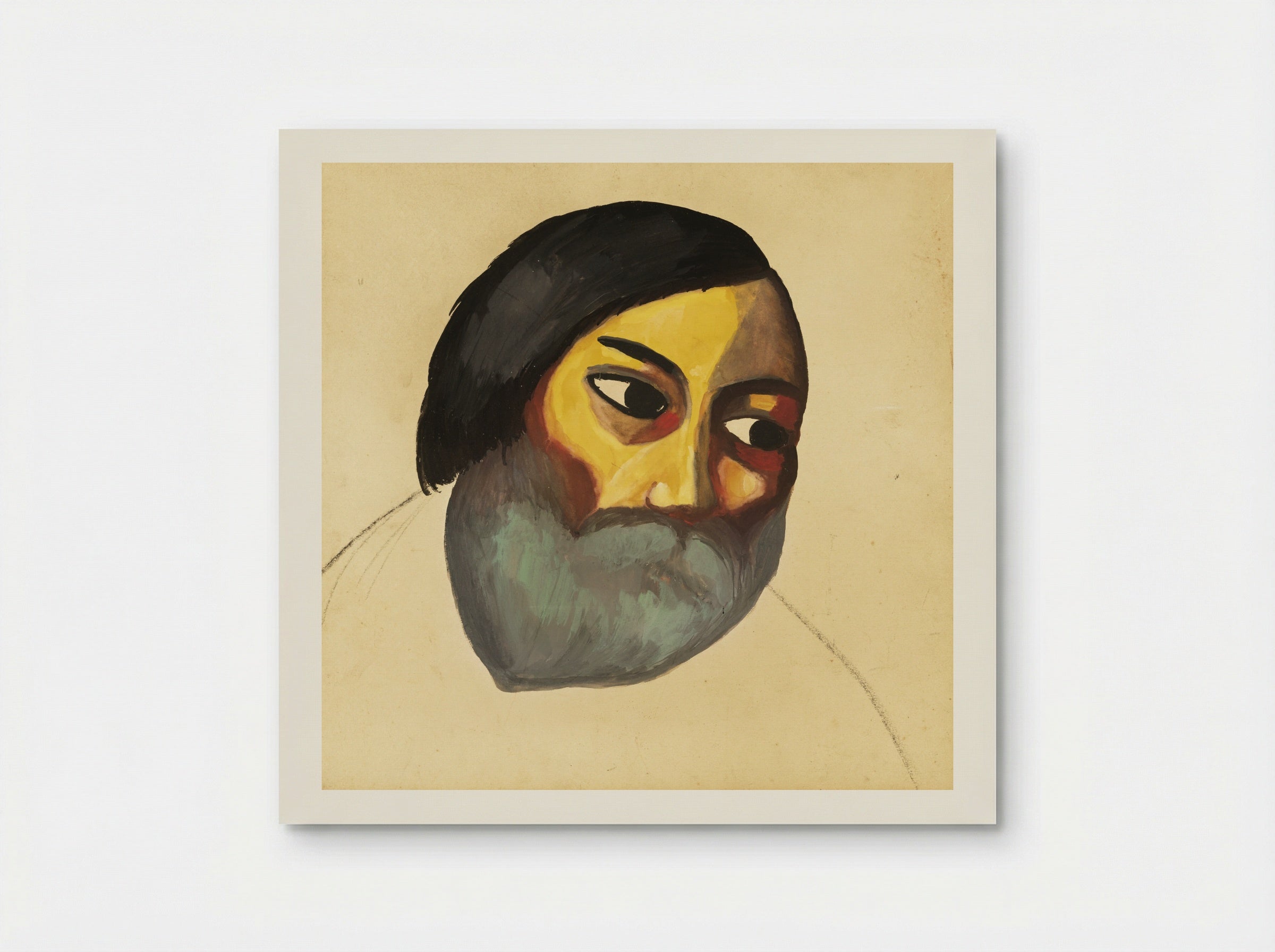
Head of Peasant - Kazimir Malevich
Archival giclée
Frames arrive ready to hang
Secure checkout
Made to order
Description
A striking, simplified portrait by Kazimir Malevich, featuring a peasant figure rendered in geometric planes and muted tones.
This work belongs to the later period of Kazimir Malevich, during which he returned to figurative subjects after his earlier experiments with pure abstraction. The composition presents a stylised, almost iconic depiction of a peasant figure. Malevich employs a simplified, geometric approach to the human form, reducing the facial features to essential shapes and planes. The colour palette is restricted, focusing on earthy tones, muted yellows, and a distinct grey for the beard, which contrasts with the dark, solid mass of the hair. The figure is set against a plain, neutral background, which removes any sense of specific location or narrative context. This isolation forces the viewer to engage directly with the form and the psychological weight of the subject. The brushwork is deliberate and flat, reflecting the artist's interest in the structural qualities of painting rather than realistic representation. The eyes are rendered as dark, almond-shaped voids, contributing to a sense of stoicism or detachment. Malevich's return to peasant themes in the late 1920s and early 1930s is often discussed in relation to the changing political climate in the Soviet Union. While his earlier Suprematist works sought to transcend the material world, these later portraits engage with the archetypal figure of the Russian labourer. The work demonstrates his ability to apply the lessons of his abstract period to the human face, creating a synthesis of modernism and traditional subject matter. The lack of detail in the clothing and the surrounding space ensures that the focus remains entirely on the head, which functions as a study in form, colour, and simplified expression. This print captures the texture of the original gouache, preserving the matte finish and the specific tonal transitions that define Malevich's late figurative style.
Return policy
Because every print is made to order, we don't offer change-of-mind returns, refunds or exchanges. If your order arrives faulty, damaged or incorrect, we'll replace it free of charge — just contact us within 48 hours of delivery. See our refunds page for full details.
Shipping
We ship worldwide, printing at the production hub nearest to your delivery address. Delivery times and costs vary by destination — you'll see the options available to you at checkout.
Manufacturing
Each print is produced to order using 12-colour giclée printing on FSC-certified archival paper. Designed in Britain and printed at your nearest production hub to reduce waste and speed up delivery.
Care and materials
Specific Features
Every Solis piece is made to order with archival, gallery-quality materials built to last.
- Museum-grade giclée printing for rich, fade-resistant colour
- Archival matte fine-art paper, FSC-certified
- Multiple sizes and framing options available
- Frames in black, natural wood, dark wood or white
- Framed prints arrive ready to hang
Care & Cleaning
To keep your artwork looking its best:
- Dust gently with a soft, dry cloth
- Avoid prolonged direct sunlight
- Never use liquid cleaners on the print or canvas surface
- Keep in a dry, room-temperature space
- Handle prints with clean, dry hands
Materials & Sizing
Museum-grade giclée on FSC-certified archival matte paper, with framed and canvas options.
- Paper sizes: A4, A3, A2, A1, A0 and B2 (50×70 cm)
- Canvas: XS (20×30 cm) to Large (60×90 cm)
- Frames: black, natural wood, dark wood or white
Head of Peasant - Kazimir Malevich

Artist Biography
Kazimir Malevich
He was born in 1879 near Kyiv, to parents of Polish origin, the eldest of fourteen children. Nine survived to adulthood. He moved through Impressionism, Symbolism, Fauvism, and Cubism before arriving at Suprematism, a system of pure geometric abstraction that he invented in 1913. White on White (1918) pushed the principle to its logical end: a white square, barely visible, tilted on a white background.
In 1927, he took approximately seventy paintings to Berlin for an exhibition. Soviet authorities recalled him abruptly. He left the entire cache with a German architect named Hugo Haering and never saw them again. The works eventually ended up at MoMA in New York and the Stedelijk Museum in Amsterdam.
In 1930, the secret police arrested him, accused him of Polish espionage, and threatened execution. He was imprisoned for two months. His teaching position was taken away. Artworks and manuscripts were confiscated. He was banned from making art and forced to return to figurative painting under Stalin.
He died of cancer in 1935, aged fifty-six. On his deathbed, Black Square was hung above him. His ashes were buried at Nemchinovka. He had requested a Suprematist sculptural form to mark his grave. Instead, it was marked with a white cube bearing a black square, which was destroyed during the war.
Why Choose Us ?
Damage-free delivery guarantee
Fast Shipping
Museum-Quality Materials
You May Also Like