

Fine Art Poster
From $29
A giclée print on 200gsm matte fine art paper, using a twelve-colour process for accurate, fade-resistant colour. Supplied unframed, delivered flat or rolled.



Archival giclée
Frames arrive ready to hang
Secure checkout
Made to order
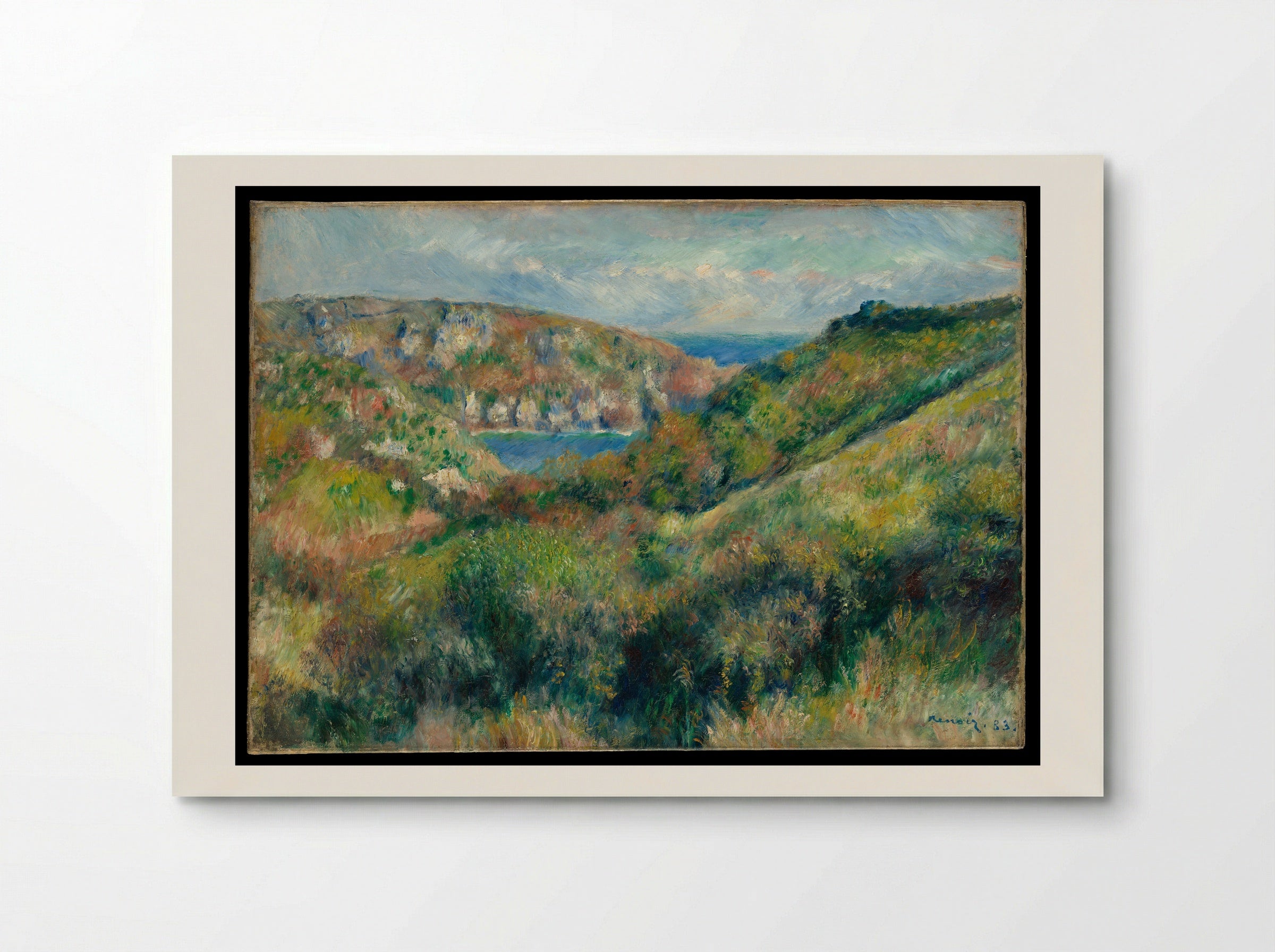
A study of the Guernsey coastline by Auguste Renoir, capturing the rugged hills and coastal light of the Bay of Moulin Huet in 1883.
In the summer of 1883, Auguste Renoir spent several weeks on the island of Guernsey. During this period, he produced a series of works capturing the rugged coastline and the unique light of the Channel Islands. This painting depicts the hills surrounding the Bay of Moulin Huet, a location that offered the artist a departure from his typical Parisian subjects. The composition is defined by short, rapid brushstrokes that capture the movement of the wind through the coastal vegetation. Renoir employs a palette of greens, ochres, and blues to describe the undulating terrain and the distant sea. The foreground is dense with foliage, rendered with a tactile quality that suggests the wild, untamed nature of the cliffside. The sky, filled with soft, shifting clouds, occupies the upper portion of the canvas, providing a sense of atmospheric depth. Unlike his earlier, more structured compositions, this work reflects a period of experimentation for Renoir. He was moving away from the rigid techniques of his youth, opting instead for a more fluid application of paint. The light in this piece is characteristic of the coastal environment, where the sun reflects off the water and illuminates the grassy slopes. The painting does not attempt to provide a precise topographical record, but rather focuses on the sensory experience of the location. The interplay between the textured foreground and the distant, hazy horizon creates a sense of space that is both immediate and expansive. This work remains a clear example of the Impressionist interest in capturing fleeting moments and the specific qualities of natural light in an outdoor setting.
Because every print is made to order, we don't offer change-of-mind returns, refunds or exchanges. If your order arrives faulty, damaged or incorrect, we'll replace it free of charge — just contact us within 48 hours of delivery. See our refunds page for full details.
We ship worldwide, printing at the production hub nearest to your delivery address. Delivery times and costs vary by destination — you'll see the options available to you at checkout.
Each print is produced to order using 12-colour giclée printing on FSC-certified archival paper. Designed in Britain and printed at your nearest production hub to reduce waste and speed up delivery.

Artist Biography
Our Features
Designed for Lasting Impact
Every Solis piece is made to order with archival, gallery-quality materials built to last.
To keep your artwork looking its best:
Museum-grade giclée on FSC-certified archival matte paper, with framed and canvas options.
Made to order
Every piece is printed to order. These are the five finishes, and what makes each one different.
From $29
A giclée print on 200gsm matte fine art paper, using a twelve-colour process for accurate, fade-resistant colour. Supplied unframed, delivered flat or rolled.

From $89
The same fine art print in a solid wood frame with UV-protective acrylic glaze and rigid backing. Five frame colours. Arrives ready to hang.

From $169
A deeper solid wood frame: 33mm deep with a 20mm face and Perspex glaze. The print sits unmounted for a clean gallery presentation. Black, white or natural.

From $59
Hand-stretched canvas with neat gallery-wrapped edges, giving the artwork surface texture and depth. Arrives ready to hang.

From $175
Stretched canvas set in a floating wood frame, our most substantial finish. Arrives ready to hang.
Why Choose Us ?
Damage-free delivery guarantee
Fast Shipping
Museum-Quality Materials
Artist Biography
Pierre-Auguste Renoir
You May Also Like
We use cookies to measure our marketing and see which prints people love.We use cookies to measure our marketing.
By continuing to browse, you agree · Privacy Policy