

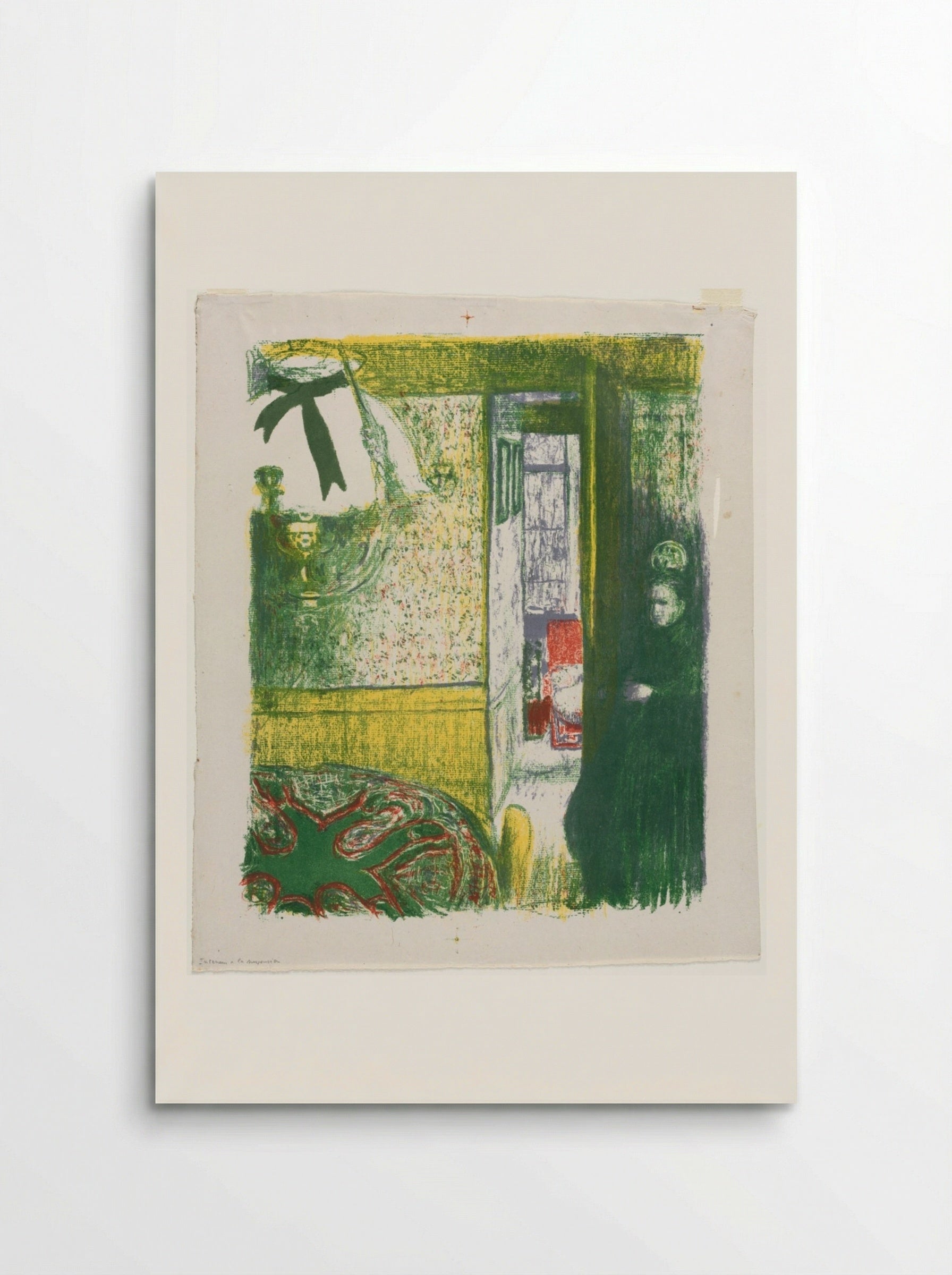
Interior with a Hanging Lamp - Édouard Vuillard
Archival giclée
Frames arrive ready to hang
Secure checkout
Made to order
Description
A colour lithograph by Édouard Vuillard depicting a domestic interior, characterised by flattened perspective and a focus on decorative patterns.
Édouard Vuillard was a central figure of the Nabis, a group of French artists who sought to move beyond the objective representation of the natural world. This work, Interior with a Hanging Lamp, demonstrates his fascination with the domestic sphere. Vuillard often depicted the quiet, private lives of his family and friends, transforming mundane settings into compositions defined by pattern and colour. In this lithograph, the artist employs a flattened perspective that merges the figure with the surrounding environment. The wall coverings, the patterned tablecloth, and the silhouette of the woman are treated with equal visual weight. This approach creates a sense of ambiguity, where the boundaries between objects and space become porous. The colour palette is dominated by greens and yellows, applied with a textured quality characteristic of his printmaking process. The hanging lamp, from which the work takes its title, acts as a structural element that guides the eye through the room. Vuillard’s work from this period is noted for its psychological depth, achieved through the subtle arrangement of shapes rather than traditional narrative. The figure, partially obscured by the doorway, adds a layer of mystery to the scene. By focusing on the decorative potential of the interior, Vuillard invites the viewer to consider the emotional resonance of everyday surroundings. This print is an example of his ability to balance abstraction with the recognisable details of bourgeois life in late nineteenth-century France. The composition avoids the rigid geometry of earlier academic styles, opting instead for a fluid, subjective interpretation of light and form.
Return policy
Because every print is made to order, we don't offer change-of-mind returns, refunds or exchanges. If your order arrives faulty, damaged or incorrect, we'll replace it free of charge — just contact us within 48 hours of delivery. See our refunds page for full details.
Shipping
We ship worldwide, printing at the production hub nearest to your delivery address. Delivery times and costs vary by destination — you'll see the options available to you at checkout.
Manufacturing
Each print is produced to order using 12-colour giclée printing on FSC-certified archival paper. Designed in Britain and printed at your nearest production hub to reduce waste and speed up delivery.
Interior with a Hanging Lamp - Édouard Vuillard
Our Features
Designed for Lasting Impact
Specific Features
Every Solis piece is made to order with archival, gallery-quality materials built to last.
- Museum-grade giclée printing for rich, fade-resistant colour
- Archival matte fine-art paper, FSC-certified
- Multiple sizes and framing options available
- Frames in black, natural wood, dark wood or white
- Framed prints arrive ready to hang
Care & Cleaning
To keep your artwork looking its best:
- Dust gently with a soft, dry cloth
- Avoid prolonged direct sunlight
- Never use liquid cleaners on the print or canvas surface
- Keep in a dry, room-temperature space
- Handle prints with clean, dry hands
Materials & Sizing
Museum-grade giclée on FSC-certified archival matte paper, with framed and canvas options.
- Paper sizes: A4, A3, A2, A1, A0 and B2 (50×70 cm)
- Canvas: XS (20×30 cm) to Large (60×90 cm)
- Frames: black, natural wood, dark wood or white
Why Choose Us ?
Damage-free delivery guarantee
Fast Shipping
Museum-Quality Materials

Artist Biography
Édouard Vuillard
He joined the Nabis in the early 1890s, a group of young painters who took their name from the Hebrew word for prophets. The others (Bonnard, Denis, Serusier) were drawn to mysticism and esoteric philosophy. Vuillard was drawn to the interior. His mother's workroom, with its bolts of fabric, wallpaper patterns, and women in patterned dresses, became his subject. The paintings flatten space: the figure merges with the wallpaper, the dress dissolves into the upholstery, the room becomes a single surface of competing patterns. Critics called the approach Intimism.
He painted almost exclusively domestic scenes: rooms, tables, women sewing, women reading. The scale is modest. The colours are muted. There is no drama, no allegory, no mythology. The work assumes that a woman sitting in a chair in a room with good light is enough to make a painting, which it is.
He never married. He lived with his mother until she died and then lived alone. In the late twentieth century, historians began to reassess his decorative work (screens, murals, theatre sets for Lugne-Poe's Theatre de l'Oeuvre) and recognised that the small domestic paintings were not minor work but a deliberate programme: the interior as a subject equal to landscape or history.
You May Also Like