

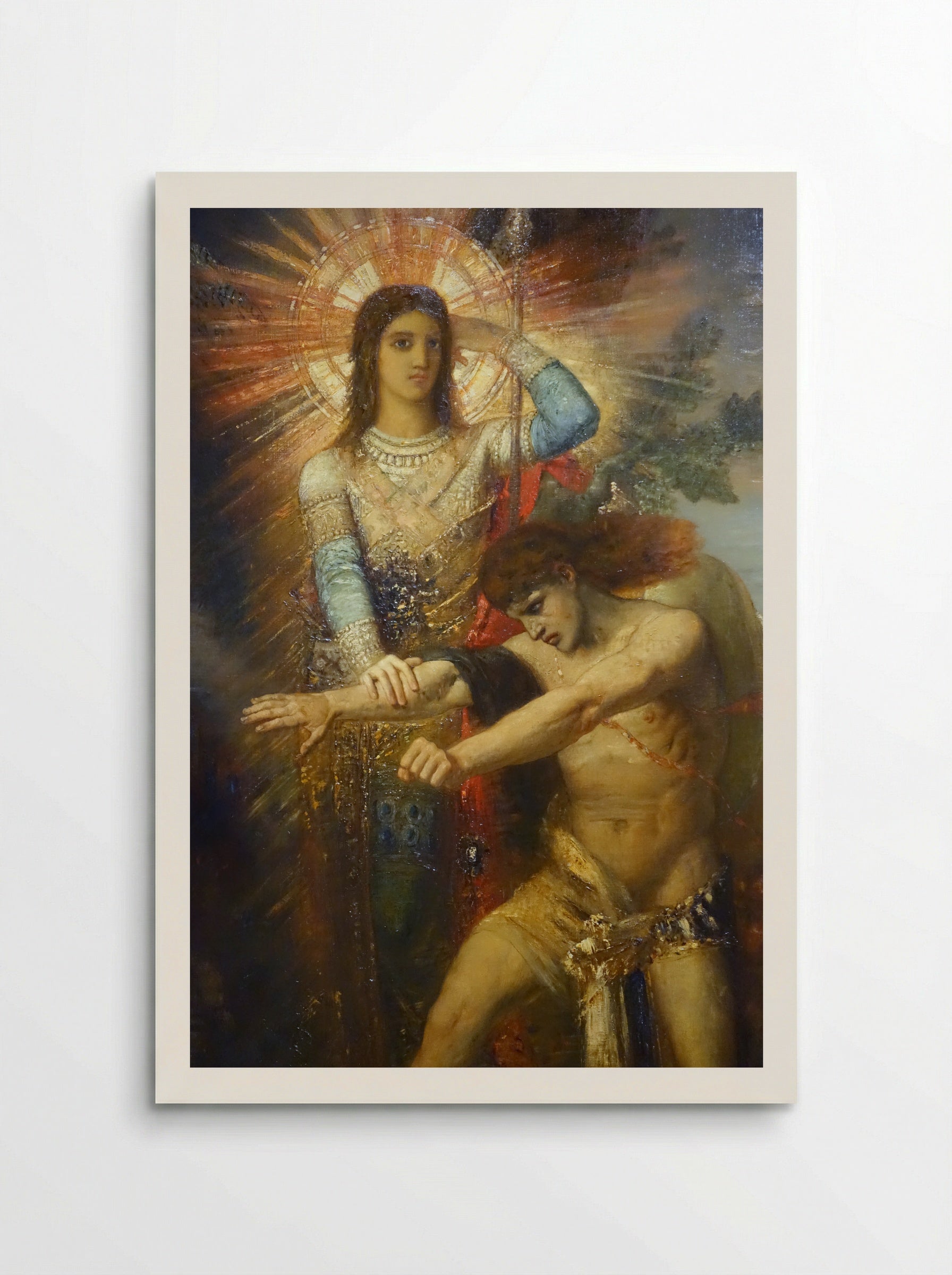
Jacob and the Angel - Gustave Moreau
Archival giclée
Frames arrive ready to hang
Secure checkout
Made to order
Description
A striking Symbolist interpretation of the biblical struggle between Jacob and the angel, featuring luminous detail and a dreamlike atmosphere.
Gustave Moreau, a central figure in the French Symbolist movement, frequently turned to biblical and mythological narratives to explore themes of spiritual struggle and divine encounter. In this depiction of the Genesis account, Jacob is shown in a physical confrontation with a celestial being. Moreau departs from traditional interpretations of this scene, choosing instead to focus on the ethereal and decorative qualities of the figures. The angel is rendered with a luminous, almost metallic quality, adorned in garments that suggest Byzantine influence. A radiant halo emanates from behind the figure, casting a golden light that permeates the composition. Jacob, by contrast, is depicted with a more grounded, human physicality, his posture conveying the exhaustion and intensity of the wrestling match. The background remains ambiguous, allowing the focus to remain entirely on the interaction between the two protagonists. Moreau was known for his meticulous approach to painting, often applying layers of glaze to achieve a jewel-like surface. His work reflects a fascination with the exotic and the mystical, moving away from the objective observation favoured by his contemporaries. This piece demonstrates his ability to transform a familiar narrative into a dreamlike vision, where the boundaries between the physical and the metaphysical appear blurred. The attention to detail in the angel's attire and the dramatic use of light are characteristic of his mature style, which prioritised internal vision over external reality. By isolating the figures against a dark, atmospheric backdrop, Moreau creates a sense of timelessness, inviting the viewer to contemplate the nature of the struggle rather than the specific historical context of the event.
Return policy
Because every print is made to order, we don't offer change-of-mind returns, refunds or exchanges. If your order arrives faulty, damaged or incorrect, we'll replace it free of charge — just contact us within 48 hours of delivery. See our refunds page for full details.
Shipping
We ship worldwide, printing at the production hub nearest to your delivery address. Delivery times and costs vary by destination — you'll see the options available to you at checkout.
Manufacturing
Each print is produced to order using 12-colour giclée printing on FSC-certified archival paper. Designed in Britain and printed at your nearest production hub to reduce waste and speed up delivery.
Care and materials
Specific Features
Every Solis piece is made to order with archival, gallery-quality materials built to last.
- Museum-grade giclée printing for rich, fade-resistant colour
- Archival matte fine-art paper, FSC-certified
- Multiple sizes and framing options available
- Frames in black, natural wood, dark wood or white
- Framed prints arrive ready to hang
Care & Cleaning
To keep your artwork looking its best:
- Dust gently with a soft, dry cloth
- Avoid prolonged direct sunlight
- Never use liquid cleaners on the print or canvas surface
- Keep in a dry, room-temperature space
- Handle prints with clean, dry hands
Materials & Sizing
Museum-grade giclée on FSC-certified archival matte paper, with framed and canvas options.
- Paper sizes: A4, A3, A2, A1, A0 and B2 (50×70 cm)
- Canvas: XS (20×30 cm) to Large (60×90 cm)
- Frames: black, natural wood, dark wood or white
Jacob and the Angel - Gustave Moreau

Artist Biography
Gustave Moreau
He was born in Paris in 1826, a sickly, solitary child who drew compulsively. He trained at the Ecole des Beaux-Arts and fell under the influence of Theodore Chasseriau, an eclectic painter whose depictions of enigmatic sea goddesses left a permanent mark. Chasseriau's death in 1856 shook Moreau badly enough to send him to Italy for two years, where he copied Mantegna, Carpaccio and the Venetians, filling notebooks with studies that fed his work for decades.
His breakthrough came at the 1864 Salon with Oedipus and the Sphinx, a painting that fused classical mythology with a strange, jewelled intensity that critics struggled to categorise. He became the foremost Symbolist painter, working in a style guided by what has been called Neo-Platonist faith: a belief that the physical world was imperfect and that art could capture something closer to divine vision. He never married, regarding the career of an artist as "a true priesthood", though he maintained a discreet relationship with Alexandrine Dureux for decades, subsidising an apartment for her near his family home.
As a teacher at the Ecole des Beaux-Arts, Moreau proved unexpectedly open-minded. His students included Henri Matisse and Georges Rouault, both of whom credited his insistence on personal expression over academic formula. Andre Breton and Salvador Dali later claimed his Symbolist imagery as a direct precursor to Surrealism.
Why Choose Us ?
Damage-free delivery guarantee
Fast Shipping
Museum-Quality Materials
You May Also Like