

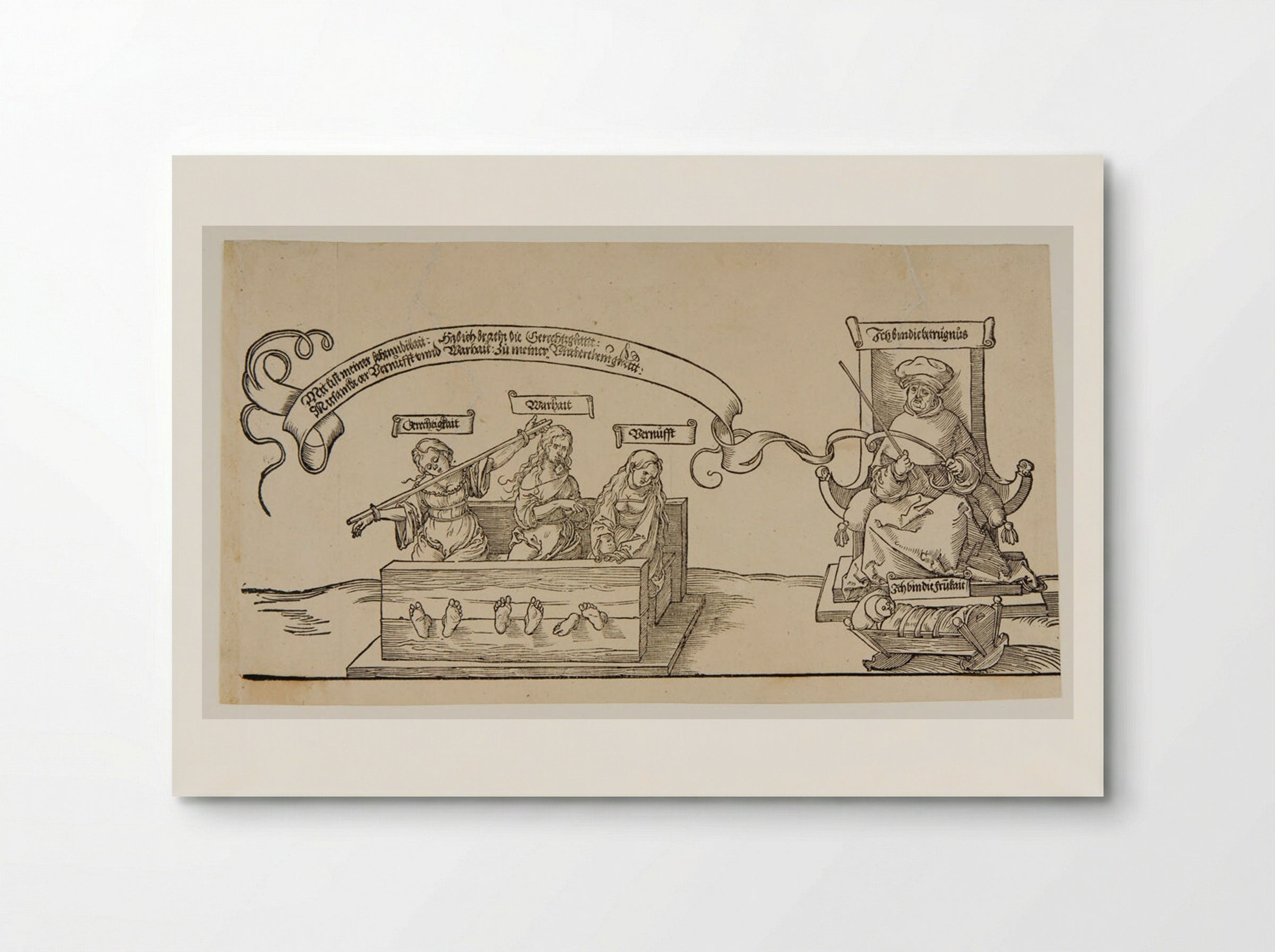
Justice, Truth, and the Future in the Stocks before the False Judge - Albrecht Dürer
Archival giclée
Frames arrive ready to hang
Secure checkout
Made to order
Description
A striking Northern Renaissance woodcut depicting an allegorical scene of virtues imprisoned before a corrupt judge.
This woodcut, attributed to the circle of Albrecht Dürer, presents a stark allegorical narrative typical of the moralising prints produced in Nuremberg during the early sixteenth century. The composition is divided into two distinct zones. On the left, three female figures representing Justice (Gerechtigkeit), Truth (Warheit), and Reason (Vernunft) are confined within wooden stocks. Their posture is one of resignation, their feet exposed in the foreground, while a long scroll unfurls above them, bearing German text that laments their imprisonment by the False Judge. To the right, the False Judge sits upon an elevated throne, holding a staff of office. Below him, a small figure in a cradle is labelled as the Future (Früheit). The visual language relies on clear, linear contours and a flat, stage-like arrangement of figures, which allows the viewer to focus on the didactic nature of the scene. The contrast between the bound virtues and the seated authority figure creates a tension that invites reflection on the corruption of legal and moral systems. Albrecht Dürer, a master of the woodcut medium, elevated the status of the printed image through his technical precision and intellectual depth. While this specific work reflects the broader humanist concerns of the period, it also demonstrates the capacity of the woodcut to disseminate complex social commentary to a wider audience. The stark black-and-white aesthetic emphasises the clarity of the allegory, stripping away unnecessary detail to ensure the message remains legible. This print serves as a historical record of the anxieties surrounding institutional integrity during the Renaissance, captured through the sharp, deliberate lines characteristic of the era's printmaking techniques.
Return policy
Because every print is made to order, we don't offer change-of-mind returns, refunds or exchanges. If your order arrives faulty, damaged or incorrect, we'll replace it free of charge — just contact us within 48 hours of delivery. See our refunds page for full details.
Shipping
We ship worldwide, printing at the production hub nearest to your delivery address. Delivery times and costs vary by destination — you'll see the options available to you at checkout.
Manufacturing
Each print is produced to order using 12-colour giclée printing on FSC-certified archival paper. Designed in Britain and printed at your nearest production hub to reduce waste and speed up delivery.
Care and materials
Specific Features
Every Solis piece is made to order with archival, gallery-quality materials built to last.
- Museum-grade giclée printing for rich, fade-resistant colour
- Archival matte fine-art paper, FSC-certified
- Multiple sizes and framing options available
- Frames in black, natural wood, dark wood or white
- Framed prints arrive ready to hang
Care & Cleaning
To keep your artwork looking its best:
- Dust gently with a soft, dry cloth
- Avoid prolonged direct sunlight
- Never use liquid cleaners on the print or canvas surface
- Keep in a dry, room-temperature space
- Handle prints with clean, dry hands
Materials & Sizing
Museum-grade giclée on FSC-certified archival matte paper, with framed and canvas options.
- Paper sizes: A4, A3, A2, A1, A0 and B2 (50×70 cm)
- Canvas: XS (20×30 cm) to Large (60×90 cm)
- Frames: black, natural wood, dark wood or white
Justice, Truth, and the Future in the Stocks before the False Judge - Albrecht Dürer

Artist Biography
Albrecht Durer
He was born in Nuremberg, the son of a Hungarian goldsmith. He trained as a goldsmith himself before apprenticing with the painter and printmaker Michael Wolgemut. The metalwork training gave him the manual precision that made his prints extraordinary. Melencolia I, Knight, Death and the Devil, and Saint Jerome in His Study, all made between 1513 and 1514, are among the finest engravings ever produced. The density of cross-hatching, the control of tonal gradation, the rendering of fur, feathers, and stone: these are virtuoso performances in a medium that most artists treated as reproductive.
He drew a rhinoceros from a description and a sketch sent by letter. He had never seen one. Dürer's Rhinoceros (1515) is anatomically wrong in several respects (the animal has an extra horn and armour plating) but it remained the standard European image of a rhinoceros for three centuries.
He was one of the first artists to paint self-portraits as a primary subject. The Self-Portrait at Twenty-Eight (1500) shows him facing the viewer directly, with long hair and a fur coat, in a pose traditionally reserved for Christ. It was either an act of supreme confidence or deliberate blasphemy. Probably both.
Why Choose Us ?
Damage-free delivery guarantee
Fast Shipping
Museum-Quality Materials
You May Also Like