

La Fortune - Man Ray
Archival giclée
Frames arrive ready to hang
Secure checkout
Made to order
Description
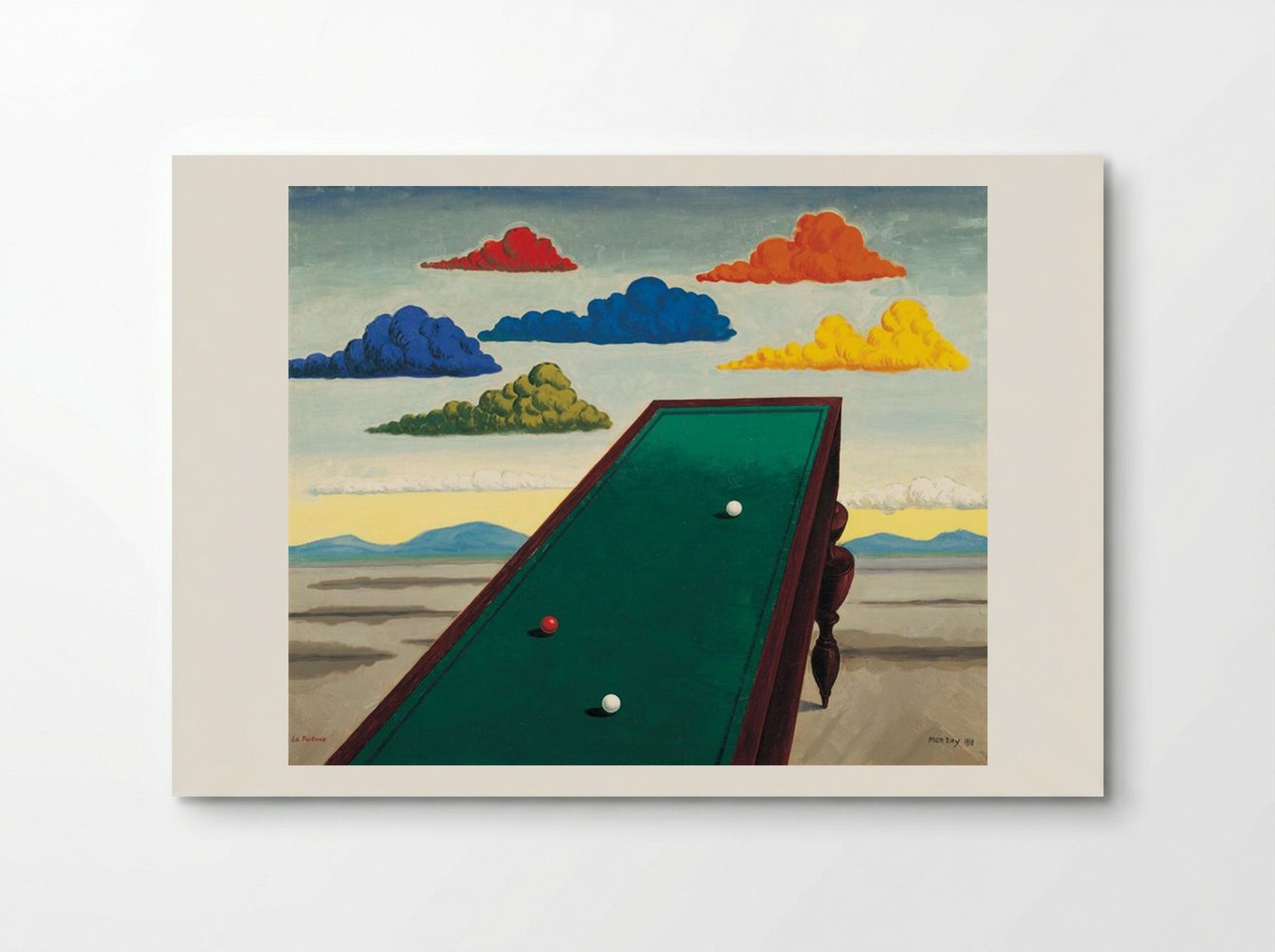
A surrealist composition by Man Ray featuring a billiard table set against a dreamlike sky of multicoloured clouds.
La Fortune, painted by Man Ray in 1938, presents a characteristic example of his approach to Surrealist imagery. The composition features a billiard table positioned at an impossible angle within an expansive, barren plain. The table, rendered with precise perspective, holds three billiard balls, while the sky above is filled with clouds in unnatural, saturated colours. These clouds, ranging from red and orange to blue and yellow, float against a pale, muted background, creating a stark contrast between the grounded object and the dreamlike atmosphere. Man Ray, a central figure in both the Dada and Surrealist movements, often utilised juxtaposition to disrupt conventional perception. By placing a mundane object like a billiard table in a vast, desolate setting, he invites the viewer to consider the irrational nature of reality. The title itself, meaning 'Fortune' or 'Luck', suggests a connection to the element of chance inherent in games, yet the stillness of the scene denies any sense of active play. The work avoids traditional narrative, instead relying on the visual tension between the geometric precision of the table and the fluid, arbitrary forms of the clouds. The painting reflects the artist's interest in the uncanny, a recurring theme in his wider body of work. The smooth, clean application of paint and the deliberate choice of a high-chroma palette for the clouds serve to heighten the sense of displacement. This piece remains a clear demonstration of how Man Ray manipulated familiar objects to evoke a sense of mystery. The absence of human presence further emphasises the isolation of the subject, leaving the viewer to interpret the relationship between the game of chance and the environment in which it is situated.
Return policy
Because every print is made to order, we don't offer change-of-mind returns, refunds or exchanges. If your order arrives faulty, damaged or incorrect, we'll replace it free of charge — just contact us within 48 hours of delivery. See our refunds page for full details.
Shipping
We ship worldwide, printing at the production hub nearest to your delivery address. Delivery times and costs vary by destination — you'll see the options available to you at checkout.
Manufacturing
Each print is produced to order using 12-colour giclée printing on FSC-certified archival paper. Designed in Britain and printed at your nearest production hub to reduce waste and speed up delivery.
La Fortune - Man Ray

Artist Biography
Man Ray
He moved to Paris in 1921 and stayed for twenty years. He arrived knowing Marcel Duchamp, who had been his closest collaborator in New York. The two of them shared an instinct for provocation. Man Ray's contribution to Dada was the 'rayograph', made by placing objects directly on photographic paper and exposing them to light. No camera, no lens. The results look like X-rays of the unconscious: keys, springs, hands, fabrics, rendered as white silhouettes on black.
He became the portrait photographer of the Parisian avant-garde. Picasso, Hemingway, Gertrude Stein, Jean Cocteau, the Surrealists. The portraits are sharp, well-lit, and respectful, which is not what you would expect from a Dadaist. He also worked in fashion photography for Vogue and Harper's Bazaar, which paid the bills and gave him access to models and studios.
The most famous image is Le Violon d'Ingres (1924): a photograph of Kiki de Montparnasse's back with f-holes painted on it, turning a woman into a cello. It is witty, elegant, and uncomfortable in exactly the way Surrealism intended. He claimed to value his paintings more than his photographs. The world disagreed, and he never entirely forgave it.
He returned to Paris after the war and stayed until his death in 1976, at eighty-six.
Our Features
Designed for Lasting Impact
Specific Features
Every Solis piece is made to order with archival, gallery-quality materials built to last.
- Museum-grade giclée printing for rich, fade-resistant colour
- Archival matte fine-art paper, FSC-certified
- Multiple sizes and framing options available
- Frames in black, natural wood, dark wood or white
- Framed prints arrive ready to hang
Care & Cleaning
To keep your artwork looking its best:
- Dust gently with a soft, dry cloth
- Avoid prolonged direct sunlight
- Never use liquid cleaners on the print or canvas surface
- Keep in a dry, room-temperature space
- Handle prints with clean, dry hands
Materials & Sizing
Museum-grade giclée on FSC-certified archival matte paper, with framed and canvas options.
- Paper sizes: A4, A3, A2, A1, A0 and B2 (50×70 cm)
- Canvas: XS (20×30 cm) to Large (60×90 cm)
- Frames: black, natural wood, dark wood or white
Why Choose Us ?
Damage-free delivery guarantee
Fast Shipping
Museum-Quality Materials
Artist Biography
Man Ray
He moved to Paris in 1921 and stayed for twenty years. He arrived knowing Marcel Duchamp, who had been his closest collaborator in New York. The two of them shared an instinct for provocation. Man Ray's contribution to Dada was the 'rayograph', made by placing objects directly on photographic paper and exposing them to light. No camera, no lens. The results look like X-rays of the unconscious: keys, springs, hands, fabrics, rendered as white silhouettes on black.
He became the portrait photographer of the Parisian avant-garde. Picasso, Hemingway, Gertrude Stein, Jean Cocteau, the Surrealists. The portraits are sharp, well-lit, and respectful, which is not what you would expect from a Dadaist. He also worked in fashion photography for Vogue and Harper's Bazaar, which paid the bills and gave him access to models and studios.
The most famous image is Le Violon d'Ingres (1924): a photograph of Kiki de Montparnasse's back with f-holes painted on it, turning a woman into a cello. It is witty, elegant, and uncomfortable in exactly the way Surrealism intended. He claimed to value his paintings more than his photographs. The world disagreed, and he never entirely forgave it.
He returned to Paris after the war and stayed until his death in 1976, at eighty-six.
You May Also Like