

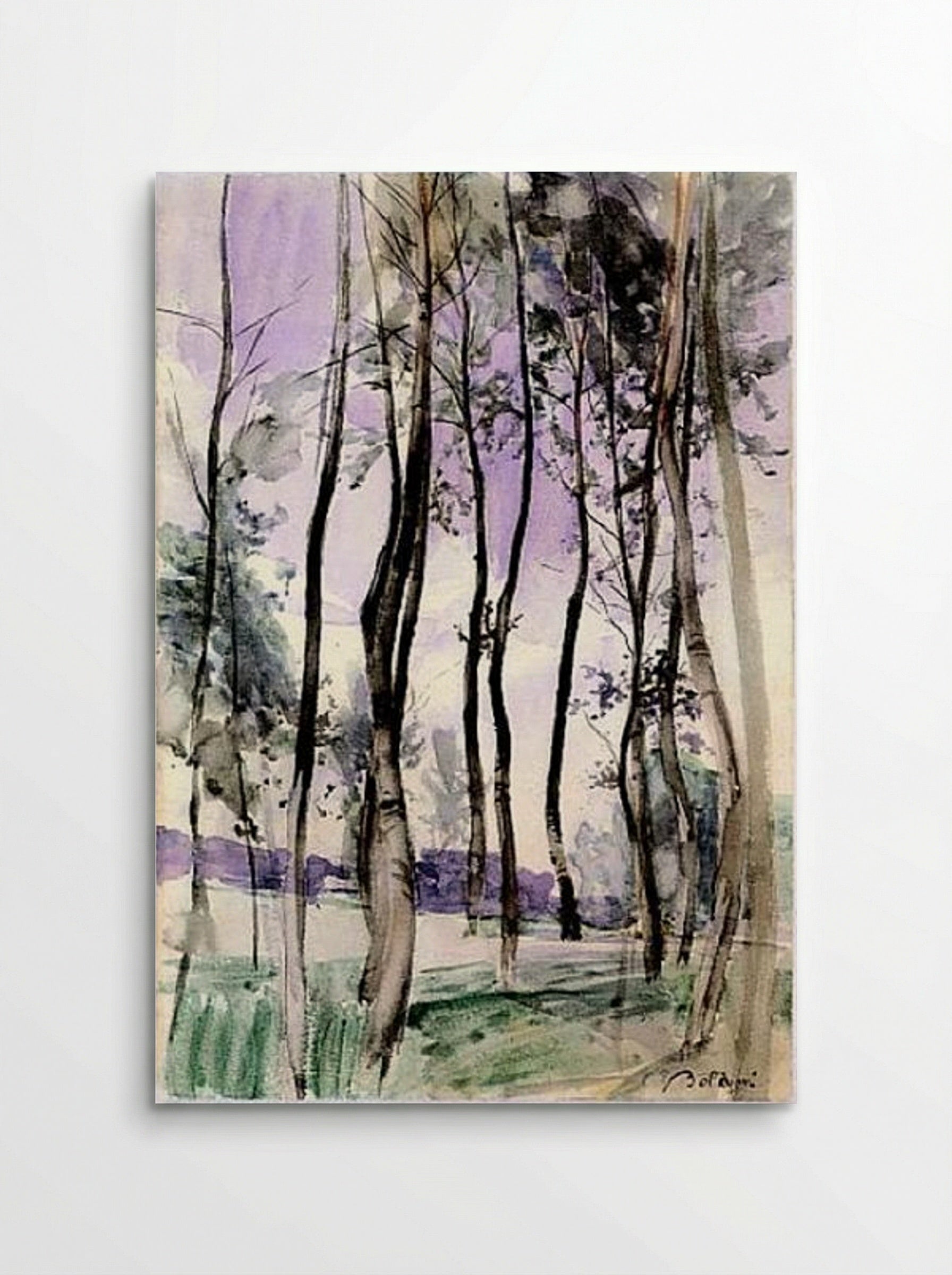
Landscape with Trees - Giovanni Boldini
Archival giclée
Frames arrive ready to hang
Secure checkout
Made to order
Description
A watercolour landscape by Giovanni Boldini, depicting a view through slender trees, rendered in fluid strokes and soft colours.
This watercolour by Giovanni Boldini (1842-1931) presents a view through a copse of slender trees. Boldini, an Italian genre and portrait painter who lived and worked in Paris for most of his career, is known for his energetic style. While celebrated for his portraits of Parisian society figures, Boldini also produced a number of less formal works, including landscapes and studies of figures in motion. These works often display a looser, more spontaneous handling of the medium. The composition is dominated by the verticality of the tree trunks, rendered in dark, fluid strokes. The trees are not depicted with botanical precision; instead, they are suggested through quick, gestural marks. The background is washed with a pale lilac, creating a soft, diffused light. A patch of green indicates the ground, adding a touch of naturalism to the scene. The overall effect is one of immediacy, capturing a fleeting moment in nature. Boldini's signature is visible in the lower right corner.
Return policy
Because every print is made to order, we don't offer change-of-mind returns, refunds or exchanges. If your order arrives faulty, damaged or incorrect, we'll replace it free of charge — just contact us within 48 hours of delivery. See our refunds page for full details.
Shipping
We ship worldwide, printing at the production hub nearest to your delivery address. Delivery times and costs vary by destination — you'll see the options available to you at checkout.
Manufacturing
Each print is produced to order using 12-colour giclée printing on FSC-certified archival paper. Designed in Britain and printed at your nearest production hub to reduce waste and speed up delivery.
Care and materials
Specific Features
Every Solis piece is made to order with archival, gallery-quality materials built to last.
- Museum-grade giclée printing for rich, fade-resistant colour
- Archival matte fine-art paper, FSC-certified
- Multiple sizes and framing options available
- Frames in black, natural wood, dark wood or white
- Framed prints arrive ready to hang
Care & Cleaning
To keep your artwork looking its best:
- Dust gently with a soft, dry cloth
- Avoid prolonged direct sunlight
- Never use liquid cleaners on the print or canvas surface
- Keep in a dry, room-temperature space
- Handle prints with clean, dry hands
Materials & Sizing
Museum-grade giclée on FSC-certified archival matte paper, with framed and canvas options.
- Paper sizes: A4, A3, A2, A1, A0 and B2 (50×70 cm)
- Canvas: XS (20×30 cm) to Large (60×90 cm)
- Frames: black, natural wood, dark wood or white
Landscape with Trees - Giovanni Boldini

Artist Biography
Giovanni Boldini
He was born in Ferrara in 1842, the son of a painter. He was filling sketchbooks by the age of five, before he could write. At eighteen he already had a reputation as a portraitist. In 1862 he went to Florence and fell in with the Macchiaioli, the Italian precursors to Impressionism whose broken brushwork and plein-air practice influenced his early style. He reached Paris in 1871 and stayed.
Time magazine later called him the "Master of Swish" for his fluid, elongated brushstrokes. His portraits captured sitters in soft focus, stretching their features to accentuate elegance and creating a sense of motion that made his subjects look both sophisticated and restless. The technique owed something to Parmigianino's Mannerist elongations and anticipated Futurism's interest in movement. He was friends with Degas, Manet, Sisley, Caillebotte and Corot, and in 1889 travelled to Spain with Degas to study Velazquez and Goya.
He worked in oil, pastel, watercolour and drawing, and was prolific across all media. He died in Paris in 1931, at eighty-eight, having outlived Belle Epoque society and the world that had kept him busy.
Why Choose Us ?
Damage-free delivery guarantee
Fast Shipping
Museum-Quality Materials
You May Also Like