

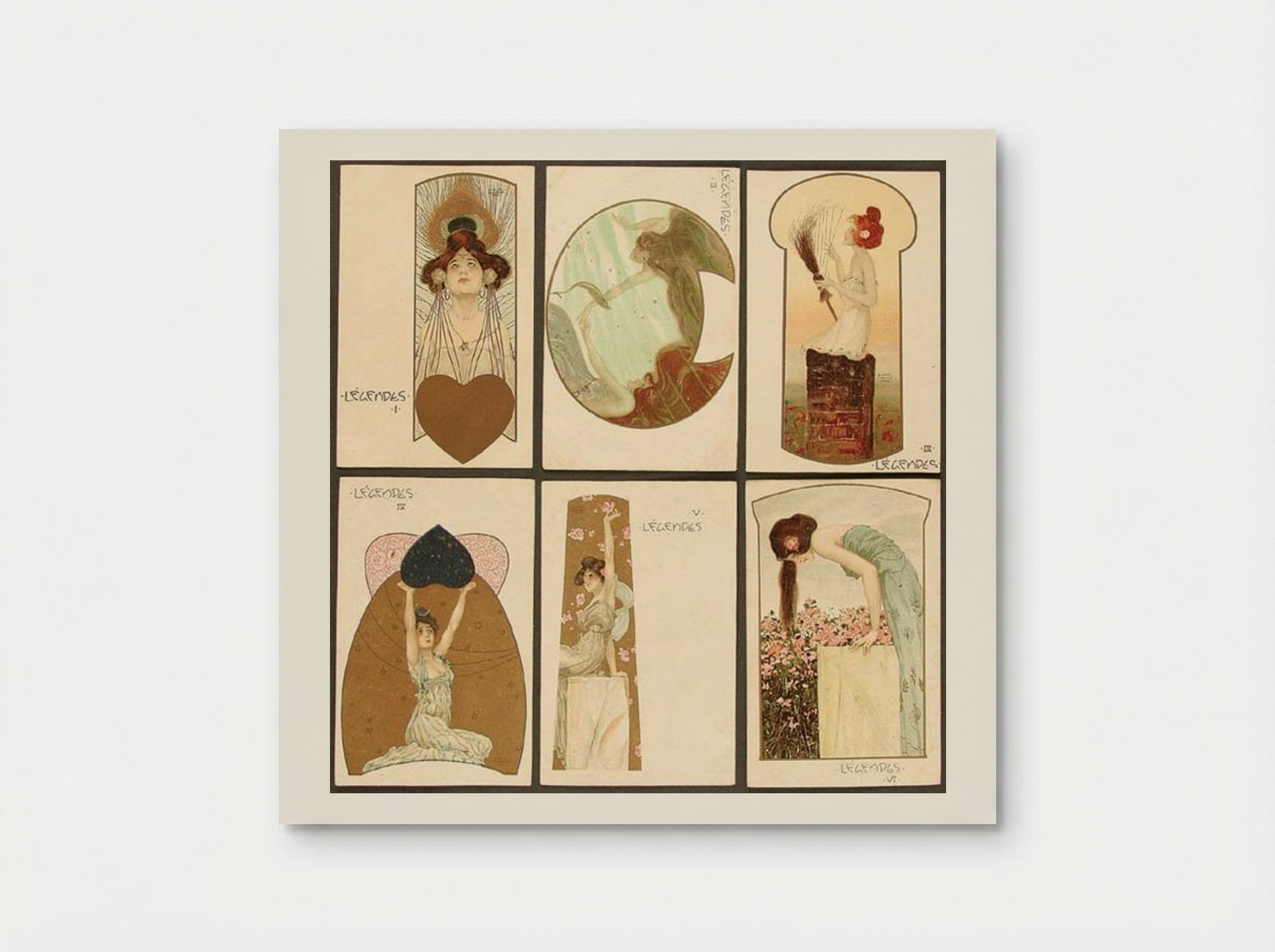
Légendes - Raphael Kirchner
Archival giclée
Frames arrive ready to hang
Secure checkout
Made to order
Description
A series of six Art Nouveau illustrations by Raphael Kirchner, depicting allegorical female figures in decorative frames. These lithographs are representative of the elegant Belle Époque style.
Raphael Kirchner was an Austrian artist who became a prominent figure in the Parisian illustration scene during the Belle Époque. This series, titled Légendes, consists of six distinct panels. Each panel depicts a female figure in a stylised, allegorical setting. The work reflects the Art Nouveau movement through its use of organic forms and decorative framing. The first panel shows a woman with a peacock feather halo above a large heart. The second features a mermaid-like figure in a circular composition. The third depicts a woman holding a bundle of grain, seated atop a stone plinth. In the fourth, a kneeling figure lifts a dark heart-shaped object. The fifth shows a woman reaching towards pink blossoms. The final panel portrays a woman in a green gown leaning over a stone wall amidst a garden of flowers. Kirchner moved to Paris in the year 1900. His work gained popularity through the publication of postcard series that collectors sought after across Europe. The Légendes series demonstrates the influence of Japanese woodblock prints on European art. This is evident in the flat application of colour and the use of strong outlines. Each panel functions as a standalone piece while contributing to the thematic unity of the collection. The artist used lithography to produce these images. This technique allowed for the subtle gradations of tone seen in the backgrounds and the delicate rendering of the figures' features. The compositions are often asymmetrical, a common trait in Art Nouveau design. The use of negative space in the fifth panel, where the figure is positioned against a plain cream background, draws attention to the floral details and the woman's pose. This series is a representative work of the intersection between commercial illustration and fine art during the turn of the century.
Return policy
Because every print is made to order, we don't offer change-of-mind returns, refunds or exchanges. If your order arrives faulty, damaged or incorrect, we'll replace it free of charge — just contact us within 48 hours of delivery. See our refunds page for full details.
Shipping
We ship worldwide, printing at the production hub nearest to your delivery address. Delivery times and costs vary by destination — you'll see the options available to you at checkout.
Manufacturing
Each print is produced to order using 12-colour giclée printing on FSC-certified archival paper. Designed in Britain and printed at your nearest production hub to reduce waste and speed up delivery.
Care and materials
Specific Features
Every Solis piece is made to order with archival, gallery-quality materials built to last.
- Museum-grade giclée printing for rich, fade-resistant colour
- Archival matte fine-art paper, FSC-certified
- Multiple sizes and framing options available
- Frames in black, natural wood, dark wood or white
- Framed prints arrive ready to hang
Care & Cleaning
To keep your artwork looking its best:
- Dust gently with a soft, dry cloth
- Avoid prolonged direct sunlight
- Never use liquid cleaners on the print or canvas surface
- Keep in a dry, room-temperature space
- Handle prints with clean, dry hands
Materials & Sizing
Museum-grade giclée on FSC-certified archival matte paper, with framed and canvas options.
- Paper sizes: A4, A3, A2, A1, A0 and B2 (50×70 cm)
- Canvas: XS (20×30 cm) to Large (60×90 cm)
- Frames: black, natural wood, dark wood or white
Légendes - Raphael Kirchner

Artist Biography
Raphael Kirchner
He was born in Vienna in 1875, studied at the Academy of Fine Arts there, and moved to Paris in 1900. At the outbreak of the First World War he relocated to New York, where he spent his final years designing panels, costumes and programmes for Florenz Ziegfeld's Follies at the Century Theatre. He died in New York in 1917, at forty-two.
Why Choose Us ?
Damage-free delivery guarantee
Fast Shipping
Museum-Quality Materials
You May Also Like