

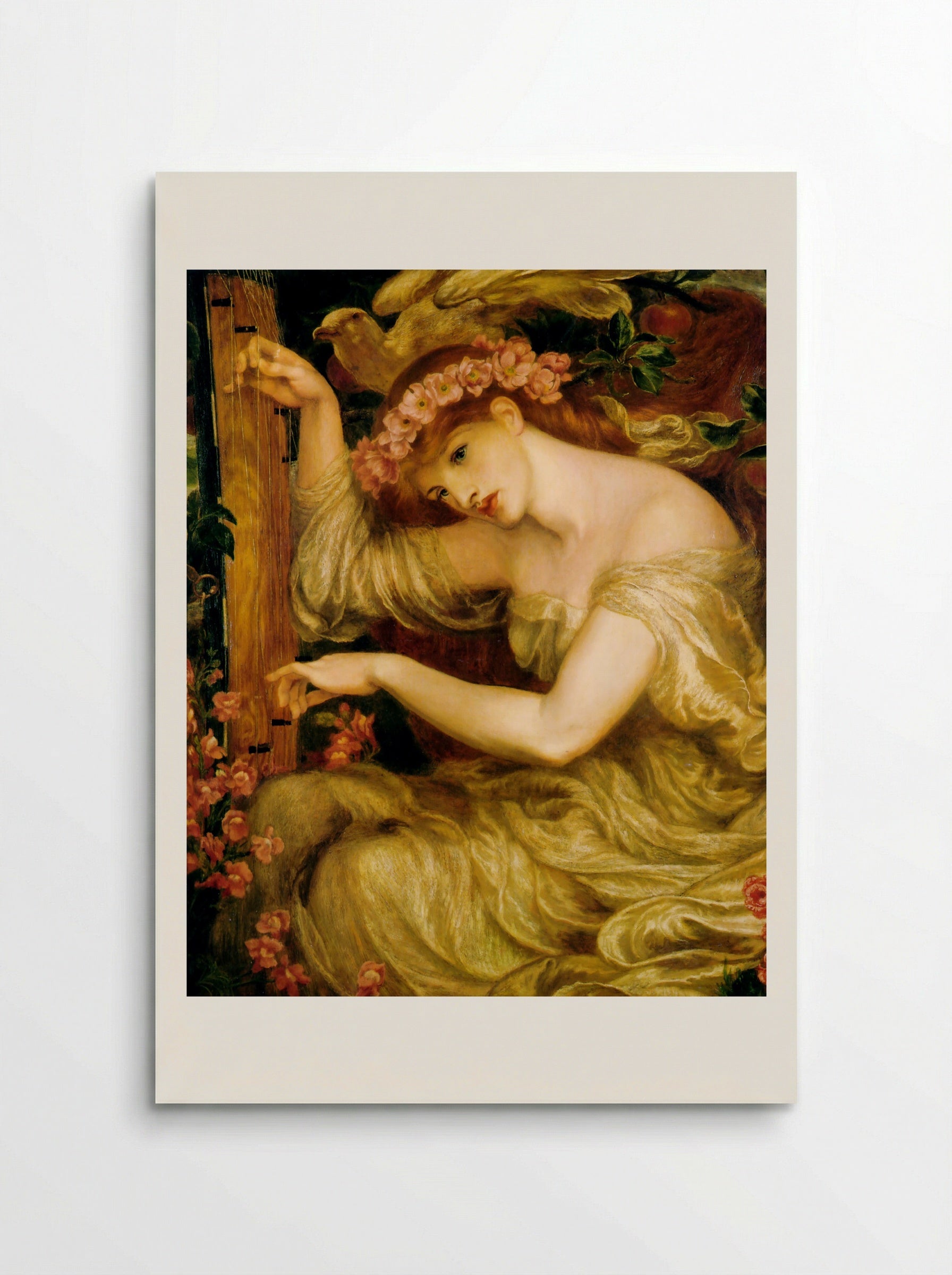
Ligeia Siren - Dante Gabriel Rossetti
Archival giclée
Frames arrive ready to hang
Secure checkout
Made to order
Description
A portrait by Dante Gabriel Rossetti featuring Alexa Wilding as a musical siren, rendered in the characteristic style of the Pre-Raphaelite movement.
Dante Gabriel Rossetti painted Ligeia Siren in 1873, a period when his work focused on the depiction of idealised female figures. The subject is Alexa Wilding, one of his most frequent models, who appears here with the characteristic auburn hair and heavy-lidded gaze common to the artist's later output. The composition features the figure playing a stringed instrument, a motif Rossetti employed to suggest musicality and poetic mood. The painting displays the technical hallmarks of the Pre-Raphaelite style, including a focus on saturated colour and a dense, atmospheric background. The figure is adorned with a wreath of pink blossoms, which echoes the floral elements surrounding the base of the instrument. Rossetti uses light to model the form of the subject, creating a soft, luminous quality on the skin and the folds of the drapery. The inclusion of a bird in the upper portion of the frame adds a layer of symbolic ambiguity, a common feature in his mythological and literary subjects. This work reflects the artist's interest in the intersection of music, poetry, and visual art. By placing the figure in a setting that feels removed from a specific time or place, Rossetti invites the viewer to engage with the mood of the piece rather than a narrative event. The handling of the paint, particularly in the treatment of the hair and the fabric, demonstrates his ability to render textures with precision. The work remains a representative example of the aesthetic concerns that occupied Rossetti during the 1870s, specifically his exploration of beauty as a primary subject for painting.
Return policy
Because every print is made to order, we don't offer change-of-mind returns, refunds or exchanges. If your order arrives faulty, damaged or incorrect, we'll replace it free of charge — just contact us within 48 hours of delivery. See our refunds page for full details.
Shipping
We ship worldwide, printing at the production hub nearest to your delivery address. Delivery times and costs vary by destination — you'll see the options available to you at checkout.
Manufacturing
Each print is produced to order using 12-colour giclée printing on FSC-certified archival paper. Designed in Britain and printed at your nearest production hub to reduce waste and speed up delivery.
Care and materials
Specific Features
Every Solis piece is made to order with archival, gallery-quality materials built to last.
- Museum-grade giclée printing for rich, fade-resistant colour
- Archival matte fine-art paper, FSC-certified
- Multiple sizes and framing options available
- Frames in black, natural wood, dark wood or white
- Framed prints arrive ready to hang
Care & Cleaning
To keep your artwork looking its best:
- Dust gently with a soft, dry cloth
- Avoid prolonged direct sunlight
- Never use liquid cleaners on the print or canvas surface
- Keep in a dry, room-temperature space
- Handle prints with clean, dry hands
Materials & Sizing
Museum-grade giclée on FSC-certified archival matte paper, with framed and canvas options.
- Paper sizes: A4, A3, A2, A1, A0 and B2 (50×70 cm)
- Canvas: XS (20×30 cm) to Large (60×90 cm)
- Frames: black, natural wood, dark wood or white
Ligeia Siren - Dante Gabriel Rossetti

Artist Biography
Dante Gabriel Rossetti
He was born in London to an Italian political exile and named after the author of the Divine Comedy. His father was a professor of Italian at King's College. The household ran on poetry, politics, and argument. Rossetti wrote verse throughout his life and considered himself a poet as much as a painter.
His early paintings are small, bright, and meticulously detailed in the Pre-Raphaelite manner. The Girlhood of Mary Virgin and Ecce Ancilla Domini have the flat, jewelled quality of medieval altarpieces. After 1860 the style changed. The paintings became larger, more sensual, and dominated by the face and figure of Jane Burden, who was William Morris's wife.
The relationship between Rossetti, Morris, and Jane is one of the more uncomfortable triangles in art history. Morris married her. Rossetti painted her obsessively. She modelled for Proserpine, La Pia de' Tolomei, and dozens of other works in which she appears as a mythological woman trapped in an unwanted situation. Whether the affair was physical remains debated. Morris, characteristically, said nothing publicly and channelled his feelings into wallpaper.
Rossetti buried a manuscript of his poems in his wife Lizzie Siddal's coffin when she died of a laudanum overdose in 1862. Seven years later he had the coffin exhumed to retrieve them. He published the poems. He was addicted to chloral hydrate by then and increasingly paranoid. He died in 1882, at fifty-three.
Why Choose Us ?
Damage-free delivery guarantee
Fast Shipping
Museum-Quality Materials
You May Also Like