

Fine Art Poster
From $29
A giclée print on 200gsm matte fine art paper, using a twelve-colour process for accurate, fade-resistant colour. Supplied unframed, delivered flat or rolled.



Archival giclée
Frames arrive ready to hang
Secure checkout
Made to order
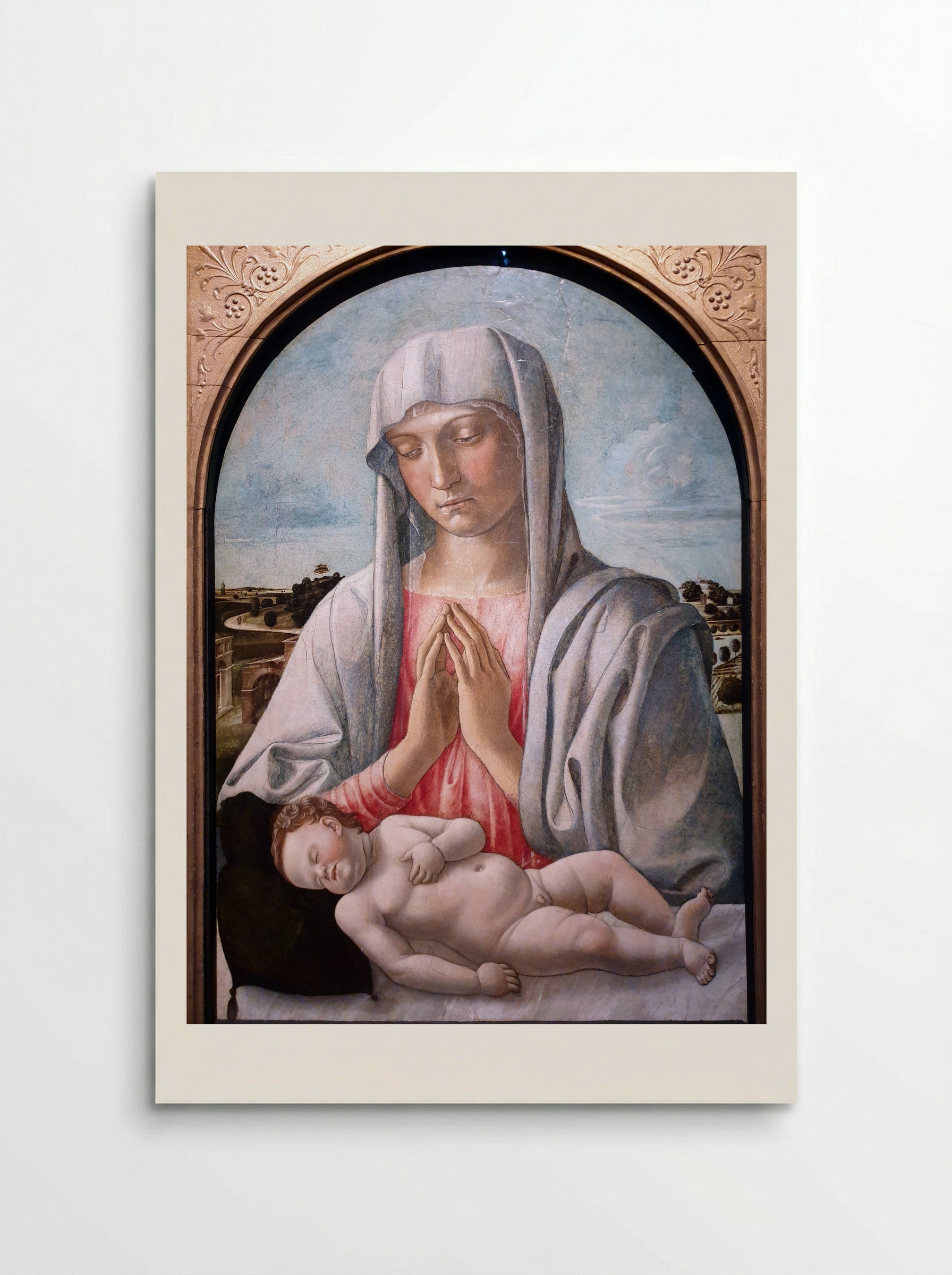
A serene Renaissance devotional work by Giovanni Bellini, depicting the Virgin Mary in quiet prayer over the sleeping infant Christ.
Giovanni Bellini, a master of the Venetian school, produced this devotional work during the latter half of the fifteenth century. The composition focuses on the intimate connection between the Virgin Mary and the infant Christ. Mary is depicted with her hands joined in prayer, her gaze directed downward toward the sleeping child who rests upon a white cloth. The artist employs a balanced arrangement, placing the figures against a backdrop that transitions from a soft, atmospheric sky to a distant, rolling horizon. This inclusion of a natural setting is characteristic of Bellini, who often integrated human subjects with the surrounding environment to create a sense of quiet contemplation. The painting demonstrates the artist's technical skill in handling oil paint, a medium that allowed for subtle gradations of light and shadow. The drapery of the Virgin's mantle is rendered with soft folds, providing a sense of volume and weight. Her expression is one of solemnity, reflecting the theological themes of the period. The infant Christ is painted with a focus on anatomical realism, his relaxed posture contrasting with the structured, vertical presence of the mother. The use of colour is restrained, relying on muted tones that contribute to the serene atmosphere of the scene. The arched top of the panel suggests its original purpose as part of a larger architectural frame or altarpiece, common in ecclesiastical settings of the time. Through this work, Bellini captures a moment of domestic stillness, elevating the subject through careful observation and refined execution. The painting remains a clear example of the transition toward the atmospheric depth that would define Venetian painting in the decades that followed.
Because every print is made to order, we don't offer change-of-mind returns, refunds or exchanges. If your order arrives faulty, damaged or incorrect, we'll replace it free of charge — just contact us within 48 hours of delivery. See our refunds page for full details.
We ship worldwide, printing at the production hub nearest to your delivery address. Delivery times and costs vary by destination — you'll see the options available to you at checkout.
Each print is produced to order using 12-colour giclée printing on FSC-certified archival paper. Designed in Britain and printed at your nearest production hub to reduce waste and speed up delivery.

Artist Biography
Our Features
Designed for Lasting Impact
Every Solis piece is made to order with archival, gallery-quality materials built to last.
To keep your artwork looking its best:
Museum-grade giclée on FSC-certified archival matte paper, with framed and canvas options.
Made to order
Every piece is printed to order. These are the five finishes, and what makes each one different.
From $29
A giclée print on 200gsm matte fine art paper, using a twelve-colour process for accurate, fade-resistant colour. Supplied unframed, delivered flat or rolled.

From $89
The same fine art print in a solid wood frame with UV-protective acrylic glaze and rigid backing. Five frame colours. Arrives ready to hang.

From $169
A deeper solid wood frame: 33mm deep with a 20mm face and Perspex glaze. The print sits unmounted for a clean gallery presentation. Black, white or natural.

From $59
Hand-stretched canvas with neat gallery-wrapped edges, giving the artwork surface texture and depth. Arrives ready to hang.

From $175
Stretched canvas set in a floating wood frame, our most substantial finish. Arrives ready to hang.
Why Choose Us ?
Damage-free delivery guarantee
Fast Shipping
Museum-Quality Materials
Artist Biography
Giovanni Bellini
You May Also Like
Cookies show us which prints people love, so we hang the right art. Help us fill it?
Essential cookies only if you prefer · Privacy Policy