

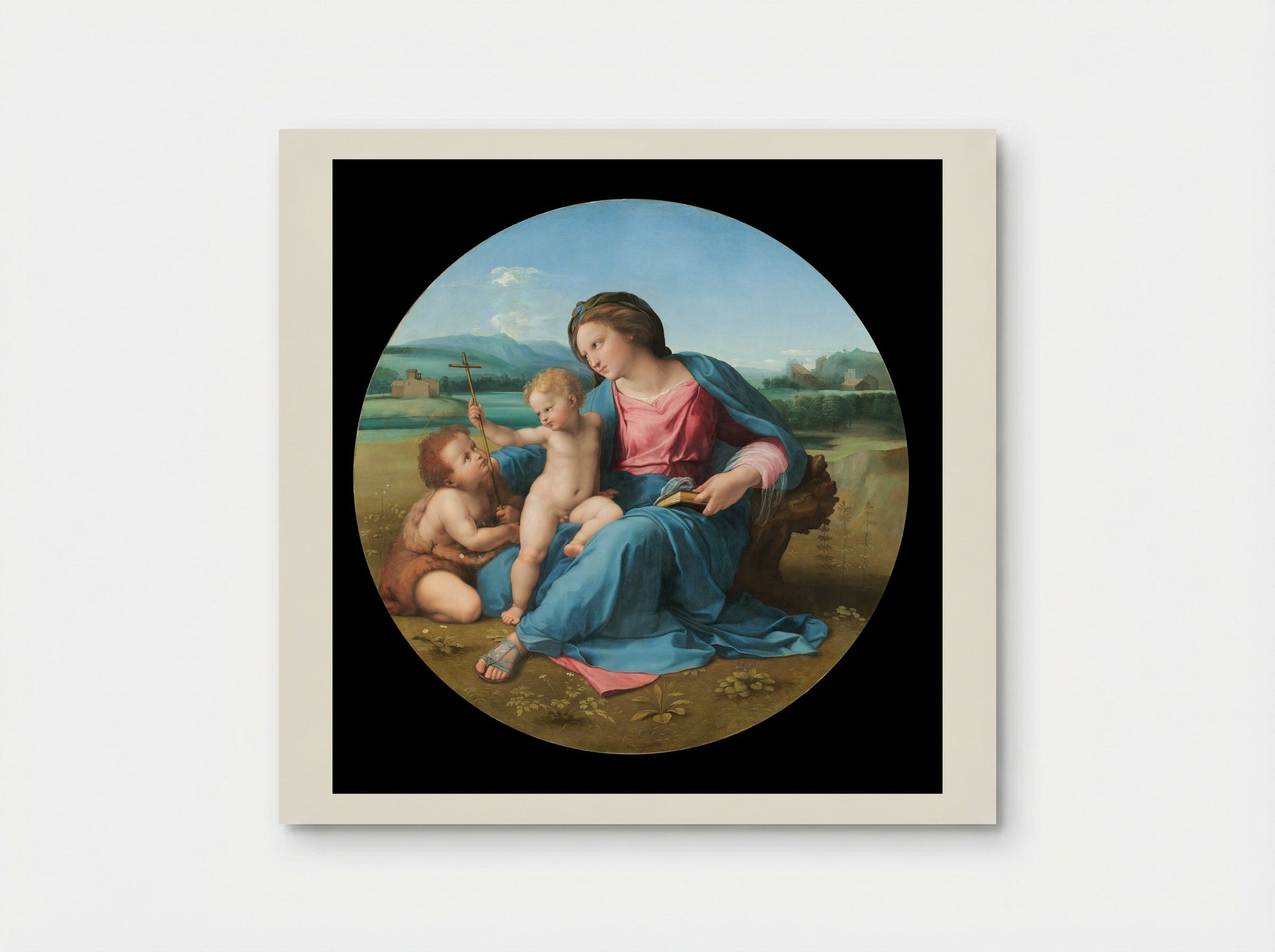
Madonna del Prato - Raphael
Archival giclée
Frames arrive ready to hang
Secure checkout
Made to order
Description
A classic High Renaissance tondo by Raphael, depicting the Virgin Mary with the infant Jesus and John the Baptist in a serene landscape.
The Madonna del Prato, also known as the Madonna of the Meadow, is a quintessential example of Raphael's Florentine period. Painted in 1506, the work depicts the Virgin Mary with the infant Jesus and the young John the Baptist. The composition is arranged in a stable triangular form, a hallmark of the High Renaissance, which provides a sense of balance and harmony to the scene. Mary sits on a grassy bank, her gaze directed towards the two children, while the landscape stretches out behind them in a soft, atmospheric manner. The figures are rendered with a gentle naturalism, their forms modelled through subtle gradations of light and shadow. The Virgin's blue mantle and pink tunic provide a clear chromatic structure, drawing the eye towards the centre of the panel. The interaction between the children, with the young John the Baptist offering a reed cross to the Christ child, is captured with a quiet, meditative quality. The background features a distant view of a town and rolling hills, typical of the Umbrian and Florentine influences that shaped Raphael's early career. This work reflects the artist's mastery of human anatomy and spatial depth. The circular format, or tondo, was a popular choice for domestic devotional art in Italy during this period. The painting is currently housed in the Kunsthistorisches Museum in Vienna. Our fine art print captures the delicate brushwork and the soft, luminous quality of the original oil on panel, allowing for a detailed appreciation of Raphael's technique. The composition remains a clear demonstration of the balance between human emotion and formal geometric order that defined the artistic output of the early sixteenth century in Italy.
Return policy
Because every print is made to order, we don't offer change-of-mind returns, refunds or exchanges. If your order arrives faulty, damaged or incorrect, we'll replace it free of charge — just contact us within 48 hours of delivery. See our refunds page for full details.
Shipping
We ship worldwide, printing at the production hub nearest to your delivery address. Delivery times and costs vary by destination — you'll see the options available to you at checkout.
Manufacturing
Each print is produced to order using 12-colour giclée printing on FSC-certified archival paper. Designed in Britain and printed at your nearest production hub to reduce waste and speed up delivery.
Care and materials
Specific Features
Every Solis piece is made to order with archival, gallery-quality materials built to last.
- Museum-grade giclée printing for rich, fade-resistant colour
- Archival matte fine-art paper, FSC-certified
- Multiple sizes and framing options available
- Frames in black, natural wood, dark wood or white
- Framed prints arrive ready to hang
Care & Cleaning
To keep your artwork looking its best:
- Dust gently with a soft, dry cloth
- Avoid prolonged direct sunlight
- Never use liquid cleaners on the print or canvas surface
- Keep in a dry, room-temperature space
- Handle prints with clean, dry hands
Materials & Sizing
Museum-grade giclée on FSC-certified archival matte paper, with framed and canvas options.
- Paper sizes: A4, A3, A2, A1, A0 and B2 (50×70 cm)
- Canvas: XS (20×30 cm) to Large (60×90 cm)
- Frames: black, natural wood, dark wood or white
Madonna del Prato - Raphael

Artist Biography
Raphael
He was born in Urbino, the son of a painter. His father died when he was eleven, and by his teens he was already working in the studio of Perugino, whose smooth, symmetrical compositions gave Raphael his starting point. He surpassed Perugino quickly. He studied Leonardo's sfumato and Michelangelo's anatomical intensity and absorbed both without losing his own clarity. The Madonnas from his Florentine period (the Madonna of the Goldfinch, the Sistine Madonna) have a serene perfection that has been imitated for five hundred years and never matched.
Pope Julius II summoned him to Rome in 1508, the same year he commissioned Michelangelo for the Sistine ceiling. Raphael painted the Stanze della Segnatura: four rooms in the Vatican whose frescoes include The School of Athens, the single most famous image of classical philosophy. Plato and Aristotle walk through an ideal architecture surrounded by every major thinker of the ancient world. Raphael painted Michelangelo into the scene as Heraclitus, brooding alone on the steps. Michelangelo was furious.
He ran a large workshop that produced portraits, altarpieces, tapestry designs, and architectural plans. He was appointed architect of St Peter's Basilica. He was charming, diplomatic, and universally liked, which made Michelangelo dislike him even more.
Why Choose Us ?
Damage-free delivery guarantee
Fast Shipping
Museum-Quality Materials
You May Also Like