

Fine Art Poster
From $29
A giclée print on 200gsm matte fine art paper, using a twelve-colour process for accurate, fade-resistant colour. Supplied unframed, delivered flat or rolled.



Archival giclée
Frames arrive ready to hang
Secure checkout
Made to order
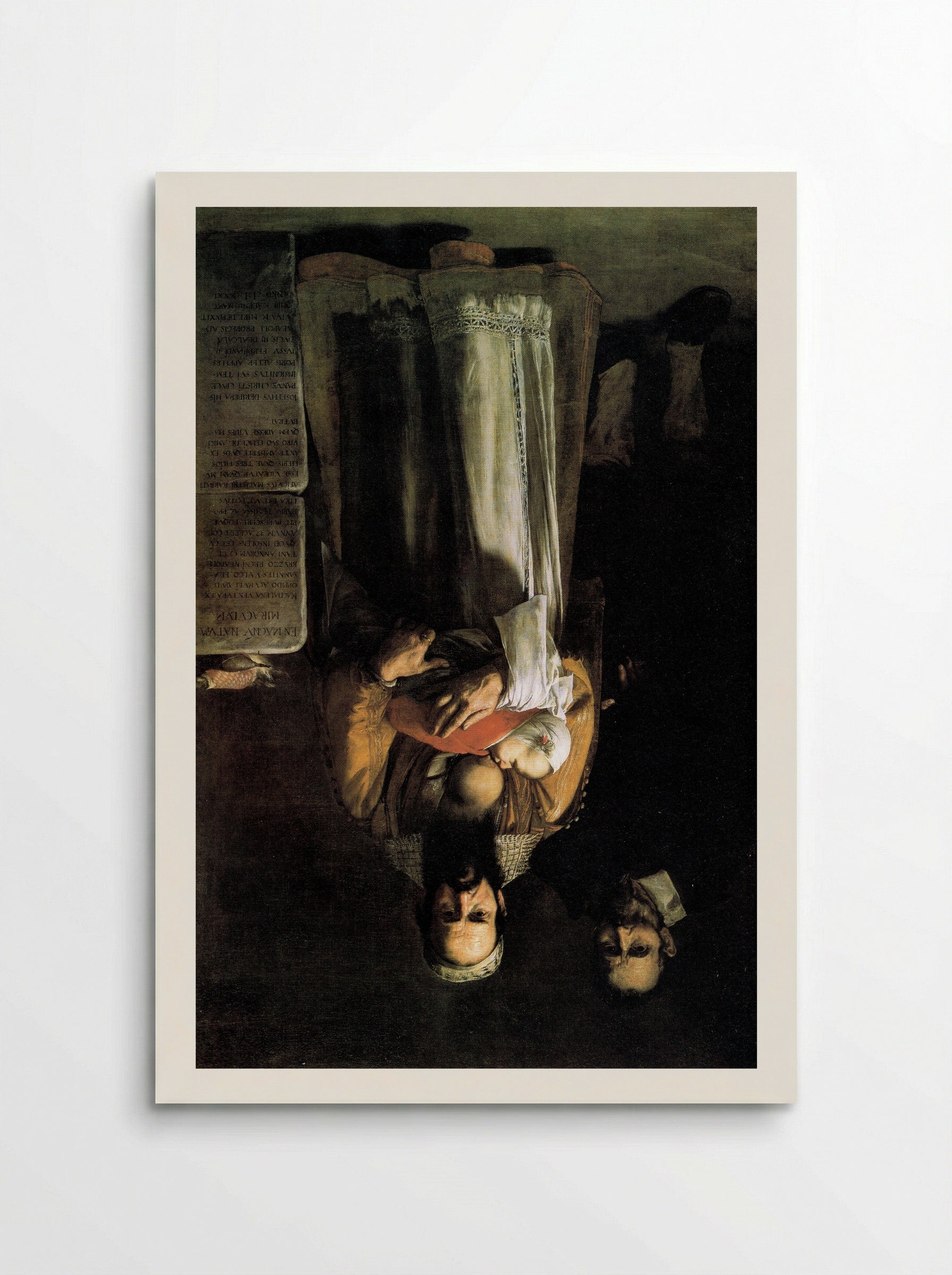
A 1631 Baroque portrait by Jusepe de Ribera depicting Magdalena Ventura, a woman known for her hirsutism, alongside her husband and infant son.
Painted in 1631, this work by Jusepe de Ribera depicts Magdalena Ventura, a woman from the Abruzzo region of Italy who was known for her hirsutism. Commissioned by the Third Duke of Alcalá, Fernando Afán de Ribera, the painting documents a medical curiosity of the seventeenth century. Ribera presents the subject with a direct, unflinching gaze, seated with her husband and infant son. The composition employs a stark chiaroscuro, a technique characteristic of the artist's training in the tradition of Caravaggio. The light source illuminates the textures of the clothing and the physical features of the figures, while the background remains obscured in shadow. To the left of the figures, a stone tablet provides a detailed Latin inscription. This text explains the circumstances of the commission and describes the subject's condition, framing the painting as a scientific record rather than a conventional portrait. The inclusion of the husband and child provides a domestic context, contrasting the biological anomaly of the mother with the ordinary appearance of her family. Ribera captures the physical reality of the subjects with precision, avoiding idealisation. The work remains in the collection of the Fundación Casa Ducal de Medinaceli, housed at the Hospital de Tavera in Toledo. It is a significant example of how seventeenth-century artists engaged with the unusual, the medical, and the empirical, moving beyond religious or mythological subjects to document the diversity of human experience.
Because every print is made to order, we don't offer change-of-mind returns, refunds or exchanges. If your order arrives faulty, damaged or incorrect, we'll replace it free of charge — just contact us within 48 hours of delivery. See our refunds page for full details.
We ship worldwide, printing at the production hub nearest to your delivery address. Delivery times and costs vary by destination — you'll see the options available to you at checkout.
Each print is produced to order using 12-colour giclée printing on FSC-certified archival paper. Designed in Britain and printed at your nearest production hub to reduce waste and speed up delivery.
Specific Features
Every Solis piece is made to order with archival, gallery-quality materials built to last.
Care & Cleaning
To keep your artwork looking its best:
Materials & Sizing
Museum-grade giclée on FSC-certified archival matte paper, with framed and canvas options.

Artist Biography
Made to order
Every piece is printed to order. These are the five finishes, and what makes each one different.
From $29
A giclée print on 200gsm matte fine art paper, using a twelve-colour process for accurate, fade-resistant colour. Supplied unframed, delivered flat or rolled.

From $89
The same fine art print in a solid wood frame with UV-protective acrylic glaze and rigid backing. Five frame colours. Arrives ready to hang.

From $169
A deeper solid wood frame: 33mm deep with a 20mm face and Perspex glaze. The print sits unmounted for a clean gallery presentation. Black, white or natural.

From $59
Hand-stretched canvas with neat gallery-wrapped edges, giving the artwork surface texture and depth. Arrives ready to hang.

From $175
Stretched canvas set in a floating wood frame, our most substantial finish. Arrives ready to hang.
Why Choose Us ?
Damage-free delivery guarantee
Fast Shipping
Museum-Quality Materials
You May Also Like
We use cookies to measure our marketing and see which prints people love.We use cookies to measure our marketing.
By continuing to browse, you agree · Privacy Policy