



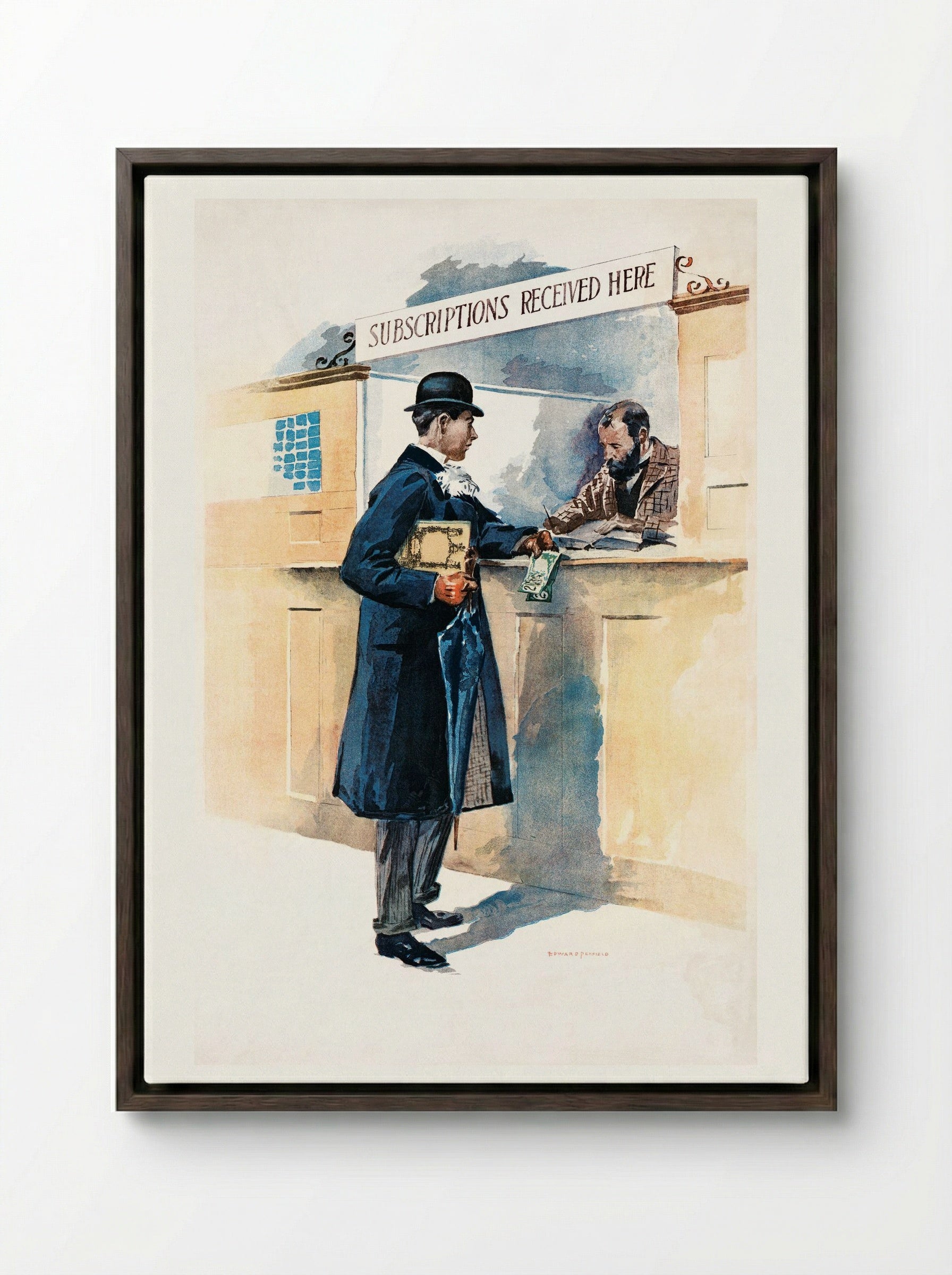


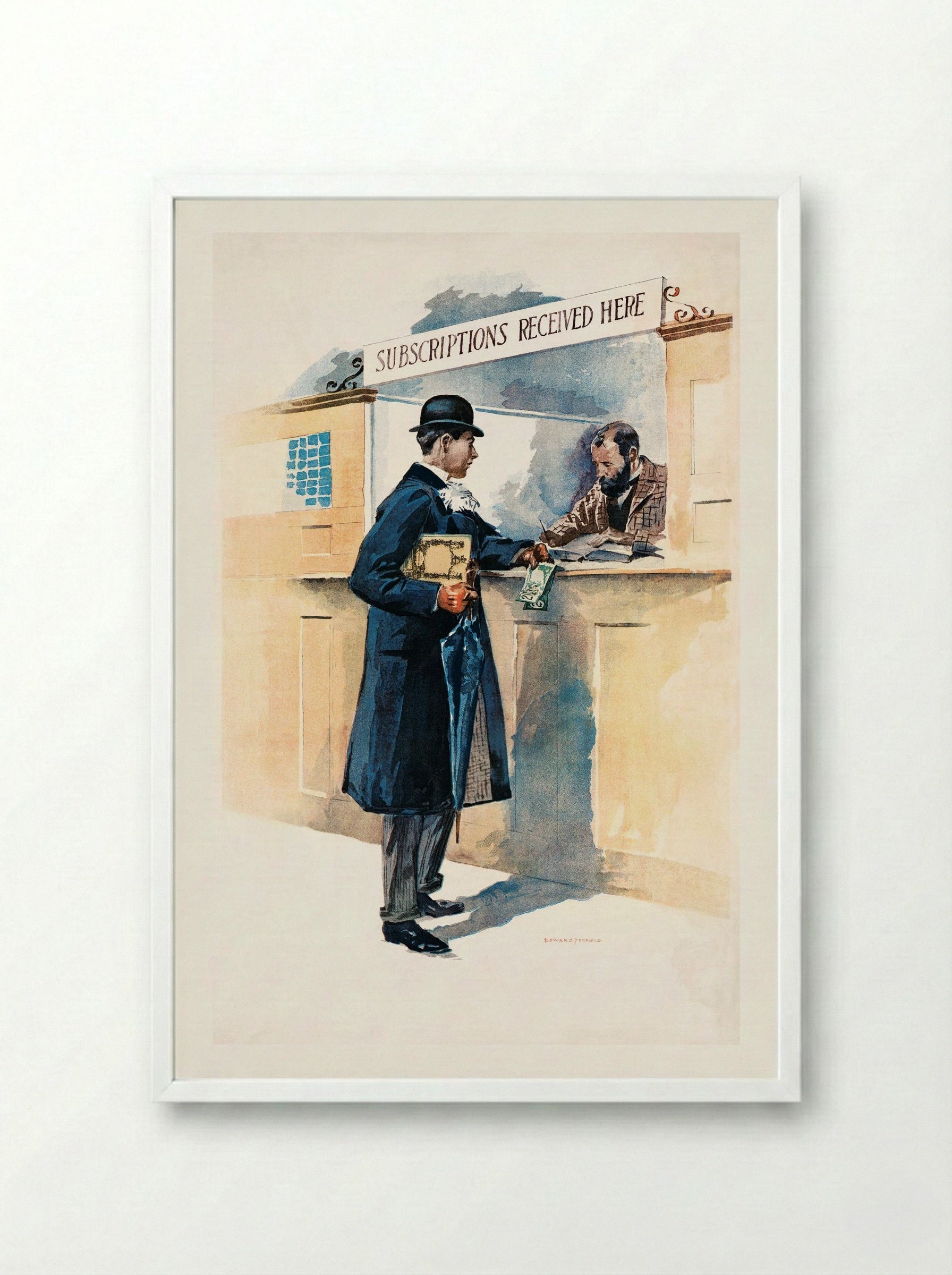
Man Getting Medicines - Edward Penfield
Archival giclée
Ready to hang
Secure checkout
Made to order
Description
Edward Penfield's 'Man Getting Medicines' is a stylish lithograph from 1893, showcasing the artist's mastery of Art Nouveau poster design. This vintage print adds a touch of historical elegance to any room.
This striking lithograph, titled 'Man Getting Medicines', is a quintessential example of Edward Penfield's poster art from 1893. Penfield, an influential figure in the American Art Nouveau movement, served as the art director for Harper's Magazine, where his distinctive style revolutionised poster design. This particular piece showcases a smartly dressed gentleman, complete with bowler hat and umbrella, purchasing medicine at a subscription window. The composition is carefully balanced, with the figure's elegant posture and attire contrasting against the muted tones of the architectural setting. Penfield's use of clean lines and flat planes of colour is characteristic of the era, lending the image a sense of sophistication and modernity. The text 'Subscriptions Received Here' suggests this image was likely used as an advertisement for a periodical or service. As a fine art print, this work brings a touch of vintage charm and historical significance to any interior. Its subtle colour palette and refined aesthetic make it a versatile addition to both contemporary and traditional spaces, offering a glimpse into the golden age of American illustration.
Return policy
Because every print is made to order, we don't offer change-of-mind returns, refunds or exchanges. If your order arrives faulty, damaged or incorrect, we'll replace it free of charge — just contact us within 48 hours of delivery. EU customers have a 14-day cooling-off right. See our refunds page for full details.
Shipping
We ship worldwide, printing at the production hub nearest to your delivery address. Delivery times and costs vary by destination — you'll see the options available to you at checkout.
Manufacturing
Each print is produced to order using 12-colour giclée printing on FSC-certified archival paper. Designed in Britain and printed at your nearest production hub to reduce waste and speed up delivery.
Man Getting Medicines - Edward Penfield
Our Features
Designed for Lasting Impact
Specific Features
Every Solis piece is made to order with archival, gallery-quality materials built to last.
- Museum-grade giclée printing for rich, fade-resistant colour
- Archival matte fine-art paper, FSC-certified
- Choose poster, framed print, canvas or framed canvas
- Frames in black, natural wood, dark wood or white
- Framed prints arrive ready to hang
Care & Cleaning
To keep your artwork looking its best:
- Dust gently with a soft, dry cloth
- Avoid prolonged direct sunlight
- Never use liquid cleaners on the print or canvas surface
- Keep in a dry, room-temperature space
- Handle prints with clean, dry hands
Materials & Sizing
Museum-grade giclée on FSC-certified archival matte paper, with framed and canvas options.
- Paper sizes: A4, A3, A2, A1, A0 and B2 (50×70 cm)
- Canvas: XS (20×30 cm) to Large (60×90 cm)
- Frames: black, natural wood, dark wood or white
Why Choose Us ?
100% Satisfaction Guarantee
Fast Shipping
Museum-Quality Materials

Artist Biography
Edward Penfield
Penfield embraced simplicity and strong, flat colours, drawing inspiration from Japanese prints and the Arts and Crafts movement. Eschewing excessive detail, he focused on conveying the essence of a scene or product with minimal lines and bold compositions. His posters, often promoting *Harper's* magazine, exude a sophisticated charm and a distinctly American sensibility. Penfield's innovative approach to composition and colour made his work instantly recognisable and highly influential.
Today, Edward Penfield's posters are celebrated for their timeless appeal and graphic ingenuity. His ability to distill complex ideas into visually arresting images continues to inspire designers and artists. Collectors are drawn to Penfield's work not only for its aesthetic beauty but also for its historical significance as a window into a bygone era of American optimism and artistic innovation. His prints add a touch of vintage elegance and graphic punch to any modern space.
You May Also Like