

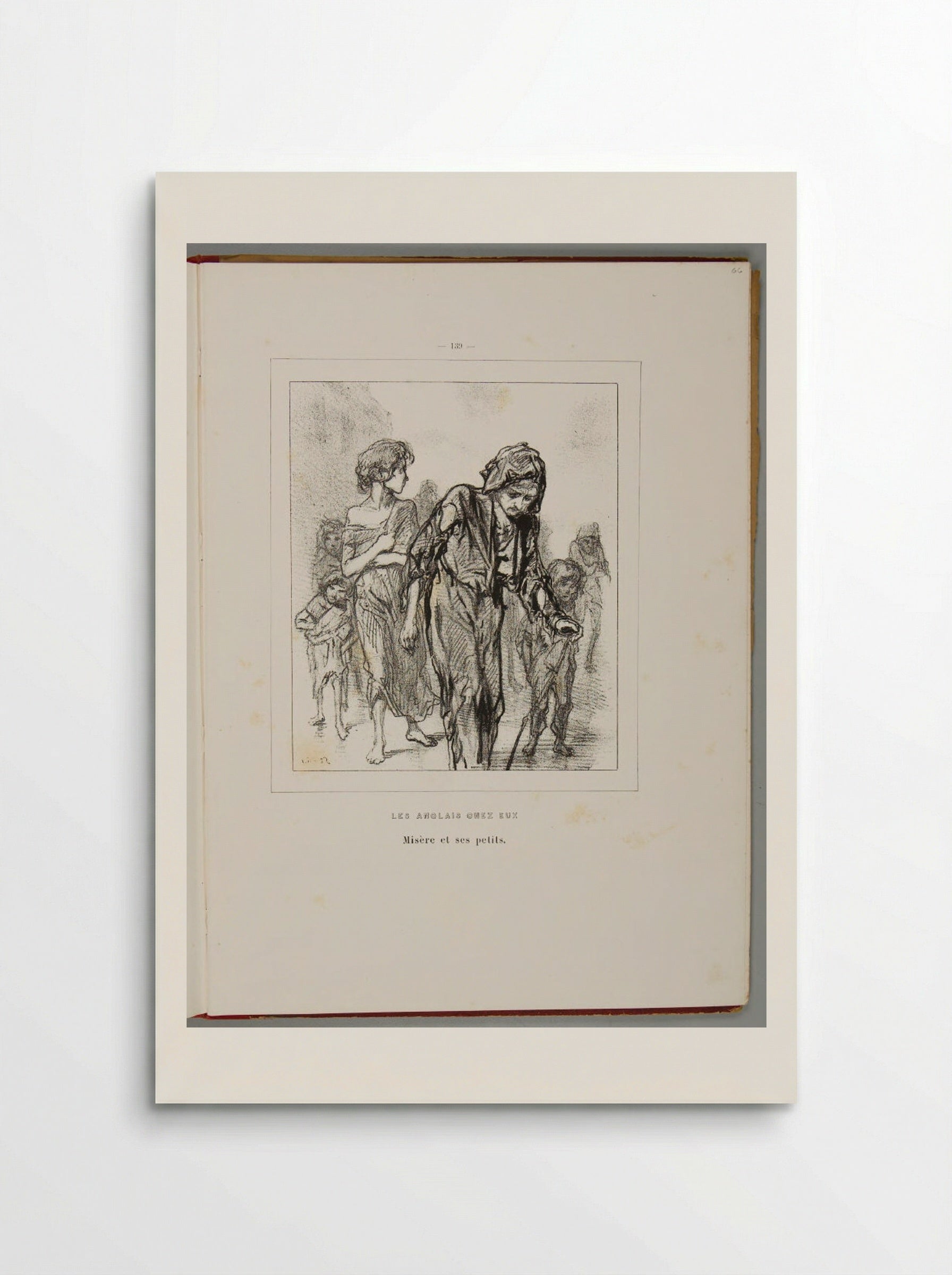
Misery and Her Children - Paul Gavarni
Archival giclée
Frames arrive ready to hang
Secure checkout
Made to order
Description
A lithograph by Paul Gavarni titled 'Misery and Her Children' depicts a group of impoverished individuals, reflecting the social inequalities of 19th-century France.
Paul Gavarni, a French artist born Hippolyte Guillaume Sulpice Chevalier, was a prominent illustrator, caricaturist, and lithographer. Active during the mid-19th century, Gavarni's work often depicted scenes of Parisian life, with a particular focus on social commentary and satire. His illustrations appeared in periodicals such as 'Le Charivari' and 'Le Figaro', and he gained recognition for his acute observations of contemporary society. Gavarni's style is characterised by its detailed linework and expressive figures, capturing the nuances of human behaviour and social dynamics. 'Misery and Her Children' exemplifies Gavarni's interest in portraying the lives of the less fortunate. The lithograph presents a group of impoverished individuals, presumably a mother and her children, walking with a weary gait. The figures are rendered with delicate lines, emphasising their worn clothing and gaunt features. The artist's use of light and shadow adds depth to the composition, creating a sense of melancholy and hardship. The work serves as a poignant commentary on the social inequalities of 19th-century France, inviting viewers to reflect on the human cost of poverty.
Return policy
Because every print is made to order, we don't offer change-of-mind returns, refunds or exchanges. If your order arrives faulty, damaged or incorrect, we'll replace it free of charge — just contact us within 48 hours of delivery. See our refunds page for full details.
Shipping
We ship worldwide, printing at the production hub nearest to your delivery address. Delivery times and costs vary by destination — you'll see the options available to you at checkout.
Manufacturing
Each print is produced to order using 12-colour giclée printing on FSC-certified archival paper. Designed in Britain and printed at your nearest production hub to reduce waste and speed up delivery.
Misery and Her Children - Paul Gavarni

Artist Biography
Paul Gavarni
His real name was Sulpice Guillaume Chevalier. He adopted "Gavarni" from the town of Gavarnie in the Pyrenees after a journey there. He was born in Paris in 1804, worked as a machinist in a factory, and taught himself to draw in evening classes. By the 1830s he was the leading illustrator of Parisian social life: fashionable women, carnival scenes, lorettes and debardeurs, all rendered with a wit and polish that Balzac praised publicly and that helped establish Gavarni's reputation.
After the deaths of his mother and the collapse of his marriage around 1845, his style shifted. He spent time in London documenting the lives of the poor, producing work that was bleaker and more compassionate than his Paris satire. His catalogue raisonne lists approximately eight thousand works. He is often compared with his contemporary Daumier, though Gavarni's satire was more polished and less political. He died in Paris in 1866.
Our Features
Designed for Lasting Impact
Specific Features
Every Solis piece is made to order with archival, gallery-quality materials built to last.
- Museum-grade giclée printing for rich, fade-resistant colour
- Archival matte fine-art paper, FSC-certified
- Multiple sizes and framing options available
- Frames in black, natural wood, dark wood or white
- Framed prints arrive ready to hang
Care & Cleaning
To keep your artwork looking its best:
- Dust gently with a soft, dry cloth
- Avoid prolonged direct sunlight
- Never use liquid cleaners on the print or canvas surface
- Keep in a dry, room-temperature space
- Handle prints with clean, dry hands
Materials & Sizing
Museum-grade giclée on FSC-certified archival matte paper, with framed and canvas options.
- Paper sizes: A4, A3, A2, A1, A0 and B2 (50×70 cm)
- Canvas: XS (20×30 cm) to Large (60×90 cm)
- Frames: black, natural wood, dark wood or white
Why Choose Us ?
Damage-free delivery guarantee
Fast Shipping
Museum-Quality Materials
Artist Biography
Paul Gavarni
His real name was Sulpice Guillaume Chevalier. He adopted "Gavarni" from the town of Gavarnie in the Pyrenees after a journey there. He was born in Paris in 1804, worked as a machinist in a factory, and taught himself to draw in evening classes. By the 1830s he was the leading illustrator of Parisian social life: fashionable women, carnival scenes, lorettes and debardeurs, all rendered with a wit and polish that Balzac praised publicly and that helped establish Gavarni's reputation.
After the deaths of his mother and the collapse of his marriage around 1845, his style shifted. He spent time in London documenting the lives of the poor, producing work that was bleaker and more compassionate than his Paris satire. His catalogue raisonne lists approximately eight thousand works. He is often compared with his contemporary Daumier, though Gavarni's satire was more polished and less political. He died in Paris in 1866.
You May Also Like