

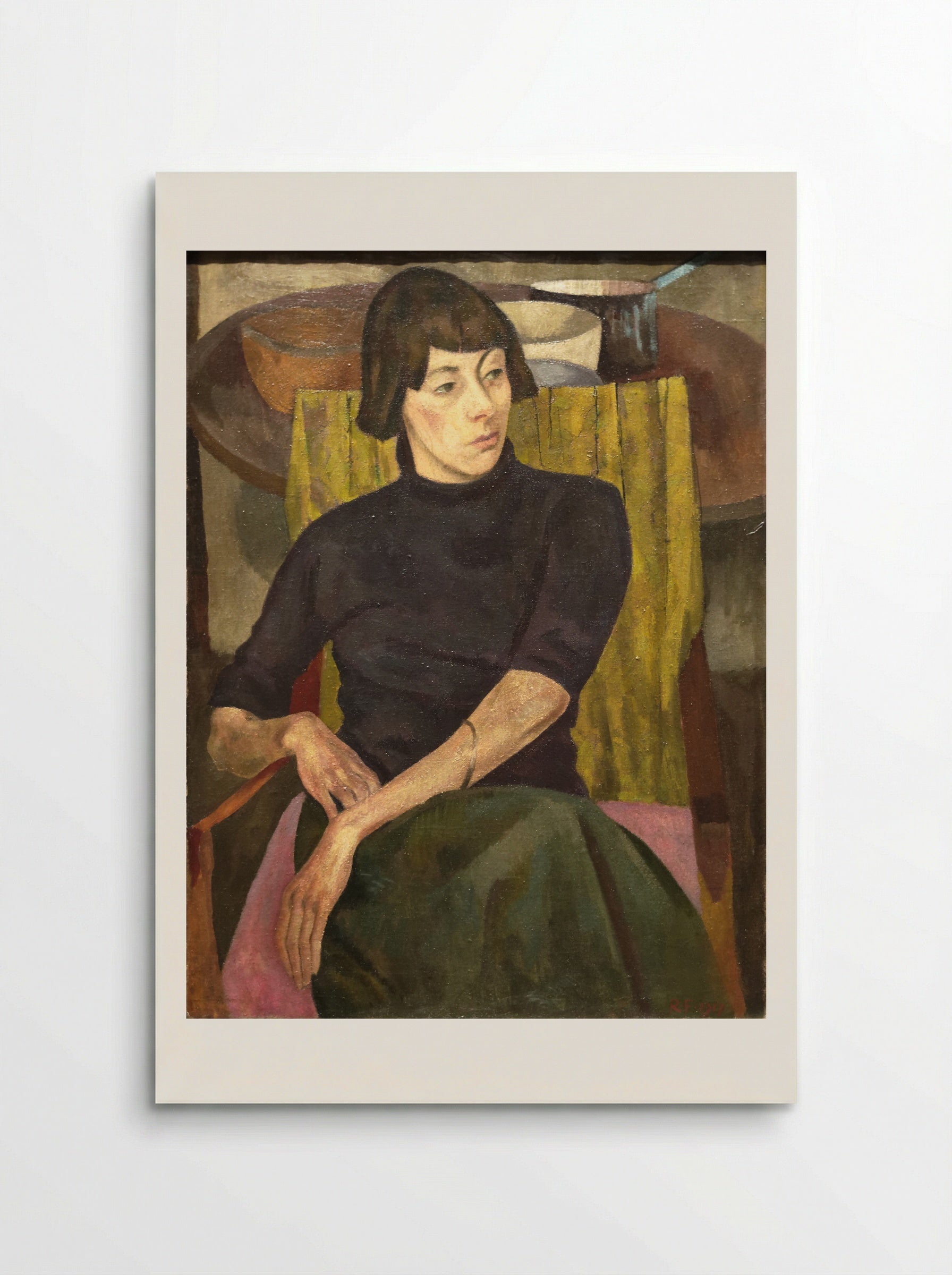
Nina Hamnett - Roger Fry
Archival giclée
Frames arrive ready to hang
Secure checkout
Made to order
Description
A 1917 portrait of the artist Nina Hamnett by Roger Fry, capturing the subject with the structural focus and muted palette characteristic of his Post-Impressionist style.
Roger Fry, a central figure in the Bloomsbury Group and a critic who introduced Post-Impressionism to British audiences, painted this portrait of the artist Nina Hamnett in 1917. Hamnett was a notable figure in the bohemian circles of London and Paris, often referred to as the Queen of Bohemia. Fry captures her with a direct, unidealised gaze, reflecting his interest in the structural qualities of form rather than mere photographic likeness. The composition is grounded in the modernist principles Fry championed. Hamnett is seated in a chair, her posture relaxed yet alert. She wears a dark, high-necked garment that contrasts with the muted, earthy tones of the background. Fry employs a controlled palette, using ochre, deep greens, and soft pinks to define the space. The background includes a table with simple domestic objects, which are rendered with a flattened perspective typical of his approach to pictorial space. The brushwork is deliberate, focusing on the weight and volume of the figure. This portrait provides a glimpse into the social and artistic milieu of the period. Hamnett, who was also a painter and a muse to many, is presented here with a sense of psychological presence. Fry avoids excessive detail, choosing instead to focus on the essential geometry of the sitter and her environment. The work is a clear example of his application of Post-Impressionist theory to portraiture, where the arrangement of colour and shape takes precedence over traditional academic finish. It remains a significant record of the relationship between two figures who occupied the centre of early twentieth-century British art.
Return policy
Because every print is made to order, we don't offer change-of-mind returns, refunds or exchanges. If your order arrives faulty, damaged or incorrect, we'll replace it free of charge — just contact us within 48 hours of delivery. See our refunds page for full details.
Shipping
We ship worldwide, printing at the production hub nearest to your delivery address. Delivery times and costs vary by destination — you'll see the options available to you at checkout.
Manufacturing
Each print is produced to order using 12-colour giclée printing on FSC-certified archival paper. Designed in Britain and printed at your nearest production hub to reduce waste and speed up delivery.
Care and materials
Specific Features
Every Solis piece is made to order with archival, gallery-quality materials built to last.
- Museum-grade giclée printing for rich, fade-resistant colour
- Archival matte fine-art paper, FSC-certified
- Multiple sizes and framing options available
- Frames in black, natural wood, dark wood or white
- Framed prints arrive ready to hang
Care & Cleaning
To keep your artwork looking its best:
- Dust gently with a soft, dry cloth
- Avoid prolonged direct sunlight
- Never use liquid cleaners on the print or canvas surface
- Keep in a dry, room-temperature space
- Handle prints with clean, dry hands
Materials & Sizing
Museum-grade giclée on FSC-certified archival matte paper, with framed and canvas options.
- Paper sizes: A4, A3, A2, A1, A0 and B2 (50×70 cm)
- Canvas: XS (20×30 cm) to Large (60×90 cm)
- Frames: black, natural wood, dark wood or white
Nina Hamnett - Roger Fry

Artist Biography
Roger Fry
In 1910 he organised an exhibition at the Grafton Galleries in London that showed Cezanne, Matisse, Van Gogh, Gauguin and Picasso to the British public for the first time. He needed a name for what these painters were doing and coined the term Post-Impressionism, which is vague enough to have stuck. Critics called him mad. Several reminded the public that his wife was in an asylum, as though this were a relevant argument about colour theory. John Singer Sargent was so furious at being listed as a supporter of the exhibition that he published open letters attacking Fry. The two became enemies. Fry later denied Sargent the right to be called an artist.
He was a central figure in the Bloomsbury Group, having met Vanessa Bell and her husband Clive in 1910. A love affair with Vanessa followed. Virginia Woolf was later entrusted with writing his biography, a task she found difficult because the family asked her to leave out the affair.
In 1913 he founded the Omega Workshops, a design collective that produced furniture, textiles, pottery and murals. The idea was that fine artists should design ordinary objects. Roger Fry's own paintings are competent but not especially memorable, which he seems to have understood. His real talent was seeing what mattered in other people's work and explaining it clearly. He wrote about African sculpture and Oceanic art when almost nobody in England took either seriously.
Why Choose Us ?
Damage-free delivery guarantee
Fast Shipping
Museum-Quality Materials
You May Also Like