

Fine Art Poster
From $29
A giclée print on 200gsm matte fine art paper, using a twelve-colour process for accurate, fade-resistant colour. Supplied unframed, delivered flat or rolled.



Archival giclée
Frames arrive ready to hang
Secure checkout
Made to order
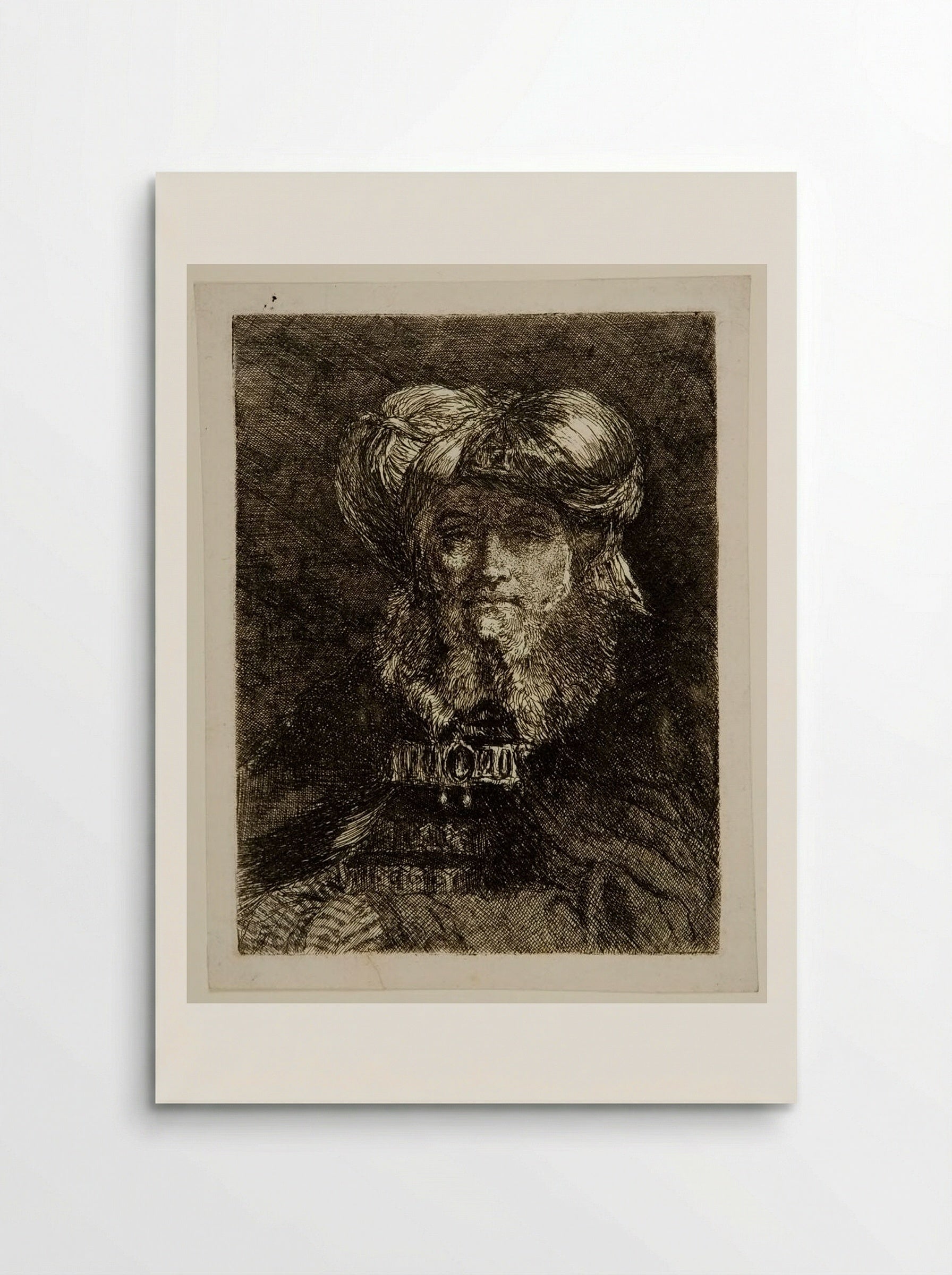
A detailed etching by Giovanni Domenico Tiepolo, capturing an elderly man in a turban through the dramatic light and shadow techniques of the Dutch masters.
Giovanni Domenico Tiepolo, the son of the celebrated Venetian painter Giambattista Tiepolo, produced a series of etchings that demonstrate his fascination with the graphic work of Rembrandt van Rijn. This specific print captures an elderly man wearing an elaborate turban and a heavy, ornate cloak. The composition relies on the dramatic use of light and shadow, a technique known as chiaroscuro, which Tiepolo adopted to emulate the Dutch master's approach to portraiture. The etching process allows for a high degree of textural detail. One can observe the fine lines used to define the subject's beard, the folds of the fabric, and the reflective surfaces of the jewellery. Unlike the lighter, more airy compositions typical of the Venetian Rococo, this work adopts a sombre, introspective mood. The subject gazes directly at the viewer, his expression conveying a sense of gravity that contrasts with the decorative nature of his attire. Tiepolo's interest in Rembrandt was not merely imitative. He sought to understand the mechanics of etching, experimenting with cross-hatching and varying line weights to create depth. By adopting the guise of a Rembrandt-inspired subject, Tiepolo engaged in a dialogue with the past, testing his own technical capabilities against the standards set by the seventeenth-century Dutch tradition. This print remains a clear example of the eighteenth-century Venetian interest in collecting and reinterpreting earlier European graphic art. The work is printed on paper, with the ink density providing a tactile quality to the dark background, which pushes the figure forward into the viewer's space.
Because every print is made to order, we don't offer change-of-mind returns, refunds or exchanges. If your order arrives faulty, damaged or incorrect, we'll replace it free of charge — just contact us within 48 hours of delivery. See our refunds page for full details.
We ship worldwide, printing at the production hub nearest to your delivery address. Delivery times and costs vary by destination — you'll see the options available to you at checkout.
Each print is produced to order using 12-colour giclée printing on FSC-certified archival paper. Designed in Britain and printed at your nearest production hub to reduce waste and speed up delivery.
Specific Features
Every Solis piece is made to order with archival, gallery-quality materials built to last.
Care & Cleaning
To keep your artwork looking its best:
Materials & Sizing
Museum-grade giclée on FSC-certified archival matte paper, with framed and canvas options.

Artist Biography
Made to order
Every piece is printed to order. These are the five finishes, and what makes each one different.
From $29
A giclée print on 200gsm matte fine art paper, using a twelve-colour process for accurate, fade-resistant colour. Supplied unframed, delivered flat or rolled.

From $89
The same fine art print in a solid wood frame with UV-protective acrylic glaze and rigid backing. Five frame colours. Arrives ready to hang.

From $169
A deeper solid wood frame: 33mm deep with a 20mm face and Perspex glaze. The print sits unmounted for a clean gallery presentation. Black, white or natural.

From $59
Hand-stretched canvas with neat gallery-wrapped edges, giving the artwork surface texture and depth. Arrives ready to hang.

From $175
Stretched canvas set in a floating wood frame, our most substantial finish. Arrives ready to hang.
Why Choose Us ?
Damage-free delivery guarantee
Fast Shipping
Museum-Quality Materials
You May Also Like
We use cookies to measure our marketing and see which prints people love.We use cookies to measure our marketing.
By continuing to browse, you agree · Privacy Policy