

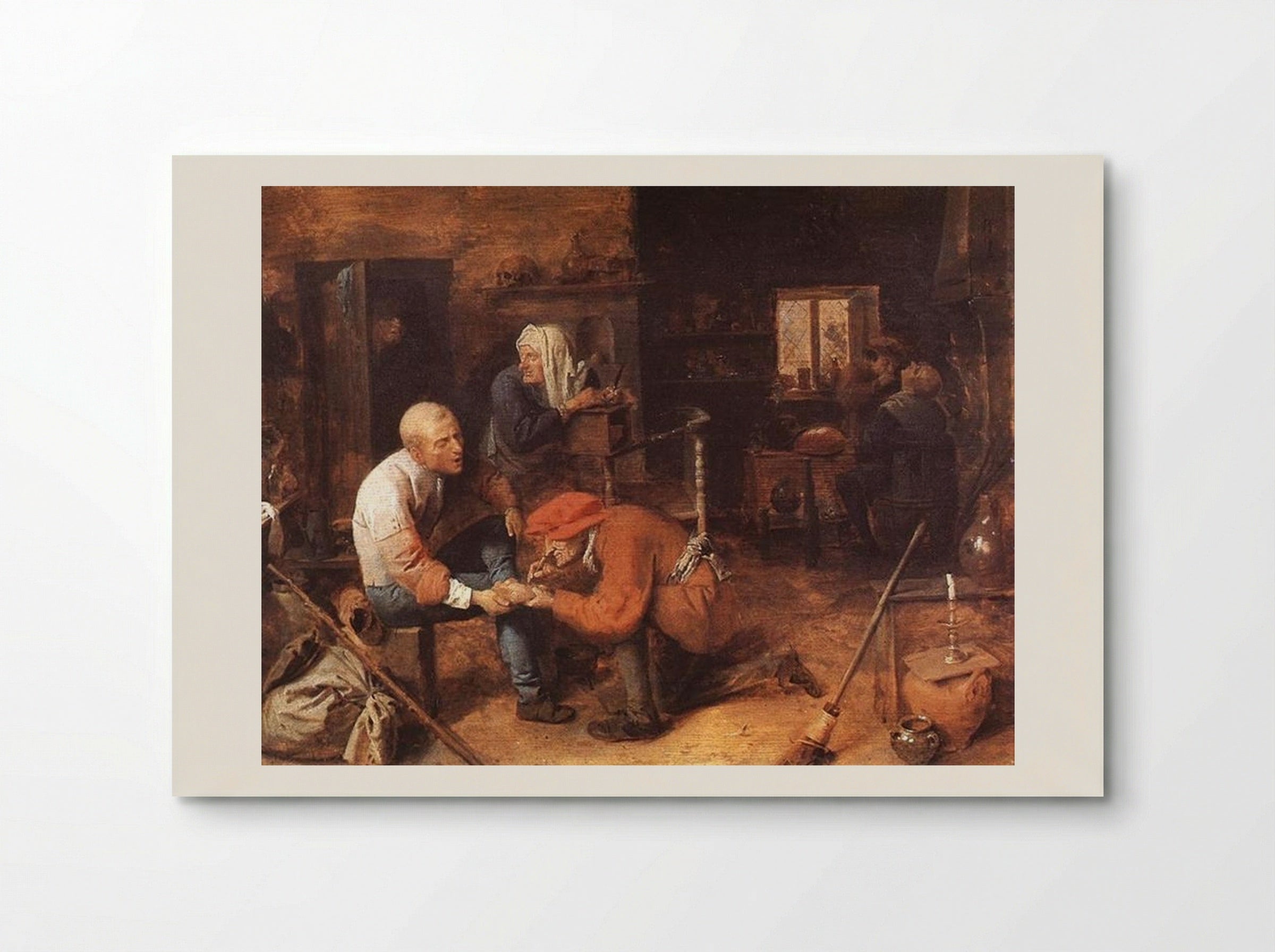
Operation on Foot - Adriaen Brouwer
Archival giclée
Frames arrive ready to hang
Secure checkout
Made to order
Description
A genre painting by Adriaen Brouwer, 'Operation on Foot' depicts a scene of everyday life, showing a man tending to another man's foot in a humble interior. The painting is characterised by its realism and earthy tones.
Adriaen Brouwer, a Flemish painter active in the first half of the 17th century, is known for his genre scenes depicting everyday life, often with a focus on the lower classes. His paintings frequently portray taverns, peasant gatherings, and scenes of revelry or hardship. Brouwer's style is characterised by its realism, attention to detail, and use of earthy tones. He had an influence on later genre painters, including David Teniers the Younger and Adriaen van Ostade. Brouwer's own life was marked by financial difficulties and periods of imprisonment. He died at a relatively young age. 'Operation on Foot' exemplifies Brouwer's interest in depicting scenes of common life. The painting shows a man tending to another man's foot, possibly removing a splinter or treating an injury. The setting appears to be a humble interior, with other figures observing the procedure. The composition is carefully arranged, with attention paid to the expressions and gestures of the figures. The colour palette is dominated by browns, ochres, and muted reds, creating a sense of realism and immediacy.
Return policy
Because every print is made to order, we don't offer change-of-mind returns, refunds or exchanges. If your order arrives faulty, damaged or incorrect, we'll replace it free of charge — just contact us within 48 hours of delivery. See our refunds page for full details.
Shipping
We ship worldwide, printing at the production hub nearest to your delivery address. Delivery times and costs vary by destination — you'll see the options available to you at checkout.
Manufacturing
Each print is produced to order using 12-colour giclée printing on FSC-certified archival paper. Designed in Britain and printed at your nearest production hub to reduce waste and speed up delivery.
Care and materials
Specific Features
Every Solis piece is made to order with archival, gallery-quality materials built to last.
- Museum-grade giclée printing for rich, fade-resistant colour
- Archival matte fine-art paper, FSC-certified
- Multiple sizes and framing options available
- Frames in black, natural wood, dark wood or white
- Framed prints arrive ready to hang
Care & Cleaning
To keep your artwork looking its best:
- Dust gently with a soft, dry cloth
- Avoid prolonged direct sunlight
- Never use liquid cleaners on the print or canvas surface
- Keep in a dry, room-temperature space
- Handle prints with clean, dry hands
Materials & Sizing
Museum-grade giclée on FSC-certified archival matte paper, with framed and canvas options.
- Paper sizes: A4, A3, A2, A1, A0 and B2 (50×70 cm)
- Canvas: XS (20×30 cm) to Large (60×90 cm)
- Frames: black, natural wood, dark wood or white
Operation on Foot - Adriaen Brouwer
Artist Biography
Adriaen Brouwer
Born around 1605 in Oudenaarde (then in the Spanish Netherlands), Brouwer trained in the Dutch Republic, probably in Haarlem, where he encountered the loose, rapid brushwork associated with Frans Hals. By 1631 he was back in Antwerp. He was imprisoned there in 1633, possibly for debt or suspected espionage; during his imprisonment a baker named Joos van Craesbeeck encountered him and became both his closest pupil and a devoted friend. Brouwer produced roughly 60 paintings across his entire career before dying aged around thirty-two.
His subjects were the lowest rung of Dutch and Flemish society: peasants drinking, smoking, gambling, fighting, and submitting themselves to rural barber-surgeons. The Barber-Surgeon paintings (including the version at the Städelsches Kunstinstitut, Frankfurt, c. 1636) carry a deliberate iconographic joke: scholars have noted that the composition of a patient having a corn cut from his foot borrows the visual conventions of Christian martyrdom paintings, pushed to the point of caricature. His technique was equally pointed: the warm, spontaneous brushwork contrasted with the grotesque content to suggest sympathy rather than contempt for his subjects.
Art historians have positioned Brouwer at the junction of Flemish and Dutch genre traditions, bridging Pieter Bruegel the Elder's peasant scenes with the looser bravura of Hals. The collector appetite that Rubens and Rembrandt demonstrated was not entirely separate from the art's critical content: the drinker and the tavern denizen functioned in this tradition as an avatar for humanity in its unguarded state, beyond social hierarchy. That reading did not make Brouwer solvent. It did save him from obscurity.
Why Choose Us ?
Damage-free delivery guarantee
Fast Shipping
Museum-Quality Materials
You May Also Like