

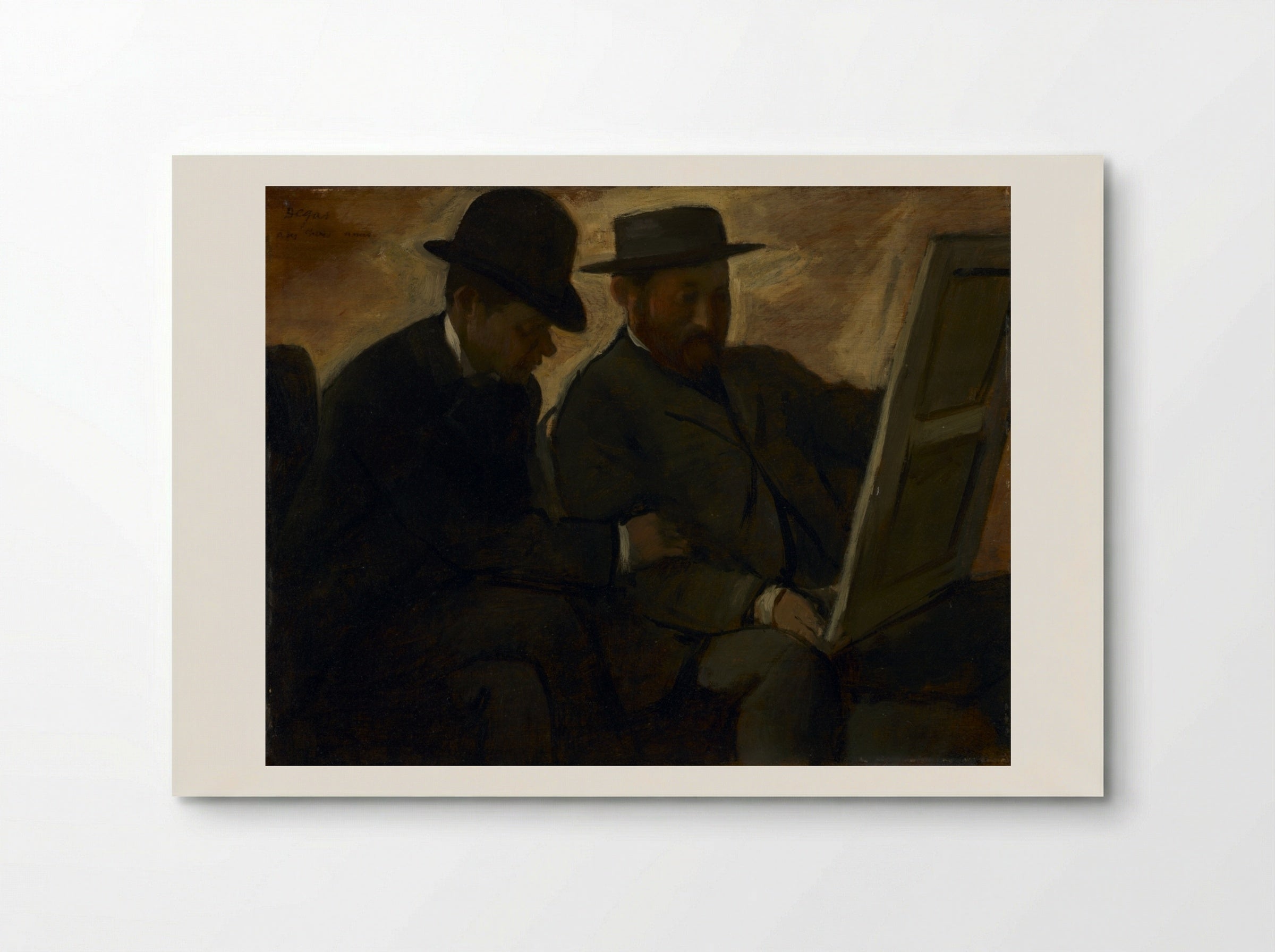
Paul Lafond and Alphonse Cherfils Examining a Painting - Edgar Degas
Archival giclée
Frames arrive ready to hang
Secure checkout
Made to order
Description
A candid portrait by Edgar Degas depicting two men engaged in the quiet, focused act of examining a painting.
Edgar Degas captures a quiet, observational moment in this portrait of Paul Lafond and Alphonse Cherfils. The two men are depicted in close proximity, their attention entirely directed toward a canvas positioned just out of the viewer's sight. The composition relies on the interplay of shadow and light to define the figures, with the dark silhouettes of their hats and coats emerging from a warm, muted background. Degas employs a restrained palette, focusing on earthy tones that draw the eye to the concentration on the subjects' faces. This work reflects the artist's interest in the social dynamics of the Parisian art world. Rather than a formal, posed portrait, the scene suggests a candid encounter. The brushwork is loose and expressive, characteristic of Degas's approach during this period. He avoids excessive detail, preferring to suggest form through tonal shifts and the physical posture of his subjects. The proximity of the two men, with one hand resting near the other, creates a sense of shared focus and professional intimacy. By placing the painting they are examining off-canvas, Degas invites the viewer to imagine the object of their scrutiny. This technique shifts the focus from the artwork itself to the act of looking and evaluating. The painting demonstrates the artist's ability to find compelling subjects in the mundane activities of his contemporaries. It is a study in human interaction, rendered with a directness that avoids sentimentality. The lighting, which appears to emanate from the direction of the unseen painting, illuminates the profiles of the men, creating a subtle contrast between the dark foreground and the atmospheric space behind them. This piece remains a fine example of the artist's skill in capturing the specific atmosphere of a private, intellectual exchange.
Return policy
Because every print is made to order, we don't offer change-of-mind returns, refunds or exchanges. If your order arrives faulty, damaged or incorrect, we'll replace it free of charge — just contact us within 48 hours of delivery. See our refunds page for full details.
Shipping
We ship worldwide, printing at the production hub nearest to your delivery address. Delivery times and costs vary by destination — you'll see the options available to you at checkout.
Manufacturing
Each print is produced to order using 12-colour giclée printing on FSC-certified archival paper. Designed in Britain and printed at your nearest production hub to reduce waste and speed up delivery.
Paul Lafond and Alphonse Cherfils Examining a Painting - Edgar Degas

Artist Biography
Edgar Degas
More than half of his entire output depicts dancers. He became a fixture at the Paris Opera, watching from the wings and from boxes above the stage, sketching not the performance but the work behind it: the stretching, the waiting, the adjusting of shoes, the corrections from the ballet master. The backstage fatigue interested him more than the applause.
In 1881, he exhibited Little Dancer Aged Fourteen, a two-thirds life-size wax figure of Marie van Goethem, a real student at the Opera ballet school. She wore a real tutu, real ballet slippers, and a wig of human hair, all coated in wax. Critics called it repulsive. One described the girl as having a face marked by the hateful promise of every vice. Wax was a material for anatomical specimens, not art. It was the only sculpture he exhibited in his lifetime. After his death, 150 more wax figures were found in his studio, many falling apart.
His eyesight began failing during the Franco-Prussian War. By his forties he had lost central vision. By fifty-seven he could not read. The deterioration drove him from fine brushwork to bolder strokes, then to pastels, then to sculpture he could work by touch. He avoided daylight and painted under controlled artificial light. Collectors joked they should chain their Degas paintings to the wall, because he would try to take them back to rework them. He compulsively revised everything.
He disliked being called an Impressionist. He preferred Realist or Independent. He never painted outdoors, which was supposedly the whole point of the movement. Despite this, he co-founded the group, organised their exhibitions, and showed in all eight. He said: there is love and there is art and we only have one heart. He never married.
Our Features
Designed for Lasting Impact
Specific Features
Every Solis piece is made to order with archival, gallery-quality materials built to last.
- Museum-grade giclée printing for rich, fade-resistant colour
- Archival matte fine-art paper, FSC-certified
- Multiple sizes and framing options available
- Frames in black, natural wood, dark wood or white
- Framed prints arrive ready to hang
Care & Cleaning
To keep your artwork looking its best:
- Dust gently with a soft, dry cloth
- Avoid prolonged direct sunlight
- Never use liquid cleaners on the print or canvas surface
- Keep in a dry, room-temperature space
- Handle prints with clean, dry hands
Materials & Sizing
Museum-grade giclée on FSC-certified archival matte paper, with framed and canvas options.
- Paper sizes: A4, A3, A2, A1, A0 and B2 (50×70 cm)
- Canvas: XS (20×30 cm) to Large (60×90 cm)
- Frames: black, natural wood, dark wood or white
Why Choose Us ?
Damage-free delivery guarantee
Fast Shipping
Museum-Quality Materials
Artist Biography
Edgar Degas
More than half of his entire output depicts dancers. He became a fixture at the Paris Opera, watching from the wings and from boxes above the stage, sketching not the performance but the work behind it: the stretching, the waiting, the adjusting of shoes, the corrections from the ballet master. The backstage fatigue interested him more than the applause.
In 1881, he exhibited Little Dancer Aged Fourteen, a two-thirds life-size wax figure of Marie van Goethem, a real student at the Opera ballet school. She wore a real tutu, real ballet slippers, and a wig of human hair, all coated in wax. Critics called it repulsive. One described the girl as having a face marked by the hateful promise of every vice. Wax was a material for anatomical specimens, not art. It was the only sculpture he exhibited in his lifetime. After his death, 150 more wax figures were found in his studio, many falling apart.
His eyesight began failing during the Franco-Prussian War. By his forties he had lost central vision. By fifty-seven he could not read. The deterioration drove him from fine brushwork to bolder strokes, then to pastels, then to sculpture he could work by touch. He avoided daylight and painted under controlled artificial light. Collectors joked they should chain their Degas paintings to the wall, because he would try to take them back to rework them. He compulsively revised everything.
He disliked being called an Impressionist. He preferred Realist or Independent. He never painted outdoors, which was supposedly the whole point of the movement. Despite this, he co-founded the group, organised their exhibitions, and showed in all eight. He said: there is love and there is art and we only have one heart. He never married.
You May Also Like