

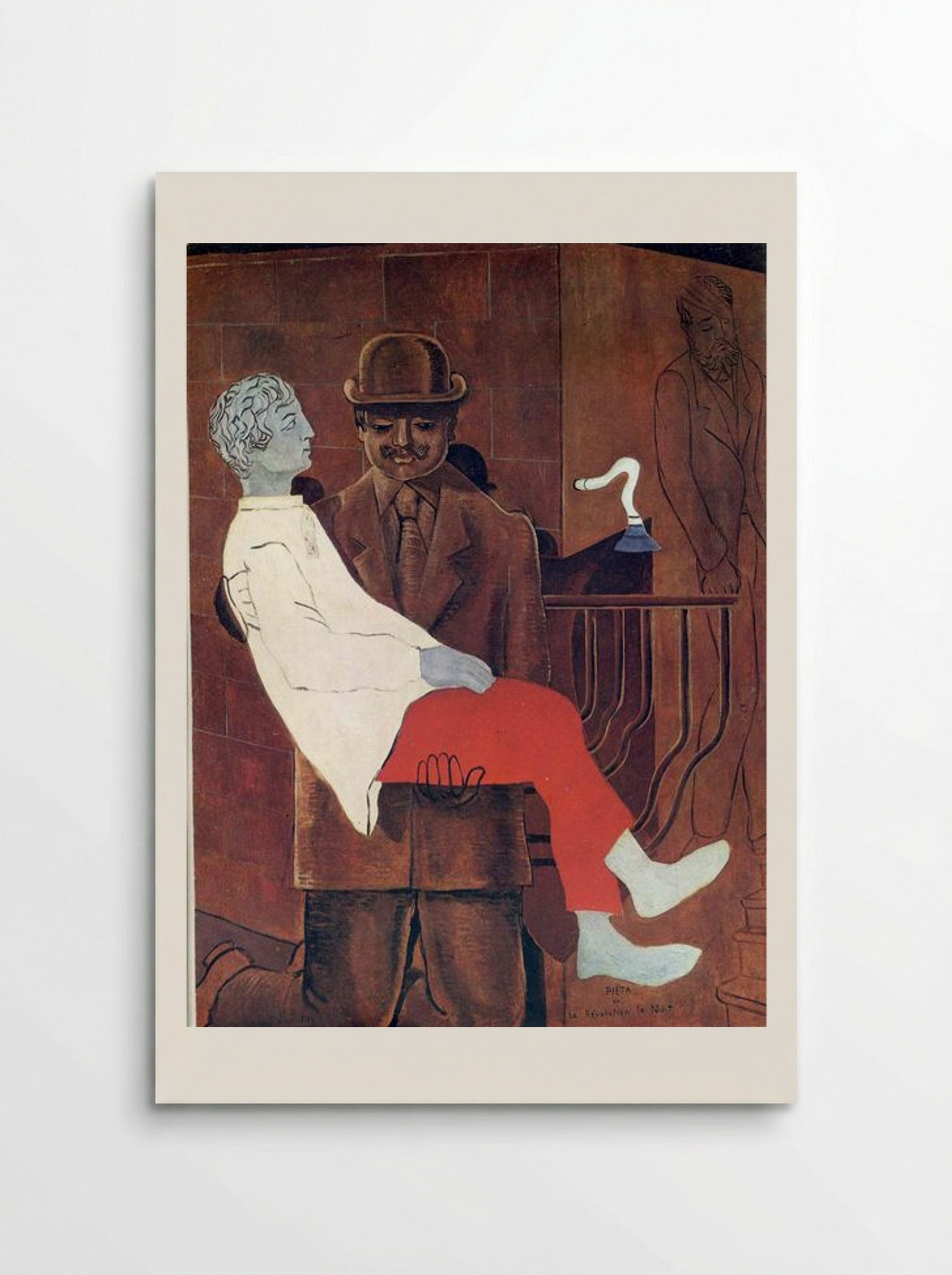
Pieta (Revolution by Night) - Max Ernst
Archival giclée
Frames arrive ready to hang
Secure checkout
Made to order
Description
A seminal Surrealist work by Max Ernst, this 1923 painting subverts traditional religious iconography through dreamlike imagery and an unsettling, ambiguous narrative.
Pieta (Revolution by Night), painted in 1923, is a work by the German artist Max Ernst. It occupies a position within the early development of Surrealism, reflecting the movement's interest in the subconscious and the subversion of traditional iconography. The title itself creates a tension between the classical religious subject of the Pieta, which depicts the Virgin Mary cradling the body of Christ, and the political or psychological implications of a revolution occurring under the cover of darkness. The composition features a man in a bowler hat, a recurring figure in Ernst's work, holding a limp, pale figure. The man's expression is stoic, almost detached, while the figure he carries appears lifeless. To the right, a second figure stands in profile, rendered in a linear, sketch-like manner that contrasts with the more solid, modelled forms of the central pair. The setting is ambiguous, suggesting an interior space with a brick wall and a staircase, yet the spatial relationships remain illogical and dreamlike. Ernst employs a muted, earthy palette dominated by browns and ochres, which serves to heighten the impact of the bright red trousers worn by the carried figure. The lighting is artificial and theatrical, casting shadows that do not align with a natural source. This work demonstrates the artist's ability to manipulate familiar visual tropes to create an atmosphere of unease. By placing a classical motif into a modern, urban context, Ernst forces the viewer to reconsider the meaning of the original religious scene. The painting functions as a visual manifestation of the irrational, a core objective of the Surrealist group during this period. It remains a significant example of how Ernst utilised painting to explore the boundaries between reality and the internal world of dreams.
Return policy
Because every print is made to order, we don't offer change-of-mind returns, refunds or exchanges. If your order arrives faulty, damaged or incorrect, we'll replace it free of charge — just contact us within 48 hours of delivery. See our refunds page for full details.
Shipping
We ship worldwide, printing at the production hub nearest to your delivery address. Delivery times and costs vary by destination — you'll see the options available to you at checkout.
Manufacturing
Each print is produced to order using 12-colour giclée printing on FSC-certified archival paper. Designed in Britain and printed at your nearest production hub to reduce waste and speed up delivery.
Care and materials
Specific Features
Every Solis piece is made to order with archival, gallery-quality materials built to last.
- Museum-grade giclée printing for rich, fade-resistant colour
- Archival matte fine-art paper, FSC-certified
- Multiple sizes and framing options available
- Frames in black, natural wood, dark wood or white
- Framed prints arrive ready to hang
Care & Cleaning
To keep your artwork looking its best:
- Dust gently with a soft, dry cloth
- Avoid prolonged direct sunlight
- Never use liquid cleaners on the print or canvas surface
- Keep in a dry, room-temperature space
- Handle prints with clean, dry hands
Materials & Sizing
Museum-grade giclée on FSC-certified archival matte paper, with framed and canvas options.
- Paper sizes: A4, A3, A2, A1, A0 and B2 (50×70 cm)
- Canvas: XS (20×30 cm) to Large (60×90 cm)
- Frames: black, natural wood, dark wood or white
Pieta (Revolution by Night) - Max Ernst
The Artwork
Pietà or Revolution by Night
Our guide to the original work behind this print.

Artist Biography
Max Ernst
He was born in Brühl, near Cologne, and studied philosophy and art history at the University of Bonn. He had no formal art training. He saw a Picasso exhibition, joined the Rhineland Expressionists, served in the German army during the First World War (artillery), and emerged with what he described as a compulsion to find something beyond rational thought. Dada gave him the method. Surrealism gave him the framework.
His collage novels, made from cut-up Victorian engravings reassembled into dreamlike narratives, are among the most original works of the twentieth century. Une Semaine de Bonte (A Week of Kindness, 1934) is a series of 182 collages arranged in five chapters, each associated with an element and a day of the week. The imagery is violent, erotic, and funny. The source material, melodramatic Victorian illustrations, is treated with deadpan seriousness.
He married four times. His second wife was Peggy Guggenheim (briefly). His fourth was the painter Dorothea Tanning. He moved to America during the war, lived in Sedona, Arizona, and then returned to France. He died in Paris in 1976, the night before his eighty-fifth birthday.
Why Choose Us ?
Damage-free delivery guarantee
Fast Shipping
Museum-Quality Materials
You May Also Like