

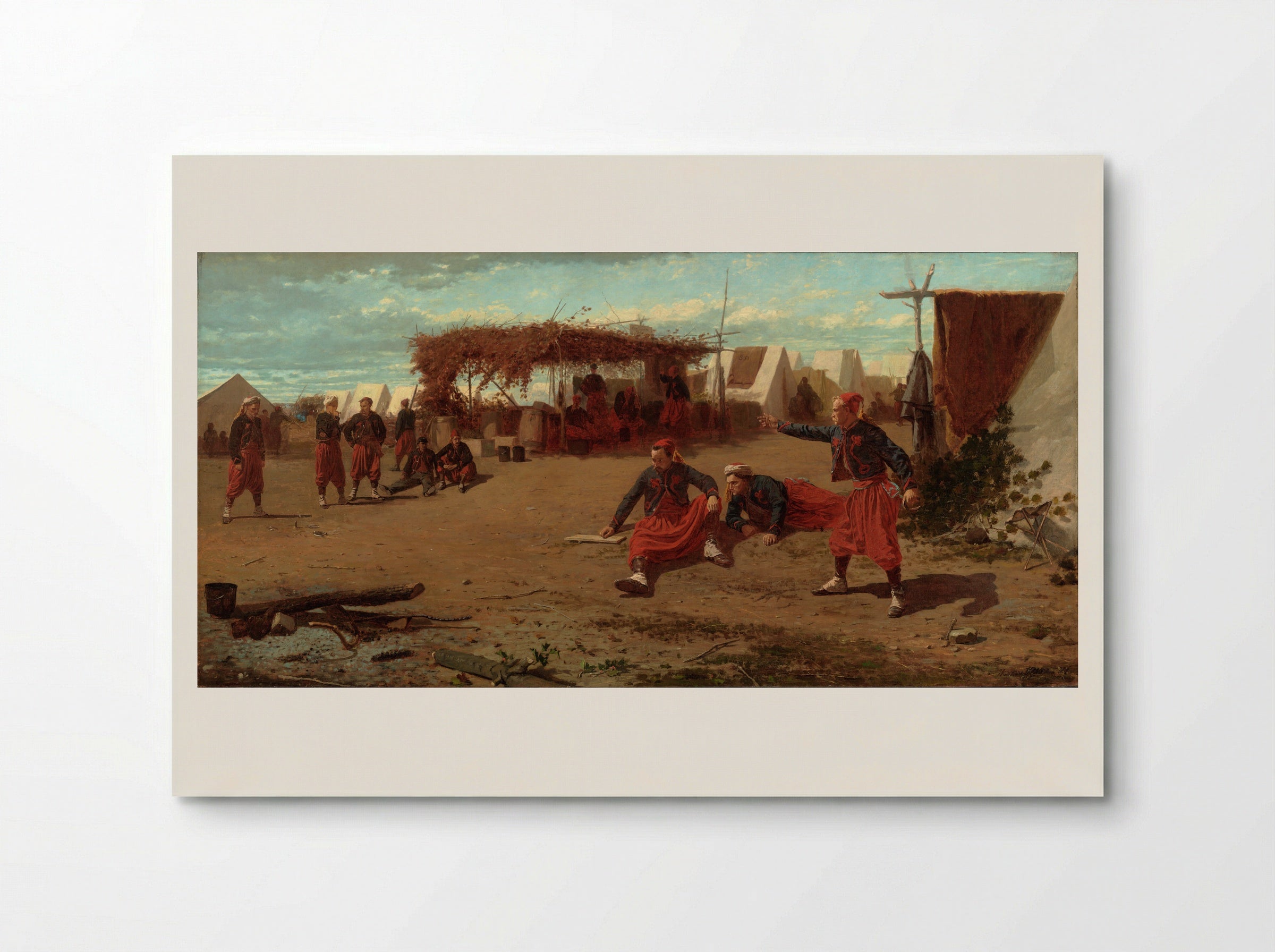
Pitching Quoits - Winslow Homer
Archival giclée
Frames arrive ready to hang
Secure checkout
Made to order
Description
A detailed genre painting by Winslow Homer depicting Union soldiers playing quoits in a camp setting, captured with realism and historical precision.
Winslow Homer painted Pitching Quoits in 1865, shortly after the conclusion of the American Civil War. The composition depicts soldiers from the 5th New York Volunteer Infantry, known as Duryée's Zouaves, during a period of respite. The men are dressed in their distinctive uniforms, featuring red trousers and dark jackets, which provide a sharp visual contrast against the muted, sun-baked earth of the encampment. Homer focuses on the mundane activities of military life rather than the violence of combat. The soldiers occupy themselves with a game of quoits, a traditional pastime involving the throwing of metal rings at a target. The artist captures the relaxed postures of the men, some sitting on the ground while others stand, creating a sense of informal camaraderie. The background shows a series of white tents and a makeshift shelter covered in foliage, which provides shade from the bright, expansive sky. The painting demonstrates Homer's ability to observe and record the details of daily life with precision. His use of light and shadow defines the forms of the figures and the textures of the ground. The horizontal orientation of the canvas emphasises the breadth of the camp, drawing the viewer into the scene. This work reflects the artist's early career as a painter of contemporary life, where he documented the experiences of soldiers with a direct, unadorned approach. The scene is devoid of overt sentimentality, presenting the reality of the soldiers' existence during their time away from the front lines. Through his careful arrangement of figures and his attention to the specific uniforms of the Zouaves, Homer provides a historical record of a specific regiment while capturing a universal moment of leisure.
Return policy
Because every print is made to order, we don't offer change-of-mind returns, refunds or exchanges. If your order arrives faulty, damaged or incorrect, we'll replace it free of charge — just contact us within 48 hours of delivery. See our refunds page for full details.
Shipping
We ship worldwide, printing at the production hub nearest to your delivery address. Delivery times and costs vary by destination — you'll see the options available to you at checkout.
Manufacturing
Each print is produced to order using 12-colour giclée printing on FSC-certified archival paper. Designed in Britain and printed at your nearest production hub to reduce waste and speed up delivery.
Care and materials
Specific Features
Every Solis piece is made to order with archival, gallery-quality materials built to last.
- Museum-grade giclée printing for rich, fade-resistant colour
- Archival matte fine-art paper, FSC-certified
- Multiple sizes and framing options available
- Frames in black, natural wood, dark wood or white
- Framed prints arrive ready to hang
Care & Cleaning
To keep your artwork looking its best:
- Dust gently with a soft, dry cloth
- Avoid prolonged direct sunlight
- Never use liquid cleaners on the print or canvas surface
- Keep in a dry, room-temperature space
- Handle prints with clean, dry hands
Materials & Sizing
Museum-grade giclée on FSC-certified archival matte paper, with framed and canvas options.
- Paper sizes: A4, A3, A2, A1, A0 and B2 (50×70 cm)
- Canvas: XS (20×30 cm) to Large (60×90 cm)
- Frames: black, natural wood, dark wood or white
Pitching Quoits - Winslow Homer

Artist Biography
Winslow Homer
He moved from illustration to painting without formal training, learning oil technique largely by observation. His early paintings are genre scenes of rural American life: children playing, women on croquet lawns, the kind of post-war pastoral that the public wanted. They sold well. He was dissatisfied with them.
In 1881 he went to Cullercoats, a fishing village in northeast England, and spent two years painting the women who waited on the shore for the fishing boats to return. The Cullercoats paintings are darker, more dramatic, and more serious than anything he had made before. The sea became his subject.
He moved to Prouts Neck, Maine, in 1883 and lived there, mostly alone, for the rest of his life. The Maine paintings, The Gulf Stream, Northeaster, Right and Left, are about the confrontation between human beings and the ocean. The figures are small. The water is enormous. The light is cold. He painted the sea the way Constable painted clouds: from direct observation, over years, until he understood its behaviour.
His watercolours, made on fishing trips to the Adirondacks, Florida, and the Bahamas, are freer and more experimental than the oils. Tropical sunlight and clear water brought out colours he did not use in Maine. He died in 1910, at seventy-four.
Why Choose Us ?
Damage-free delivery guarantee
Fast Shipping
Museum-Quality Materials
You May Also Like