

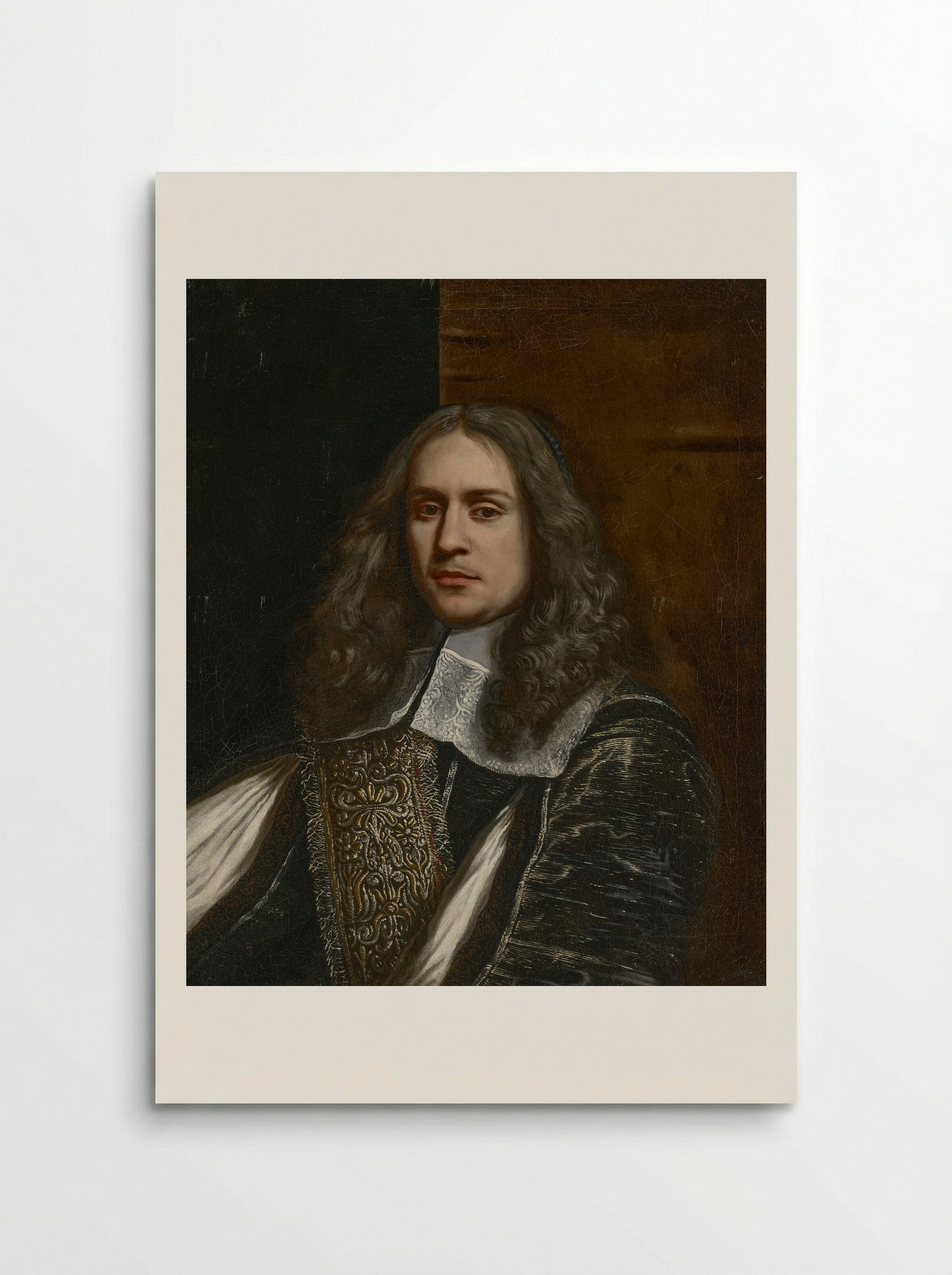
Portrait of a Man - Wallerant Vaillant
Archival giclée
Frames arrive ready to hang
Secure checkout
Made to order
Description
A classic seventeenth-century Dutch portrait by Wallerant Vaillant, capturing a man in period attire with refined use of light and shadow.
Wallerant Vaillant, a Dutch painter and printmaker, produced this portrait during the mid-seventeenth century. The work reflects the conventions of the Dutch Golden Age, where portraiture functioned as a record of social status and personal identity. The subject is depicted in a three-quarter view, his gaze directed toward the viewer with a composed expression. His long, flowing hair and the lace collar indicate the fashion of the period, while the dark, subdued background ensures the focus remains on the sitter. Vaillant was known for his technical skill, particularly in his mastery of mezzotint, a medium he helped popularise. In this oil painting, he employs a controlled palette of browns, blacks, and creams. The light source is positioned to the left, illuminating the sitter's face and the texture of his lace collar, while casting the remainder of the figure into shadow. This use of chiaroscuro creates a sense of volume and presence. The brushwork is precise, capturing the sheen of the fabric and the individual strands of hair with clarity. The composition is balanced, relying on the contrast between the dark backdrop and the lighter tones of the sitter's attire to define the form. This portrait provides an example of the professional portraiture commissioned by the merchant and professional classes of the Netherlands during the seventeenth century. Vaillant's ability to render the textures of clothing and the subtle nuances of human expression made him a sought-after artist in his time. The painting remains a representative piece of the period's aesthetic, prioritising realism and a restrained, dignified presentation of the individual. It offers a glimpse into the visual culture of the Dutch Republic, where the depiction of the self was a primary concern for the rising middle class.
Return policy
Because every print is made to order, we don't offer change-of-mind returns, refunds or exchanges. If your order arrives faulty, damaged or incorrect, we'll replace it free of charge — just contact us within 48 hours of delivery. See our refunds page for full details.
Shipping
We ship worldwide, printing at the production hub nearest to your delivery address. Delivery times and costs vary by destination — you'll see the options available to you at checkout.
Manufacturing
Each print is produced to order using 12-colour giclée printing on FSC-certified archival paper. Designed in Britain and printed at your nearest production hub to reduce waste and speed up delivery.
Care and materials
Specific Features
Every Solis piece is made to order with archival, gallery-quality materials built to last.
- Museum-grade giclée printing for rich, fade-resistant colour
- Archival matte fine-art paper, FSC-certified
- Multiple sizes and framing options available
- Frames in black, natural wood, dark wood or white
- Framed prints arrive ready to hang
Care & Cleaning
To keep your artwork looking its best:
- Dust gently with a soft, dry cloth
- Avoid prolonged direct sunlight
- Never use liquid cleaners on the print or canvas surface
- Keep in a dry, room-temperature space
- Handle prints with clean, dry hands
Materials & Sizing
Museum-grade giclée on FSC-certified archival matte paper, with framed and canvas options.
- Paper sizes: A4, A3, A2, A1, A0 and B2 (50×70 cm)
- Canvas: XS (20×30 cm) to Large (60×90 cm)
- Frames: black, natural wood, dark wood or white
Portrait of a Man - Wallerant Vaillant

Artist Biography
Wallerant Vaillant
He was born in Lille in 1623, the eldest of five brothers who all became painters. He trained under Erasmus Quellinus II in Antwerp and worked as a portraitist in Amsterdam, with extended stays in Paris from 1659 to 1664. He is remembered today primarily as a printmaker rather than a painter. He died in Amsterdam in 1677.
Why Choose Us ?
Damage-free delivery guarantee
Fast Shipping
Museum-Quality Materials
You May Also Like