

Fine Art Poster
From $29
A giclée print on 200gsm matte fine art paper, using a twelve-colour process for accurate, fade-resistant colour. Supplied unframed, delivered flat or rolled.



Archival giclée
Frames arrive ready to hang
Secure checkout
Made to order
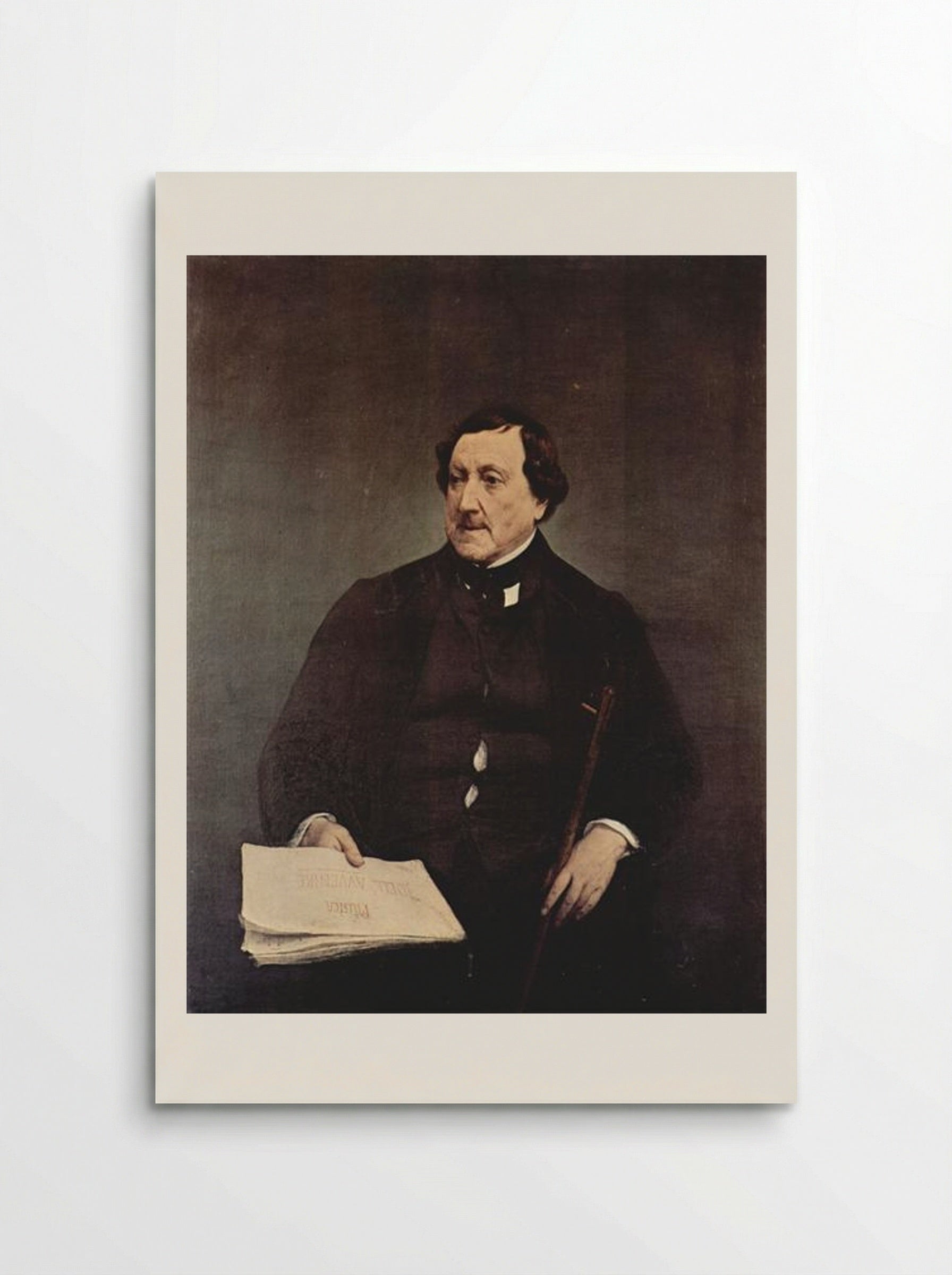
A dignified 1870 portrait of the composer Gioacchino Rossini by the Italian Romantic painter Francesco Hayez.
Francesco Hayez, a leading figure in the Italian Romantic movement, painted this portrait of the composer Gioacchino Rossini in 1870. The work captures the musician in his later years, presenting a sober and direct likeness that avoids the theatricality often associated with the period. Hayez focuses on the physical presence of the sitter, using a restrained palette of dark tones to draw attention to the face and the hands. Rossini is depicted in a seated position, holding a musical score in one hand and a walking stick in the other. The background is a neutral, dark wash, which pushes the figure forward and creates a sense of quietude. The lighting is focused, illuminating the composer's features and the white paper of the score, which provides a sharp contrast to his dark attire. The brushwork is precise, reflecting the artist's academic training and his ability to render texture, from the fabric of the coat to the weathered skin of the subject. This portrait belongs to the later phase of Hayez's career, during which he produced numerous likenesses of contemporary cultural figures. Unlike his earlier historical paintings, which were often charged with political or allegorical meaning, this work is a study in character and age. It documents the appearance of one of the most influential composers of the nineteenth century with clarity and technical control. The composition is balanced, with the diagonal line of the walking stick providing a subtle counterpoint to the horizontal orientation of the musical score. The result is a dignified image that captures the composer in a moment of reflection, stripped of unnecessary artifice.
Because every print is made to order, we don't offer change-of-mind returns, refunds or exchanges. If your order arrives faulty, damaged or incorrect, we'll replace it free of charge — just contact us within 48 hours of delivery. See our refunds page for full details.
We ship worldwide, printing at the production hub nearest to your delivery address. Delivery times and costs vary by destination — you'll see the options available to you at checkout.
Each print is produced to order using 12-colour giclée printing on FSC-certified archival paper. Designed in Britain and printed at your nearest production hub to reduce waste and speed up delivery.

Artist Biography
Our Features
Designed for Lasting Impact
Every Solis piece is made to order with archival, gallery-quality materials built to last.
To keep your artwork looking its best:
Museum-grade giclée on FSC-certified archival matte paper, with framed and canvas options.
Made to order
Every piece is printed to order. These are the five finishes, and what makes each one different.
From $29
A giclée print on 200gsm matte fine art paper, using a twelve-colour process for accurate, fade-resistant colour. Supplied unframed, delivered flat or rolled.

From $89
The same fine art print in a solid wood frame with UV-protective acrylic glaze and rigid backing. Five frame colours. Arrives ready to hang.

From $169
A deeper solid wood frame: 33mm deep with a 20mm face and Perspex glaze. The print sits unmounted for a clean gallery presentation. Black, white or natural.

From $59
Hand-stretched canvas with neat gallery-wrapped edges, giving the artwork surface texture and depth. Arrives ready to hang.

From $175
Stretched canvas set in a floating wood frame, our most substantial finish. Arrives ready to hang.
Why Choose Us ?
Damage-free delivery guarantee
Fast Shipping
Museum-Quality Materials
Artist Biography
Francesco Hayez
You May Also Like
Cookies show us which prints people love, so we hang the right art. Help us fill it?
Essential cookies only if you prefer · Privacy Policy