

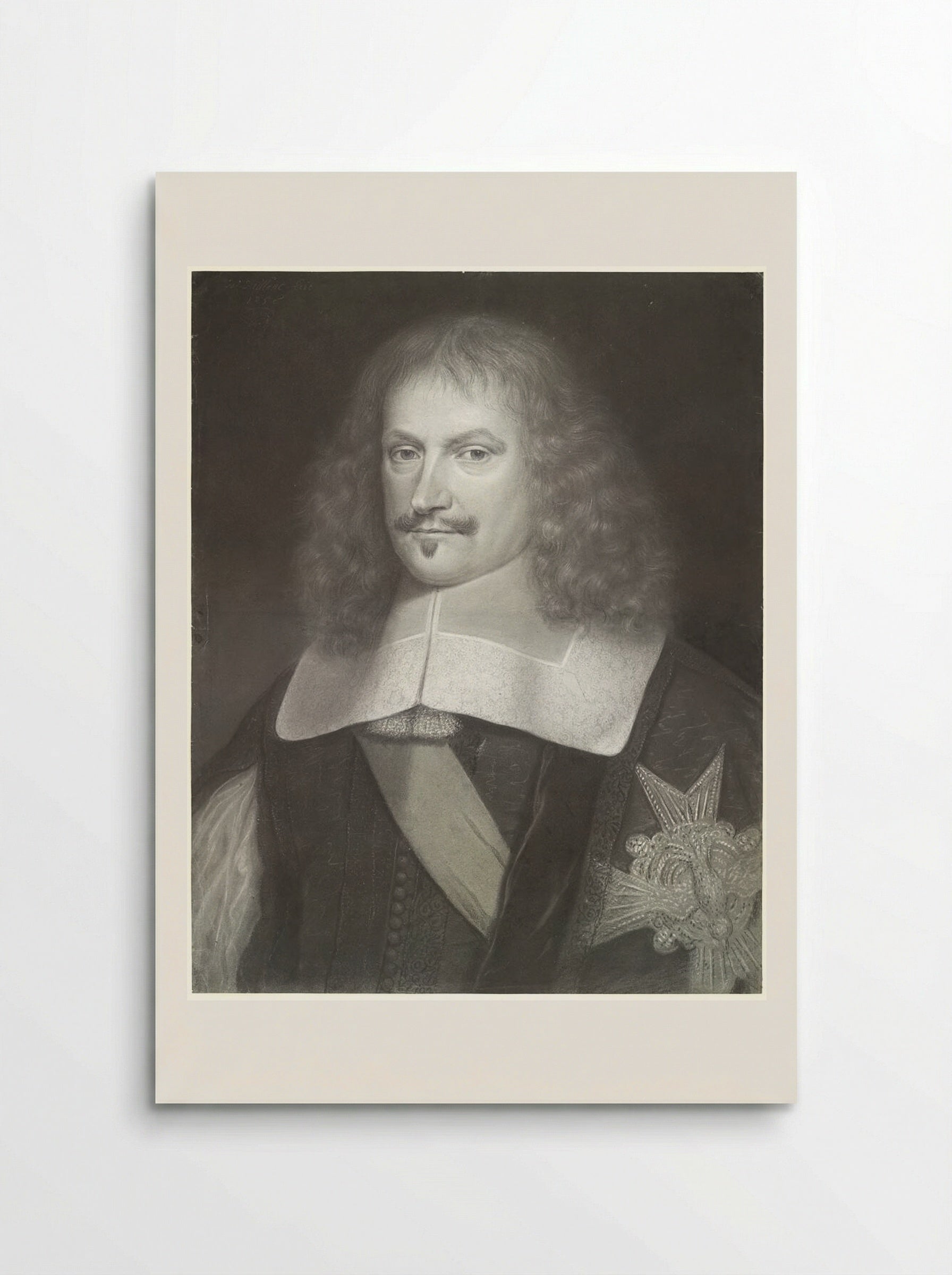
Portrait of Hugues de Lionne - Wallerant Vaillant
Archival giclée
Frames arrive ready to hang
Secure checkout
Made to order
Description
A fine mezzotint portrait of the French statesman Hugues de Lionne, executed by the Dutch master Wallerant Vaillant in 1665.
This mezzotint by Wallerant Vaillant depicts Hugues de Lionne, a French statesman and diplomat who served under Louis XIV. Vaillant was a pioneer of the mezzotint technique, having learned the process from Prince Rupert of the Rhine. This specific print demonstrates the tonal range achievable through the method, which relies on the roughening of a copper plate to create soft transitions between light and shadow. The portrait captures the subject in a formal pose, wearing the insignia of the Order of the Holy Spirit. The sitter's expression is composed, reflecting the gravity expected of a high-ranking official of the seventeenth century. Vaillant focuses on the textures of the clothing, particularly the lace collar and the embroidered badge, using the velvety blacks and subtle greys characteristic of early mezzotint work. The background remains dark and indistinct, which directs the viewer's attention to the face and the decorative elements of the costume. Vaillant was highly regarded for his ability to translate the qualities of oil painting into the medium of printmaking. His work often involved reproducing portraits of the nobility and the intellectual elite of his time. This print is an example of the technical precision he brought to the craft. The composition follows the conventions of aristocratic portraiture, with the subject turned slightly to the side, maintaining a direct gaze. The work provides insight into the visual culture of the period, where the dissemination of such portraits helped to establish the public image of political figures. As a practitioner of this early printmaking method, Vaillant helped to popularise the medium across Europe, influencing subsequent generations of printmakers who sought to replicate the painterly effects of light and shadow.
Return policy
Because every print is made to order, we don't offer change-of-mind returns, refunds or exchanges. If your order arrives faulty, damaged or incorrect, we'll replace it free of charge — just contact us within 48 hours of delivery. See our refunds page for full details.
Shipping
We ship worldwide, printing at the production hub nearest to your delivery address. Delivery times and costs vary by destination — you'll see the options available to you at checkout.
Manufacturing
Each print is produced to order using 12-colour giclée printing on FSC-certified archival paper. Designed in Britain and printed at your nearest production hub to reduce waste and speed up delivery.
Care and materials
Specific Features
Every Solis piece is made to order with archival, gallery-quality materials built to last.
- Museum-grade giclée printing for rich, fade-resistant colour
- Archival matte fine-art paper, FSC-certified
- Multiple sizes and framing options available
- Frames in black, natural wood, dark wood or white
- Framed prints arrive ready to hang
Care & Cleaning
To keep your artwork looking its best:
- Dust gently with a soft, dry cloth
- Avoid prolonged direct sunlight
- Never use liquid cleaners on the print or canvas surface
- Keep in a dry, room-temperature space
- Handle prints with clean, dry hands
Materials & Sizing
Museum-grade giclée on FSC-certified archival matte paper, with framed and canvas options.
- Paper sizes: A4, A3, A2, A1, A0 and B2 (50×70 cm)
- Canvas: XS (20×30 cm) to Large (60×90 cm)
- Frames: black, natural wood, dark wood or white
Portrait of Hugues de Lionne - Wallerant Vaillant

Artist Biography
Wallerant Vaillant
He was born in Lille in 1623, the eldest of five brothers who all became painters. He trained under Erasmus Quellinus II in Antwerp and worked as a portraitist in Amsterdam, with extended stays in Paris from 1659 to 1664. He is remembered today primarily as a printmaker rather than a painter. He died in Amsterdam in 1677.
Why Choose Us ?
Damage-free delivery guarantee
Fast Shipping
Museum-Quality Materials
You May Also Like