

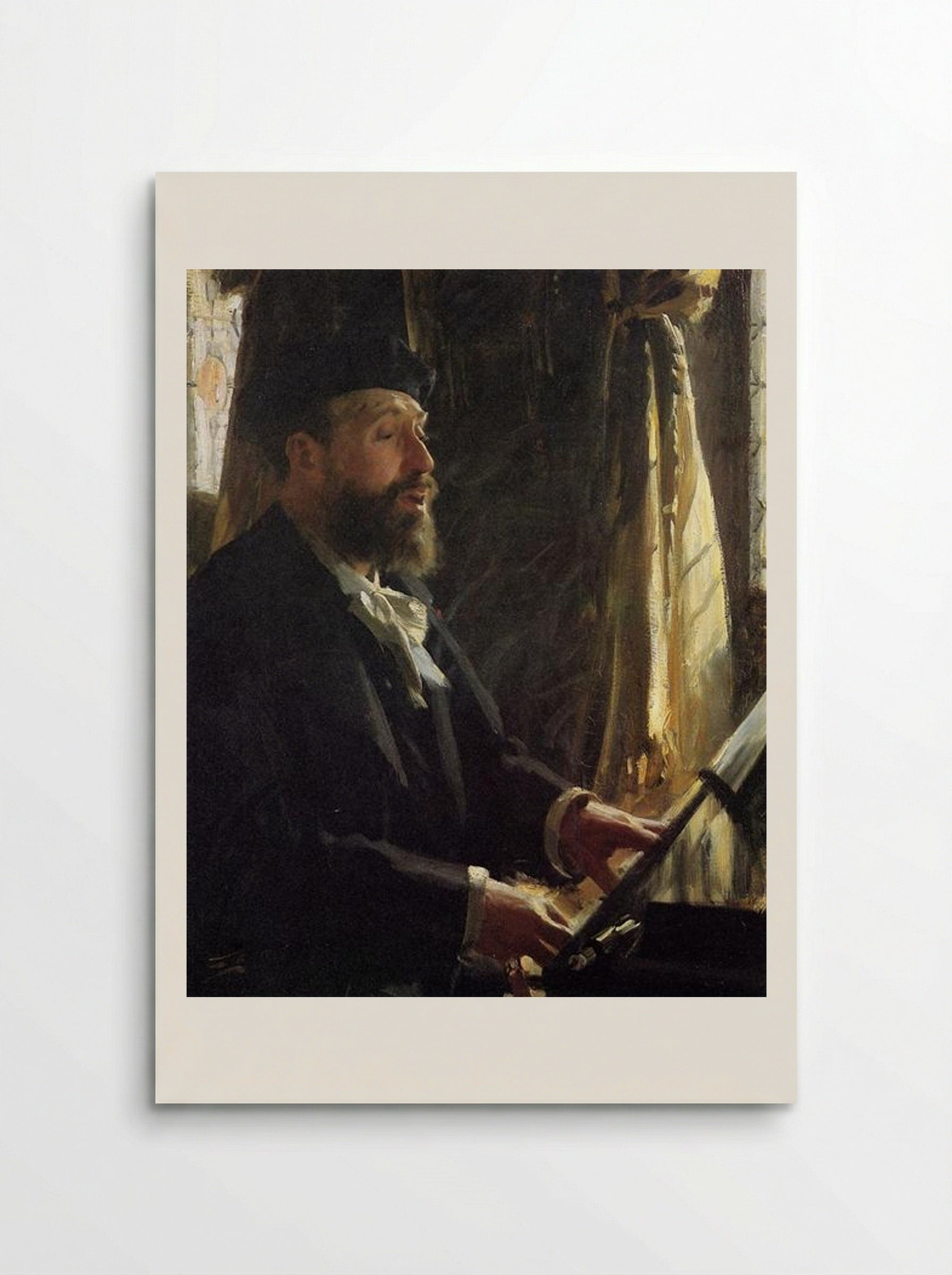
Portrait of Jean-Baptiste Faure - Anders Zorn
Archival giclée
Frames arrive ready to hang
Secure checkout
Made to order
Description
A 1891 portrait of French baritone Jean-Baptiste Faure by Swedish artist Anders Zorn. This oil painting uses a restricted palette and bold brushwork to capture the singer in a moment of musical concentration.
Anders Zorn painted this portrait of the French baritone Jean-Baptiste Faure in 1891. Faure was a prominent figure in the Parisian art world and a collector of Impressionist works. Zorn depicts him in a moment of musical practice. The setting is an interior space where light enters from a window on the right. This light source defines the contours of the face and the texture of the clothing. The painting shows Zorn's use of a restricted palette to create a variety of tones. He employs broad brushstrokes to define the sitter's clothing and the background. This technique suggests texture and form through suggestion rather than fine detail. Light catches the edge of Faure's profile and his hands as they rest on a music stand. The artist uses white and ochre tones to represent the illumination on the fabric and paper. The dark values of the coat provide a strong contrast against the bright window light. The composition is focused on the sitter. Faure wears a dark beret and a heavy coat. His expression shows concentration. The background remains loosely defined with vertical elements that suggest curtains. This lack of detail keeps the focus on the presence of the singer. The work is an example of Zorn's ability to combine character study with a painterly style. It avoids unnecessary ornamentation to prioritise the play of light on the subject. Zorn was a successful portraitist in Europe and America during this period. His style was often compared to that of John Singer Sargent. Both artists used a fluid, direct method of painting. In this work, the speed of execution is visible in the gestural marks of the background. The portrait remains a factual record of a significant 19th-century performer.
Return policy
Because every print is made to order, we don't offer change-of-mind returns, refunds or exchanges. If your order arrives faulty, damaged or incorrect, we'll replace it free of charge — just contact us within 48 hours of delivery. See our refunds page for full details.
Shipping
We ship worldwide, printing at the production hub nearest to your delivery address. Delivery times and costs vary by destination — you'll see the options available to you at checkout.
Manufacturing
Each print is produced to order using 12-colour giclée printing on FSC-certified archival paper. Designed in Britain and printed at your nearest production hub to reduce waste and speed up delivery.
Care and materials
Specific Features
Every Solis piece is made to order with archival, gallery-quality materials built to last.
- Museum-grade giclée printing for rich, fade-resistant colour
- Archival matte fine-art paper, FSC-certified
- Multiple sizes and framing options available
- Frames in black, natural wood, dark wood or white
- Framed prints arrive ready to hang
Care & Cleaning
To keep your artwork looking its best:
- Dust gently with a soft, dry cloth
- Avoid prolonged direct sunlight
- Never use liquid cleaners on the print or canvas surface
- Keep in a dry, room-temperature space
- Handle prints with clean, dry hands
Materials & Sizing
Museum-grade giclée on FSC-certified archival matte paper, with framed and canvas options.
- Paper sizes: A4, A3, A2, A1, A0 and B2 (50×70 cm)
- Canvas: XS (20×30 cm) to Large (60×90 cm)
- Frames: black, natural wood, dark wood or white
Portrait of Jean-Baptiste Faure - Anders Zorn

Artist Biography
Anders Zorn
He was born in Mora in 1860, studied at the Royal Swedish Academy of Arts in Stockholm, and worked across Paris, London and the United States. His ability to render water and flesh with loose, confident brushwork set him apart from more academic contemporaries. His etchings, numbering roughly three hundred, are considered among the finest of the period.
He returned to Mora later in life, establishing a museum and open-air museum there. The Zorn Museum remains a major cultural institution in Sweden. He died in Mora in 1920, at sixty.
Why Choose Us ?
Damage-free delivery guarantee
Fast Shipping
Museum-Quality Materials
You May Also Like